
XRP Whales Are Buying The Dip As Panic Eases – How Much Will The Price Recover?

XRP plunged from $2.83 to $1.77 in one of its sharpest crashes this year, but on-chain data shows it wasn’t real token dumping. Whales quietly added $2.54 billion in XRP as derivatives liquidations drove the fall, signaling that the panic may have set up a rebound toward $2.8.
XRP price saw one of its sharpest drops of the year. It plunged from $2.83 to as low as $1.77 in a matter of hours before bouncing to around $2.44.
Even after that rebound, the token is still down about 14% in 24 hours and nearly 20% weekly. But the data shows this wasn’t a normal sell-off — it was a panic-led, derivatives-driven flush, not real token selling. And now that the XRP price rebound is shaping up, a key group is seen adding to the token stash.
Panic-Led Derivatives Crash, Not Spot Selling
On-chain data confirms that this was not a wave of investors dumping tokens.
Over the past month, XRP’s supply on exchanges has hardly moved, even through this violent drop, showing that few coins were sent to exchanges for sale.
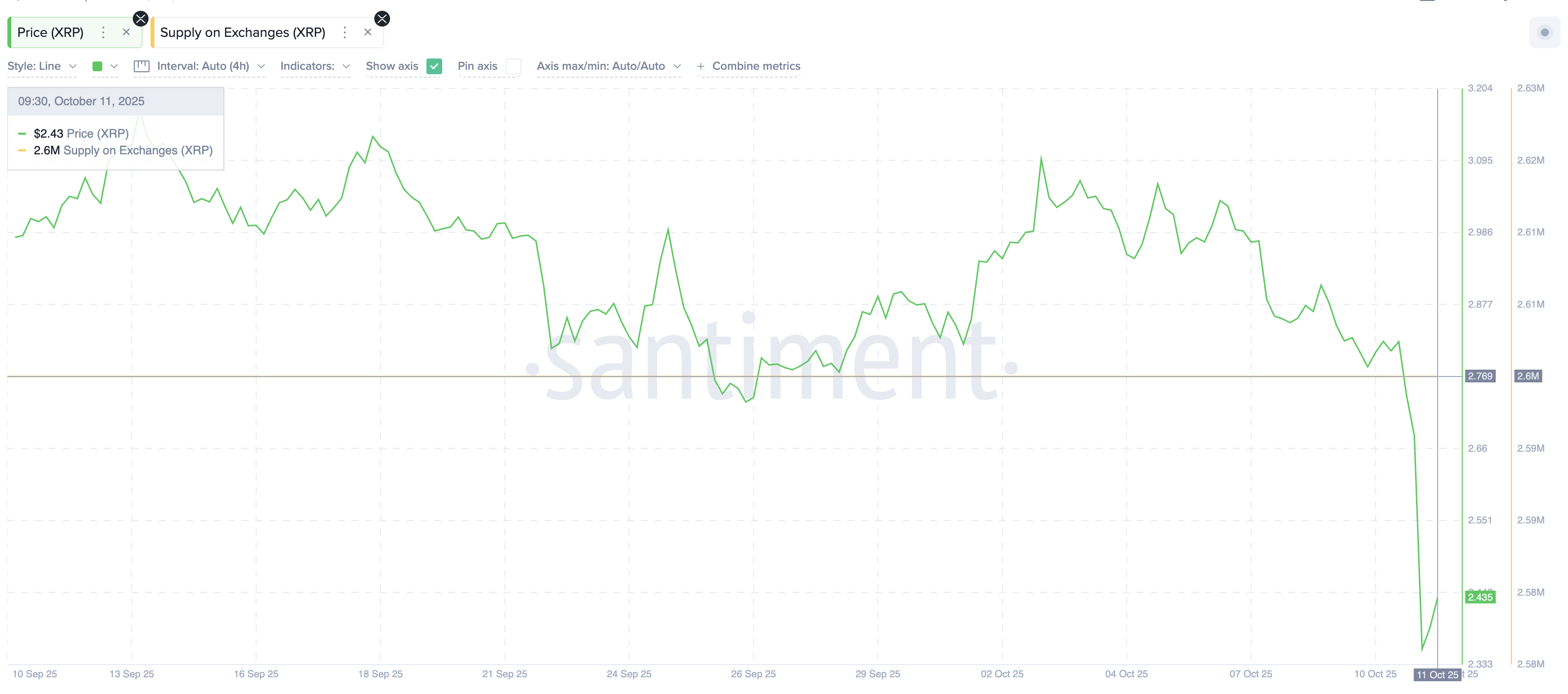 XRP Supply On Exchanges:
Santiment
XRP Supply On Exchanges:
Santiment
Instead, the slide possibly began in the derivatives market, where over-leveraged long positions got liquidated as prices broke key support levels. When that happens, exchanges automatically close futures contracts, triggering forced selling in order books — even though no tokens move on-chain.
Want more token insights like this? Sign up for Editor Harsh Notariya’s Daily Crypto Newsletter.
This off-chain panic shows up clearly in the Wyckoff Volume Spread Analysis (VSA): a huge red bar formed at the peak of the liquidation wave, followed by yellow bars as the selling eased.
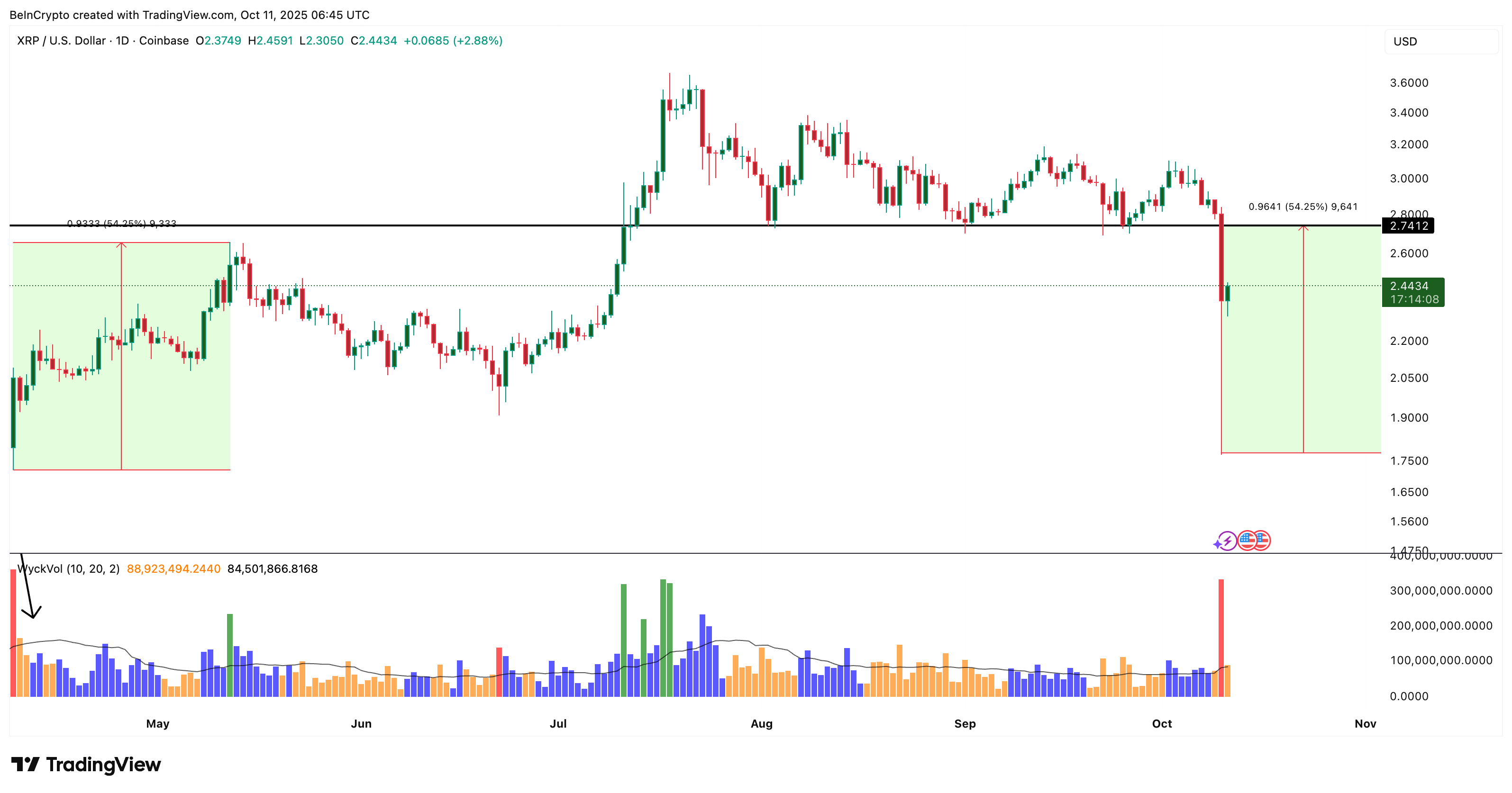 XRP Price Fractal:
TradingView
XRP Price Fractal:
TradingView
That shift from red (full selling control) to yellow (weaker control) usually means forced liquidations are cooling down.
Wyckoff Volume Spread Analysis (VSA) tracks how price and volume interact to show when buying or selling pressure dominates. VSA doesn’t know where that volume comes from — it doesn’t distinguish between spot selling and derivative-driven liquidations.
The last time XRP’s Wyckoff bars showed a similar red-to-yellow transition in early May, the token rebounded over 54% from its lows. If this pattern repeats, a similar move could follow once the panic fades. And that puts the XRP price target of $2.74 in play.
Whales Accumulate as the Market Cools
While smaller traders were being flushed out, whales were quietly buying.
Data from Santiment shows that wallets holding more than 1 billion XRP increased their holdings from 23.98 billion to 25.02 billion after the crash — an addition of roughly 1.04 billion XRP, worth about $2.54 billion at the current XRP price.
That behavior aligns with the on-chain picture: no major spike in exchange balances and rising whale holdings mean this wasn’t spot selling — it was a derivatives panic met by whale accumulation.
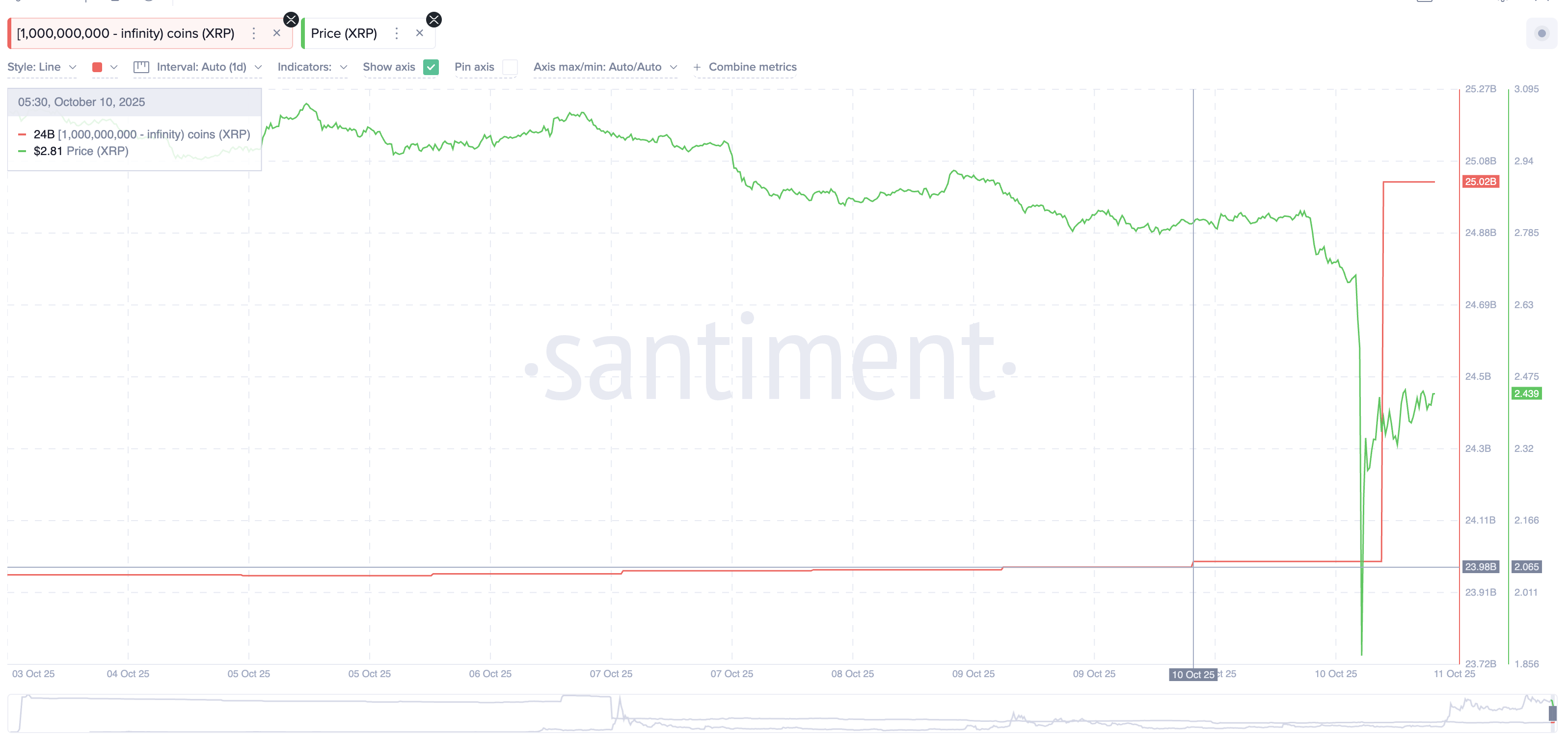 XRP Whales Start Buying:
Santiment
XRP Whales Start Buying:
Santiment
Note: The stable exchange supply also fits the picture. Large holders usually buy through OTC deals or internal swaps. Hence, their accumulation doesn’t immediately show up as on-chain exchange outflows.
Such setups often mark the bottom phase of a sentiment-driven crash, where strong hands absorb weak hands before a recovery begins.
XRP Price Eyes “This Rebound Target” as Recovery Builds
At press time, XRP trades at $2.44. This level aligns with the 0.5 Fibonacci level from the previous swing high to the $1.70 zone, the newest multi-week low.
If XRP manages a daily close above $2.43, the structure strengthens for a move toward $2.59. That could be followed by $2.82 (key resistance). That aligns with the Wyckoff projection of over $2.74, presented on the earlier chart.
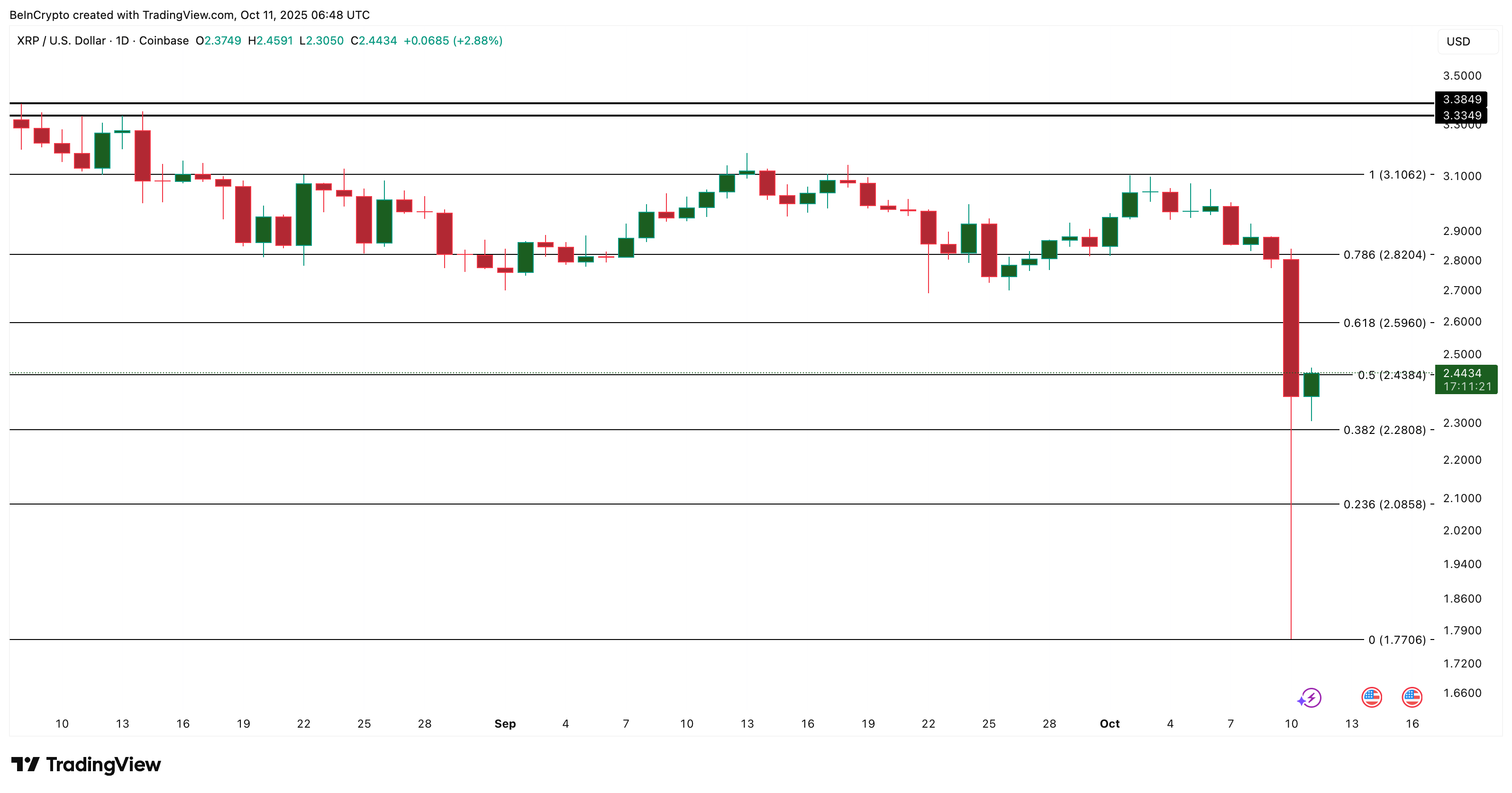 XRP Price Analysis:
TradingView
XRP Price Analysis:
TradingView
An XRP price fall below $2.28, however, would weaken the setup and open downside risks to $2.05.
With whales accumulating, exchange supply stable, and panic liquidations easing, the data points to a clear shift in sentiment. This wasn’t real capitulation — it was a sentiment-driven washout that might have set the stage for XRP’s next short-term rebound.
Disclaimer: The content of this article solely reflects the author's opinion and does not represent the platform in any capacity. This article is not intended to serve as a reference for making investment decisions.
You may also like
Credit panic hits AI trading: CoreWeave bond yields remain high, Nasdaq posts biggest weekly drop since late June
Concerns over the debt risk of AI infrastructure companies continue to rise. Yields on some CoreWeave bonds briefly exceeded 15% on Thursday and remained elevated on Friday. CoreWeave's stock price plunged another 12% on Friday, and the Nasdaq Composite Index fell about 4.5% for the week. Analysts point out that as capital costs rise to unbearable levels, companies will have no choice but to reduce their capital expenditures.
Philadelphia Semiconductor Index Experiences Longest Losing Streak Since 2008; Jensen Huang Responds Calmly: Short-term Fluctuations Won't Change AI's Long-term Growth Prospects
Despite recent sell-offs in AI-related stocks, Nvidia CEO Jensen Huang remains confident in the long-term prospects of the AI industry.
U.S. chip stocks drop for eight consecutive sessions! $2 trillion wiped out in market value, marking the longest losing streak since 2008
This week, the investment prospects of AI were questioned by the market. The Philadelphia Semiconductor Index fell by 11.4%, and the Nasdaq dropped more than 4% in a single week. CoreWeave's stock price fell over 25% during the week, and its bonds dropped to distressed levels, casting doubt on the high-yield debt financing model. Strategists warned that being overly bearish could lead to missing opportunities, while "Wood Sister" bucked the trend and increased her holdings of CoreWeave.
In August, overseas funds returned to the U.S. Treasury market; UK holdings surpassed $1 trillion for the first time; Japan and China continued to reduce holdings, with China’s U.S. Treasury holdings hitting the lowest level since 2008
According to a report by the U.S. Treasury Department, overseas investors made net purchases of $108.9 billion in U.S. Treasury bonds in August, reversing a two-month decline in holdings. Among the top ten countries and regions holding U.S. debt, only China and Japan reduced their holdings in August. Japan, the largest holder, saw its holdings drop for the fourth consecutive month, reaching a 22-month low in the same month it intervened in the foreign exchange market. China’s holdings declined for the third straight month, hitting new lows for two consecutive months not seen since 2008. The UK, the second-largest holder, posted historic highs for two consecutive months. Canada recorded the largest increase in August, up $38.3 billion, ranking fifth overall. Belgium had the second-largest increase, up $19.8 billion.

Crypto prices
More


