
Crypto traders blame Trump’s tariffs in search of ‘singular event’: Santiment

Crypto retail traders were quick to blame Friday’s broader crypto market decline on US President Donald Trump announcing a 100% tariff on China, as they often look for something to point the finger at during downturns, according to Santiment.
Analysts, however, say the reason for the market slump runs deeper than the tariffs alone.
“This is typical 'rationalization' behavior from retailers, who need to point to a singular event as the reason for a cataclysmic downturn in crypto,” Santiment said in a report on Saturday.
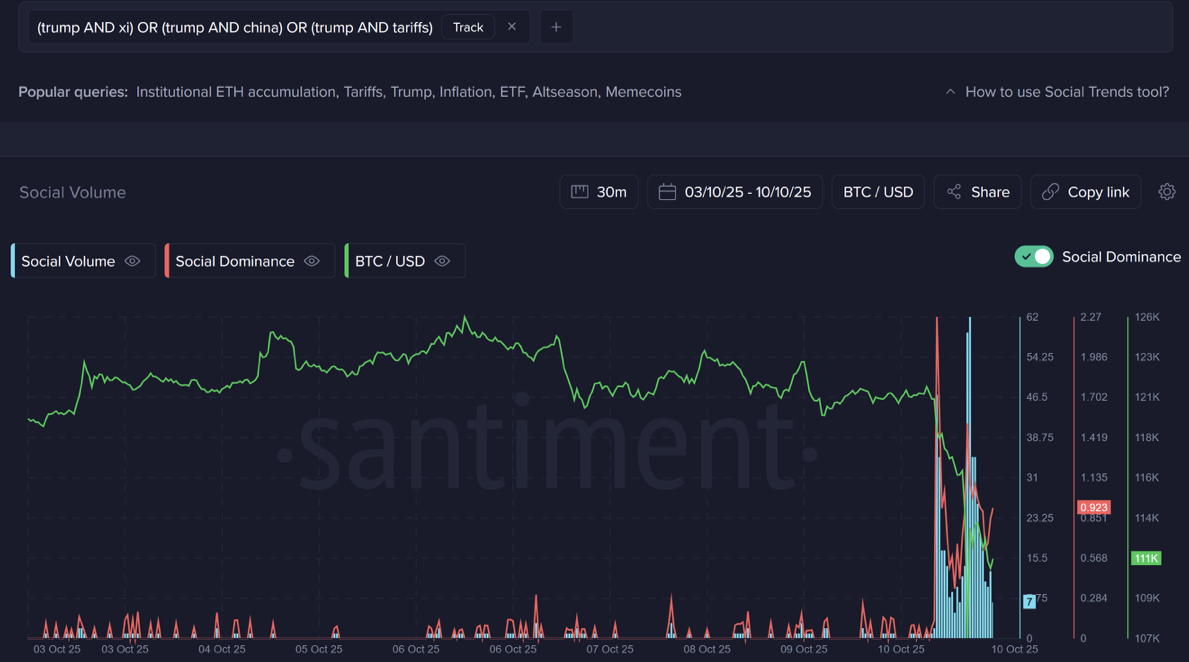
“After the crash, the crowd quickly jumped to collectively come to a consensus as to what the flush could be attributed to,” Santiment said, referring to the increase in social media discussions related to both the crypto market and US-China tariff concerns.
US and China developments will be vital for retail traders
Although the geopolitical event was a catalyst for the market decline, it wasn’t the only factor, according to analysts from The Kobeissi Letter, who also pointed to “excessive leverage and risk” in the crypto market. The analysts noted its heavy long bias, with around $16.7 billion in long positions liquidated versus just $2.5 billion in shorts, a ratio of nearly 7-to-1.
The significant liquidation event came as Bitcoin (BTC) fell more than 10% within 24 hours, with the BTC/USDT futures pair on Binance falling to as low as $102,000 following Trump’s tariff announcement.
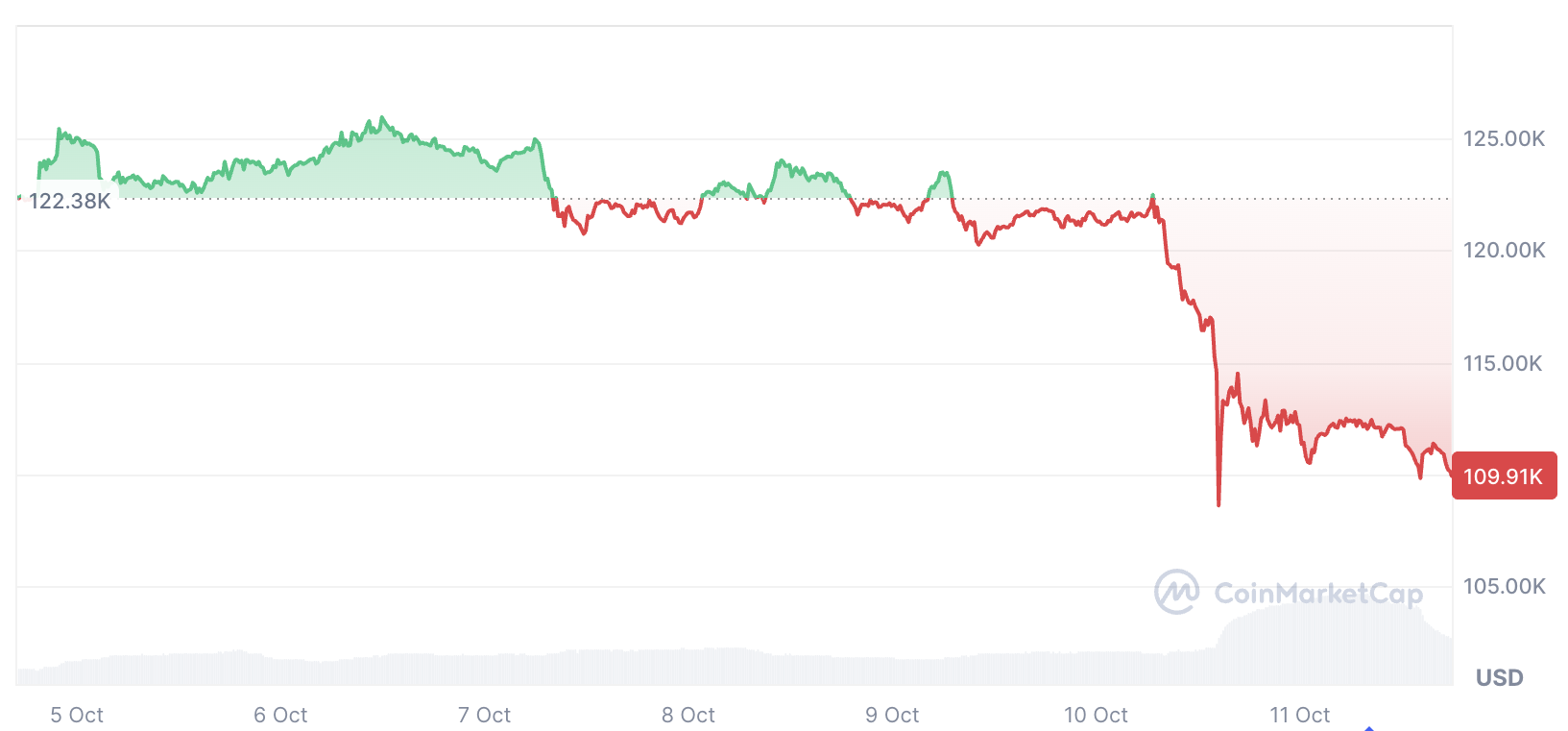
Santiment said that developments between the US and China will “be central” in shaping crypto retail investors’ trading decisions, at least in the short term.
Bitcoin falling under $100,000 predictions may emerge
Santiment added that if talks between Trump and Xi improve and lead to “positive news,” retail sentiment toward crypto is likely to get better.
However, if tensions escalate, traders should brace for more pessimistic price forecasts. “Expect for the 'Bitcoin sub-100K' prediction floodgates to begin opening up,” Santiment said, adding:
“Bitcoin, whether we like it or not, is behaving more like a risk asset than a safe haven during times of country tensions.”
Sentiment plunged after the crypto market decline, with the Crypto Fear Greed Index, which measures overall crypto market sentiment, dropping to a “Fear” level of 27 in Saturday’s update.
That represents a sharp 37-point fall from Friday’s “Greed” reading of 64, its lowest level in nearly six months.
Disclaimer: The content of this article solely reflects the author's opinion and does not represent the platform in any capacity. This article is not intended to serve as a reference for making investment decisions.
You may also like
Credit panic hits AI trading: CoreWeave bond yields remain high, Nasdaq posts biggest weekly drop since late June
Concerns over the debt risk of AI infrastructure companies continue to rise. Yields on some CoreWeave bonds briefly exceeded 15% on Thursday and remained elevated on Friday. CoreWeave's stock price plunged another 12% on Friday, and the Nasdaq Composite Index fell about 4.5% for the week. Analysts point out that as capital costs rise to unbearable levels, companies will have no choice but to reduce their capital expenditures.
Philadelphia Semiconductor Index Experiences Longest Losing Streak Since 2008; Jensen Huang Responds Calmly: Short-term Fluctuations Won't Change AI's Long-term Growth Prospects
Despite recent sell-offs in AI-related stocks, Nvidia CEO Jensen Huang remains confident in the long-term prospects of the AI industry.
U.S. chip stocks drop for eight consecutive sessions! $2 trillion wiped out in market value, marking the longest losing streak since 2008
This week, the investment prospects of AI were questioned by the market. The Philadelphia Semiconductor Index fell by 11.4%, and the Nasdaq dropped more than 4% in a single week. CoreWeave's stock price fell over 25% during the week, and its bonds dropped to distressed levels, casting doubt on the high-yield debt financing model. Strategists warned that being overly bearish could lead to missing opportunities, while "Wood Sister" bucked the trend and increased her holdings of CoreWeave.
In August, overseas funds returned to the U.S. Treasury market; UK holdings surpassed $1 trillion for the first time; Japan and China continued to reduce holdings, with China’s U.S. Treasury holdings hitting the lowest level since 2008
According to a report by the U.S. Treasury Department, overseas investors made net purchases of $108.9 billion in U.S. Treasury bonds in August, reversing a two-month decline in holdings. Among the top ten countries and regions holding U.S. debt, only China and Japan reduced their holdings in August. Japan, the largest holder, saw its holdings drop for the fourth consecutive month, reaching a 22-month low in the same month it intervened in the foreign exchange market. China’s holdings declined for the third straight month, hitting new lows for two consecutive months not seen since 2008. The UK, the second-largest holder, posted historic highs for two consecutive months. Canada recorded the largest increase in August, up $38.3 billion, ranking fifth overall. Belgium had the second-largest increase, up $19.8 billion.

Crypto prices
More


