
Tether and Circle Inject Billions After Weekend Market Crash – Here’s Why

Analysts say the surge reflects traders repositioning to accumulate digital assets at discounted prices after the $20 billion market wipeout.
More than $1.75 billion in new USDT and USDC entered circulation after President Donald Trump’s tariff announcement on China triggered the recent market crash.
On October 11, blockchain analytics firm Lookonchain reported that Tether, the world’s largest stablecoin issuer, minted roughly $1 billion worth of USDT on Ethereum.
New Stablecoin Mints Suggest Investors Buying the Crypto Dip
Crypto analyst JA Maartun, citing CryptoQuant data, noted that Tether minted $775.8 million on Oct. 10 and another $771 million on Oct. 11. Notably, this represents one of the largest short-term issuance bursts this year.
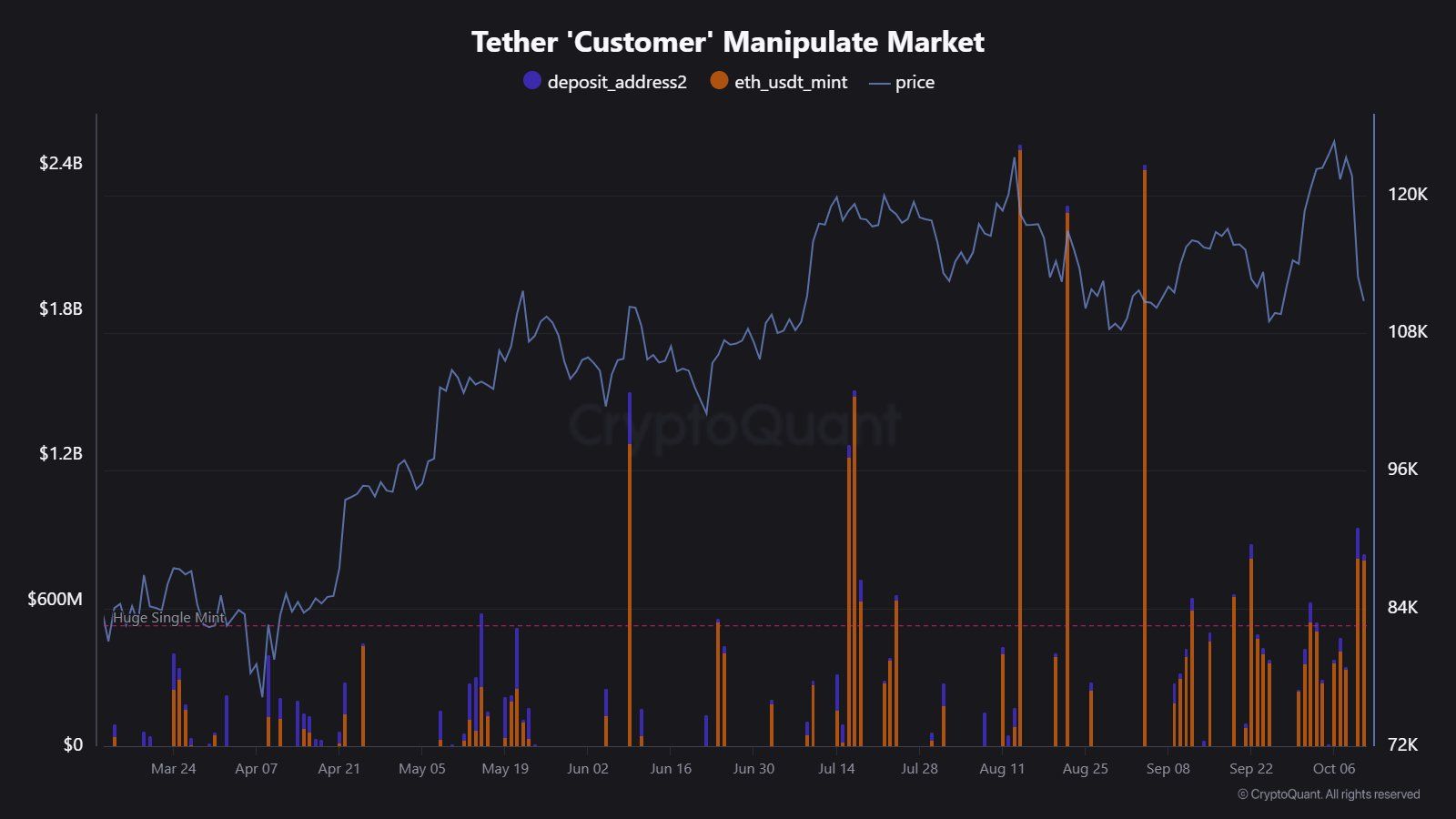 Tether’s USDT Stablecoin Mints on Ethereum. Source:
Maarturn/X
Tether’s USDT Stablecoin Mints on Ethereum. Source:
Maarturn/X
With this expansion, Tether’s total supply now stands at $180 billion, including $80 billion on Ethereum alone.
Meanwhile, Circle—the issuer of USDC—minted $750 million in new tokens on Solana. This move boosted its total holdings on the network to $12.84 billion and raised its overall supply to nearly $75 billion.
The timing of these issuances is significant.
On Friday, the crypto market lost about $20 billion in leveraged positions following Trump’s tariff expansion. This triggered a steep sell-off across major assets such as Bitcoin and Ethereum.
The resulting liquidation cascade wiped out over-extended longs and erased double-digit gains from earlier in the week.
However, the wave of new stablecoin mints suggests that market participants are reallocating capital through stable assets. Instead of exiting the space, they are positioning themselves for renewed market opportunities.
Considering this, market analysts have interpreted the move as a sign that traders are positioning to accumulate digital assets at discounted prices.
Supporting that view, blockchain tracker Lookonchain reported that Bitmine, an Ethereum-focused investment firm, acquired roughly 128,700 ETH worth about $480 million shortly after the crash.
According to the firm, six wallets tied to the ETH treasury company withdrew the funds from trading platforms, FalconX and Kraken, within hours of the downturn.
Bitmine() appears to have bought 128,718 $ETH ($480M) after the market crash.6 new wallets (likely belonging to #Bitmine) withdrew 128,718 $ETH ($480M) from #FalconX and #Kraken.https://t.co/yrR74RyMHo pic.twitter.com/XsfjD3c3lX
— Lookonchain (@lookonchain) October 12, 2025
So, the swift return of capital via new USDT and USDC issuances underscores how quickly sentiment in digital markets can rebound, even after a sharp macro-driven correction.
Disclaimer: The content of this article solely reflects the author's opinion and does not represent the platform in any capacity. This article is not intended to serve as a reference for making investment decisions.
You may also like
The Kiwi defies hot US inflation as Fed pause bets weaken the USD
Apple says iPhone Duo demand is "unprecedented," pre-orders sold out within minutes, deliveries postponed until January next year
Within minutes of opening pre-orders for Apple's first foldable screen phone, iPhone Duo, the delivery period was extended to the end of January next year, affecting all colors and storage configurations. Analysts from Bloomberg Intelligence have raised their sales expectations, believing that sales may surpass the target of 14 million units and $28 billion. On Friday, Apple's stock price rose slightly by 0.43%.

Credit panic hits AI trading: CoreWeave bond yields remain high, Nasdaq posts biggest weekly drop since late June
Concerns over the debt risk of AI infrastructure companies continue to rise. Yields on some CoreWeave bonds briefly exceeded 15% on Thursday and remained elevated on Friday. CoreWeave's stock price plunged another 12% on Friday, and the Nasdaq Composite Index fell about 4.5% for the week. Analysts point out that as capital costs rise to unbearable levels, companies will have no choice but to reduce their capital expenditures.
Philadelphia Semiconductor Index Experiences Longest Losing Streak Since 2008; Jensen Huang Responds Calmly: Short-term Fluctuations Won't Change AI's Long-term Growth Prospects
Despite recent sell-offs in AI-related stocks, Nvidia CEO Jensen Huang remains confident in the long-term prospects of the AI industry.
Crypto prices
More


