
COAI soars 113% and leads recovery as Bitcoin falls to $111

- COAI soars 113% and dominates the market
- Bitcoin Retreats to $111.973 After Resistance
- Altcoins reach $100 billion in market value
Bitcoin (BTC) is trading slightly higher by 0,5% this Tuesday (15), trading at US$ 111.973, after failing to hold above the US$ 113.500 reached earlier. The cryptocurrency continues to face resistance in this price range, reflecting the volatility that has dominated the market since the beginning of the month.
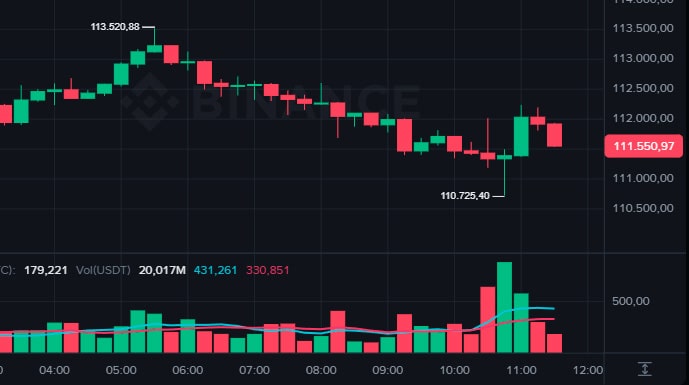
October began with a strong rally, with Bitcoin breaking through $126.000 and setting a new all-time high. However, after US President Donald Trump announced new tariffs on China, the market reacted with a massive sell-off. BTC plummeted from $122.000 to $101.000 in just a few hours, dragging down the rest of the cryptocurrencies. More than 1,6 million leveraged traders were liquidated, totaling $19 billion in 24 hours—a record high.
After the collapse, Bitcoin rebounded and reclaimed the $110.000 level, reaching $116.000 on Tuesday morning, but retreated again under selling pressure. Its market cap currently stands at $2,25 trillion, while its dominance over altcoins has fallen to less than 57%.
COAI soars and dominates the day's highs
The standout altcoin is COAI, a token linked to artificial intelligence (AI), which has soared 113% in the last 24 hours, reaching the $16 mark. This impressive performance has attracted investors' attention and placed the asset among the most talked-about on the market today.
Other cryptos also advanced: ZEC rose 18%, surpassing $260, while ASTER and TAO gained 11% and 10%, respectively. Among the largest cryptocurrencies, Ethereum (ETH) rose 4,7%, Solana (SOL) rose 5%, and assets like DOGE, TRX, ADA, XLM, and BCH gained around 3%. XMR gained 7,5%, and HYPE increased 5,5%.
The total value of the cryptocurrency market has grown by about $100 billion since its previous low, reaching $3,96 trillion, driven mainly by the COAI surge and the return of risk appetite among investors.
Disclaimer: The content of this article solely reflects the author's opinion and does not represent the platform in any capacity. This article is not intended to serve as a reference for making investment decisions.
You may also like
Quarterly refinancing statement due on Wednesday, U.S. Treasury market holds its breath for major signals
The U.S. Treasury will release its quarterly refinancing statement this Wednesday, and the market anticipates that this may be the largest adjustment to U.S. Treasury issuance guidance since the beginning of 2024. Citi even predicts that the Treasury might cut 20-year and 30-year bond issuances ahead of schedule, shifting to increase the supply of short- and medium-term bonds. However, with the proportion of Treasury bills already rising to 22%, the pressure from short-term financing and the demand for long-term borrowing are creating a dilemma for the adjustment of the issuance structure.

UBS Sees Buying Opportunity After Tech Stock Plunge: Market Underestimates AI Supercycle, Inflection Point for Returns May Come in 2027
UBS stated that after the recent AI pullback, the valuation of hyperscale data centers appears attractive, as the market expects the AI cycle to be shorter than it actually will be. Hyperscale data center operators may soon enter a phase where their significant investments in artificial intelligence begin to pay off. Gerry Fowler, UBS's Chief European Equity Strategist and Head of Derivatives, believes that a turning point may occur in 2027.

U.S. Stocks Preview | Three Major Index Futures Rise, WTI Crude Falls Below $100, Midterm Elections, Apple Earnings, and Nonfarm Payrolls All Coming This Week
On November 2 (Monday), before the US stock market opened, futures for the three major US stock indexes all rose.
UK factory output posts strongest growth in over two years! Cost pressures are rising again, further reinforcing the Bank of England's rate hike path this week
Orders and production in the UK are recovering at an accelerating pace, but rising input costs and stagnant hiring mean that improved demand has not yet smoothly translated into business profits and employment growth.

Crypto prices
More


