
Bitcoin’s Profit Supply Shrinks as Price Fails to Breach 2-Week Downtrend

Bitcoin shows capitulation signals as profit-taking collapses and selling accelerates. BTC remains below $108,000, but reclaiming $110,000 could spark recovery toward $112,500.
Bitcoin (BTC) is facing mounting pressure after extending its two-week-long decline. The cryptocurrency has struggled to break above resistance, suggesting growing investor fatigue.
Market conditions remain fragile as trading volumes decline and volatility spikes, leaving Bitcoin vulnerable to further losses if sentiment fails to recover soon.
Bitcoin Holders Are Losing Gains
The percentage of BTC supply in profit has dropped significantly, falling from 98% to 78% within two weeks. This steep decline reflects widespread unrealized losses and signals rising investor caution. Such rapid contractions are typically seen during capitulation phases, when fear dominates the market and selling intensifies.
The reduced incentive for profit-taking highlights that most holders are either in loss or barely breaking even. This creates a self-reinforcing cycle of hesitation, where buyers remain cautious while sellers seek to exit at the first sign of strength.
Want more token insights like this? Sign up for Editor Harsh Notariya’s Daily Crypto Newsletter.
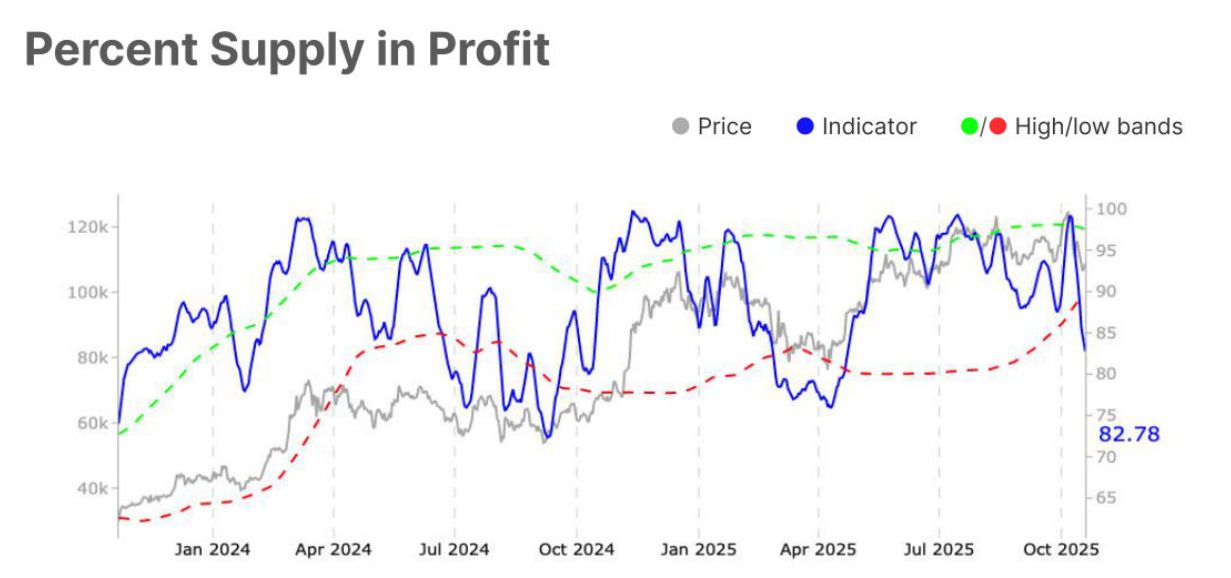 Bitcoin Supply In Profit. Source:
Santiment
The Realized Profit to Loss (RPL) Ratio reinforces this capitulation narrative. The metric, which tracks Bitcoin’s realized gains versus realized losses, has slipped from 1.2 to 0.7, breaching the lower bound of 1.5. This means more investors are selling at a loss, indicating capitulation-like conditions across the market.
Such a low ratio reflects the growing dominance of loss realization, where participants exit positions in panic rather than strategic profit-taking. The broader macro environment—tight liquidity, risk-off sentiment, and declining inflows—adds further pressure.
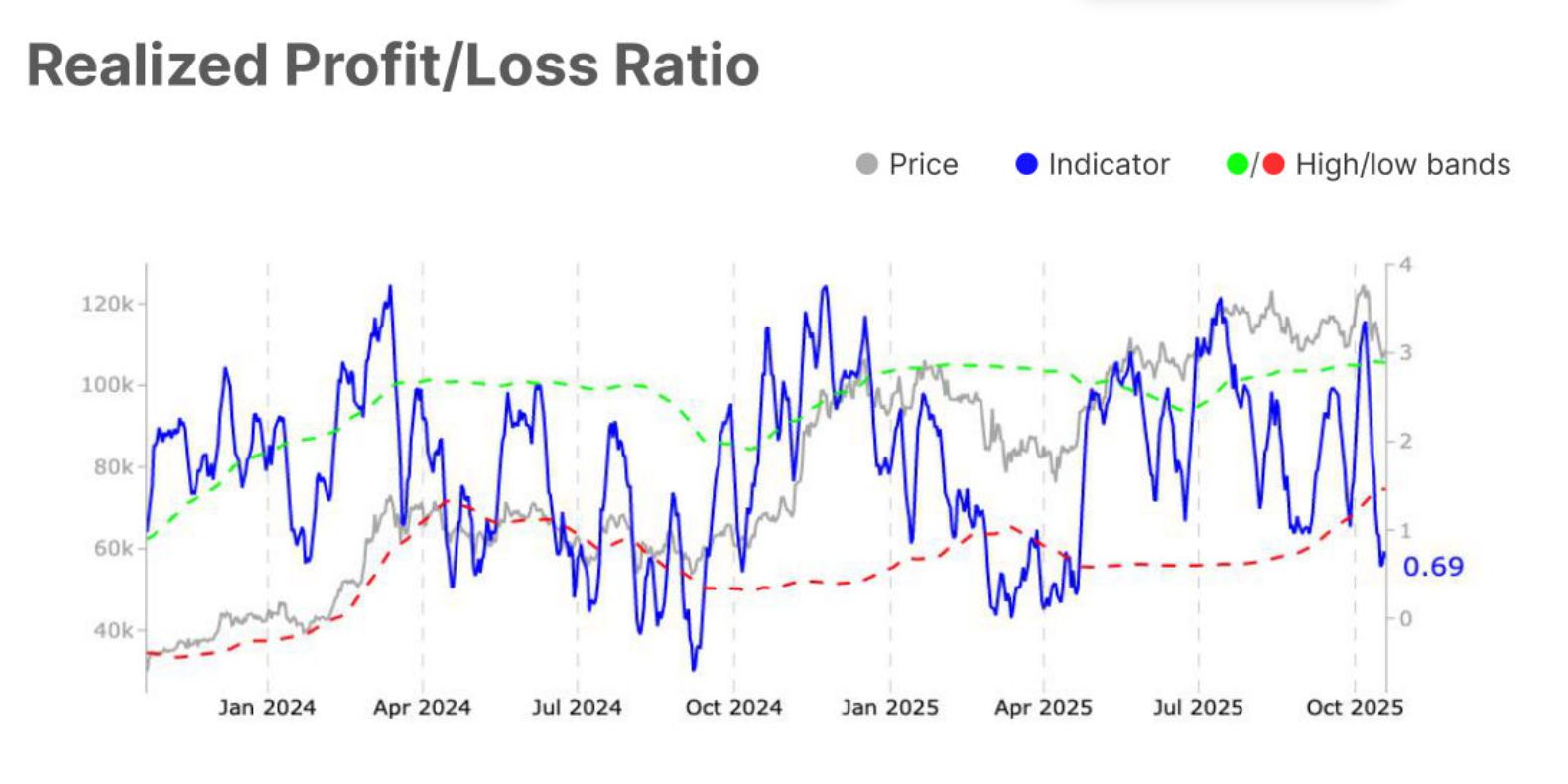 Bitcoin RPL Ratio. Source:
Santiment
BTC Price Under Pressure
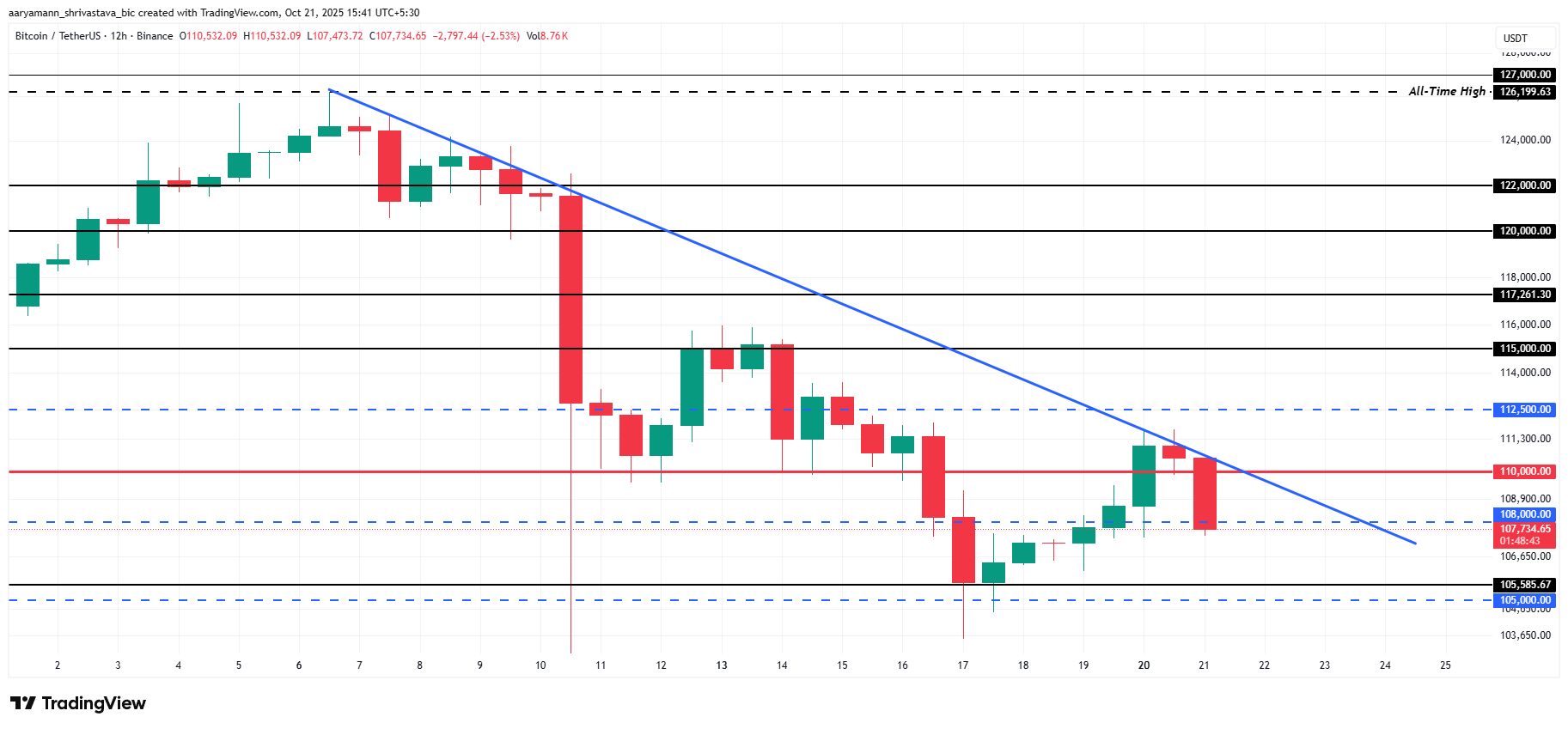
At the time of writing, Bitcoin trades at $107,734, holding below the $108,000 resistance. The crypto giant has repeatedly failed to break the two-week downtrend line, signaling weakening momentum and growing skepticism among investors.
The formation of lower lows this week is concerning. If Bitcoin cannot reclaim the $110,000 psychological level, the price could slip further toward $105,000 or even lower, amplifying selling pressure. Sustained bearishness could accelerate this move, pushing BTC into deeper correction territory.
 Bitcoin Price Analysis. Source:
TradingView
However, if Bitcoin manages to regain $110,000 as support, the technical outlook could improve sharply. This would invalidate the downtrend and open the door to a move toward $112,500 and possibly higher. In that case, short-term recovery would be back on the table, but for now, caution remains the dominant theme across the Bitcoin market.
Disclaimer: The content of this article solely reflects the author's opinion and does not represent the platform in any capacity. This article is not intended to serve as a reference for making investment decisions.
You may also like
After the Nasdaq evaporated over $2 trillion in a single month, Wall Street is starting to look for buying opportunities! Deutsche Bank upgrades its technology rating, and Goldman Sachs’s “seven signals” outline the bull narrative.
Deutsche Bank is optimistic about U.S. tech stocks, overturning its downgrade rating from three weeks ago. The bank claims that the large sell-off has created attractive buying opportunities and that most of the risks related to artificial intelligence have already been excessively priced in by the market.

NEAR Enters Bitwise Large-Cap Indexes in October Rebalance

Ethena Pay Adds Earn+ Through Aave V4 Lending on Avalanche

DoorDash (DASH.US) Outperforms Nasdaq Amid Tech Stock Selloff! Officially Announces $17 Billion Acquisition of Instacart; Will Grocery Delivery and Retail Advertising Drive a Revaluation of Value?
The complete integration of the two major platforms may enhance their overall competitive and bargaining power in terms of delivery economics, consumer reach, and retail media monetization. Grocery retailers lacking their own delivery networks are bound to face more significant bargaining pressure, while Walmart and Target, which own Spark and Shipt, are relatively more capable of withstanding the impact.
Crypto prices
More


