
ASTER Price Could Use Short Squeeze as a Rebound Catalyst — Is $1.39 Possible?

ASTER price has fallen nearly 40% over the past month, but a hidden setup could flip the trend. A bullish RSI divergence and a short-squeeze cluster near $1.39 suggest the next move might catch traders off guard.
Aster (ASTER) price has dropped almost 40% over the past 30 days, trading close to $1.10 after weeks of steady selling. The downtrend looks heavy on the surface, but behind the scenes, a mix of retail exits and short-heavy positioning could actually be setting up the next rebound.
If ASTER manages to reclaim $1.39, where a defining short-squeeze play would complete, the structure could flip fast.
Retail Steps Away, But Crowded Shorts May Be Laying the Groundwork
Smaller investors appear to be stepping back. The Money Flow Index, which tracks how much money is entering or leaving the market, has dropped by over 50% since mid-October — falling from nearly 80 to 38.27. That means retail traders are no longer buying as aggressively. It usually signals weakness, but it can also create conditions where big traders accumulate quietly before a move higher.
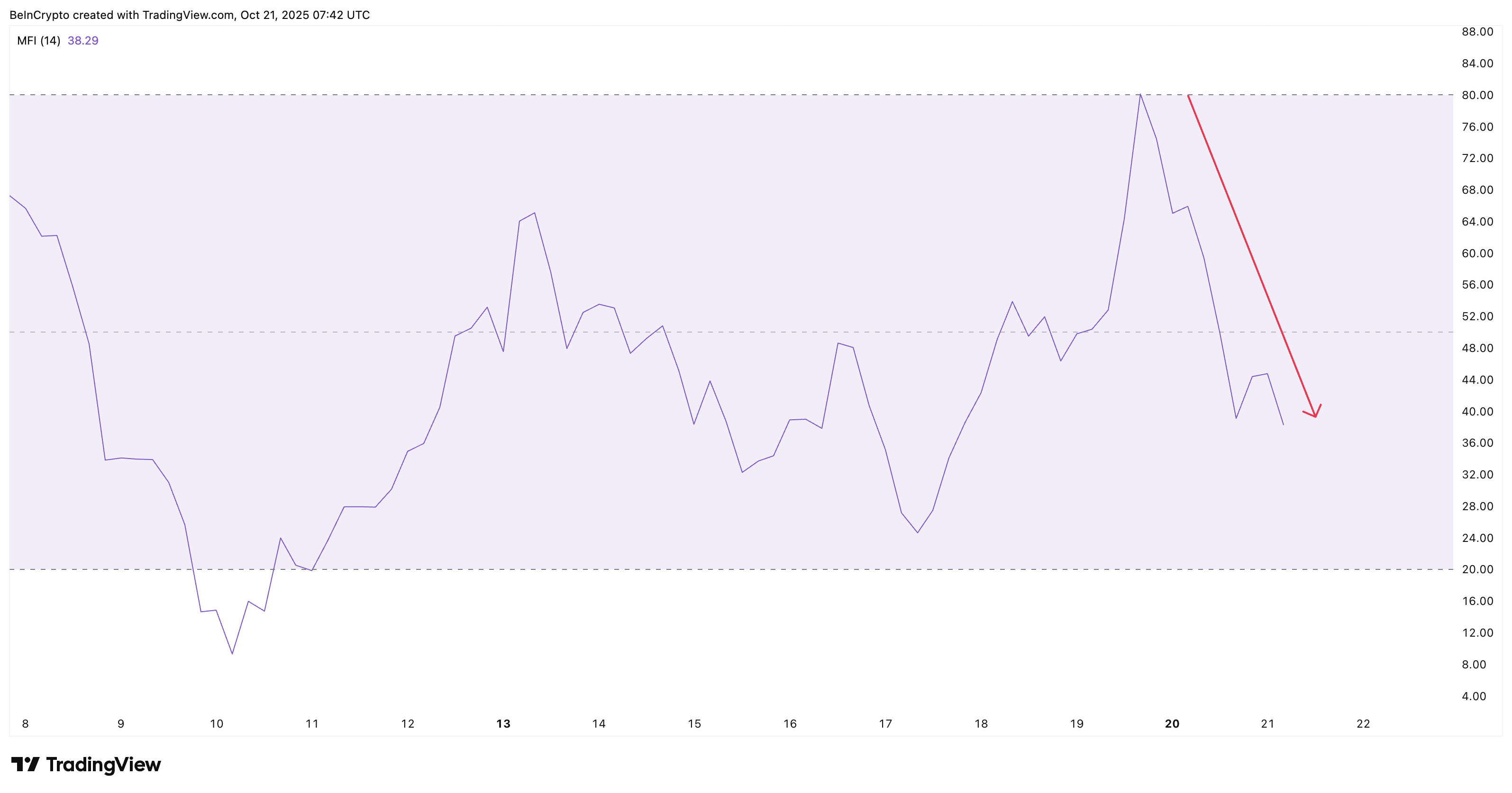 ASTER Retail Moving Out:
TradingView
ASTER Retail Moving Out:
TradingView
Meanwhile, derivatives data show that most traders are heavily tilted to the short side. That also confirms the bearish bias and the MFI dip.
Want more token insights like this? Sign up for Editor Harsh Notariya’s Daily Crypto Newsletter
On Binance alone, ASTER’s short liquidations total $34.6 million, compared to $8.46 million in longs. This means almost 80% of leveraged positions are betting on a further drop — a heavily biased setup that often leads to sudden reversals when price pressure shifts.
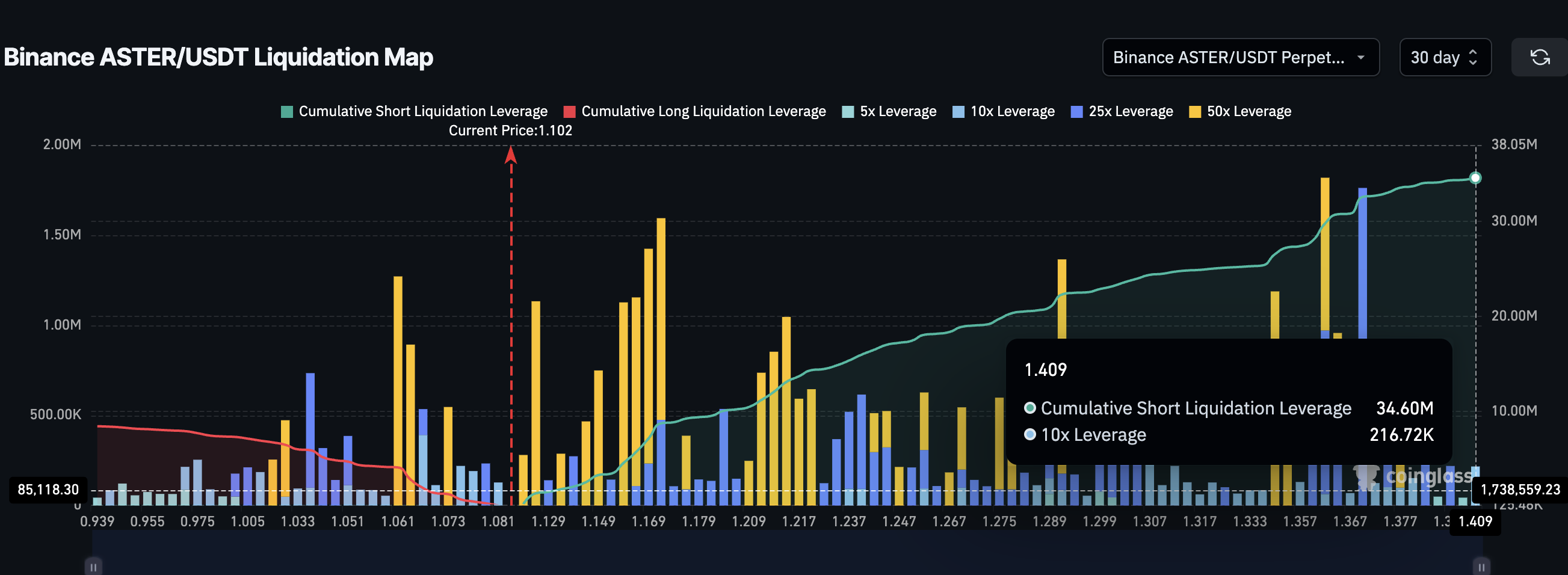 Massive Short-Bias For Aster:
Coinglass
Massive Short-Bias For Aster:
Coinglass
The liquidation map suggests that if the ASTER price climbs above $1.39 (a 26% upmove from the current level), all these short positions would be forced to close. Such a squeeze could trigger automated buy orders and cascade into a sharper rally.
So, while retail money is moving out and sentiment looks weak, that very imbalance could end up driving the rebound once the right level breaks.
One ASTER Price Level Could Flip the Setup Entirely
The 4-hour price structure on ASTER’s chart gives a possible explanation for the retail pullback. The token is still trading inside a falling channel, a pattern that usually signals weakness. That visual bearishness could be what’s keeping retail traders away.
However, under the surface, the setup might be quietly shifting. The same falling channel also supports the short squeeze possibility discussed earlier. The cluster of short liquidations sits tightly between $1.15 and $1.39, meaning that if ASTER starts climbing within this zone, many traders betting on the downside would get wiped out — accelerating the rebound.
The Relative Strength Index (RSI) — which measures the strength and speed of price movements — adds to this theory. Between October 11 and 21, the RSI made higher lows while ASTER’s price made lower lows. This bullish divergence usually appears when sellers are losing power, even though the price remains weak. That shift in momentum often precedes rebounds, especially when paired with high short exposure.
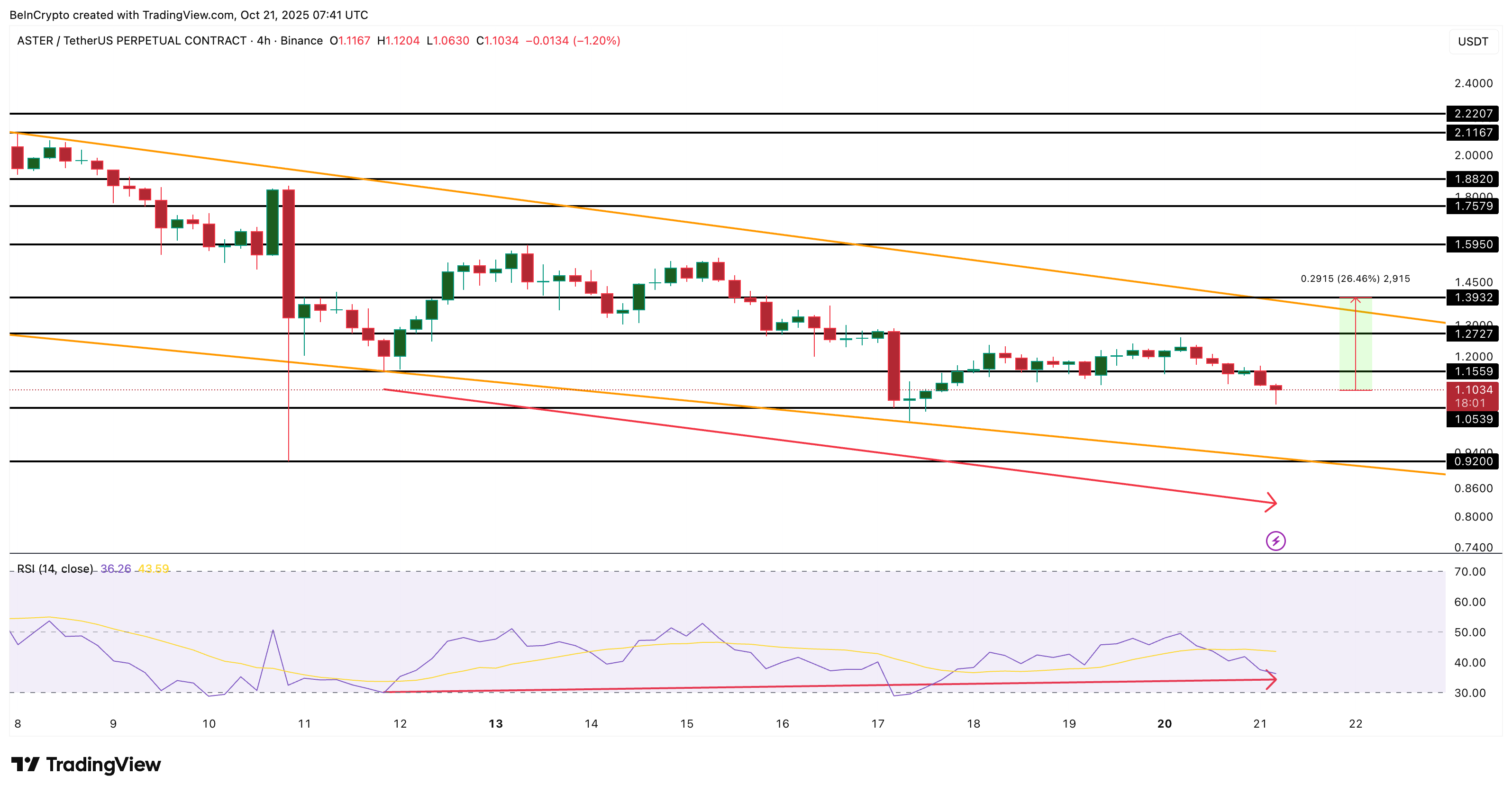 ASTER Price Analysis:
TradingView
ASTER Price Analysis:
TradingView
If ASTER manages to climb above $1.39, it would not only break the upper trendline of the falling channel — effectively cancelling the bearish setup — but also trigger a full round of short liquidations. That could push prices toward $1.88 and $2.22.
On the other hand, if the ASTER price slips below $1.05, the rebound setup weakens. A close under $0.92 would break the lower channel boundary. And it would expose the token to a deeper fall, invalidating the potential recovery.
Disclaimer: The content of this article solely reflects the author's opinion and does not represent the platform in any capacity. This article is not intended to serve as a reference for making investment decisions.
You may also like
CoreWeave, the "Eye of the Storm" in the Latest AI Crash amid "Double Blow to Stocks and Bonds"
CoreWeave's stock price plummeted 25% in a single week, with junk bond yields soaring to 15% and the default probability exceeding 60%, triggering a financing crisis in AI infrastructure. This "double whammy" in both stocks and bonds has led to an 11% drop in the Philadelphia Semiconductor Index and the Nasdaq 100 experiencing its worst weekly performance of the year. Market participants warn that this marks a turning point in AI hype credit pricing—the high-leverage, heavy-debt expansion model is now facing a severe test amid elevated interest rates.

Japan taps Chainlink’s CCIP to accelerate tokenization — Details

Bank of America’s Hartnett, who accurately predicted major declines: “Sell signal” is over, investors will "return to tech stocks in mid-November”, the key lies in “chip prices”
Bank of America’s “sell signal” has ended, but this is by no means a call to bottom fish. Currently, the AI financing gap is widening, and technology stocks are extremely crowded. Strategists warn that the key to whether technology stocks can rebound in November depends entirely on “semiconductor prices.” In the short term, it is advised to avoid technology stocks, maintain a defensive stance, and position in small caps and REITs.

AI leader Anthropic reveals the harshest truth of the entire AI industry!

Crypto prices
More


