
Solana DEX Meteora to launch MET token with half supply circulating: What will its FDV be?

Meteora’s MET token debuts on October 23, with nearly 48% of its 1 billion supply entering circulation. What will its FDV be?
- Meteora is distributing 480 million MET tokens (48% of supply) via an airdrop to users and partners.
- The Solana-based DEX commands 26% of network trading volume and generates around $3.9 million in daily fees — eight times higher than Raydium.
- Polymarket traders see a 53% chance of a $1B FDV one day post-launch, but many are concerned that the large token float could trigger early selling pressure despite solid performance metrics.
Meteora’s TGE is set for October 23, with the MET token confirmed to list on major exchanges including OKX and Bitget, alongside several Solana-native launchpads. The debut marks one of the most anticipated Solana ecosystem launches of the year, with nearly 48% of the total 1 billion MET supply — or 480 million tokens — entering circulation at launch.
Meteora is taking a community-first approach to the launch, airdropping MET to eligible users, including Mercurial Finance stakeholders, Meteora liquidity providers, JUP stakers, and partner launchpad participants. Recipients can either hold their tokens unlocked or provide liquidity in Meteora’s dynamic AMM pools to earn trading fees.
About Meteora
For context, Meteora was built by the team behind Jupiter , Solana’s largest DEX aggregator. It was born from the remnants of Mercurial Finance, which was wound down following the FTX collapse. To revitalize the protocol, the team created Meteora in 2023, promising to compensate legacy Mercurial users through MET token distribution.
According to analysis by @0xashensoul , Meteora currently commands 26% of Solana’s DEX market share, generating roughly $3.9 million in daily trading fees — eight times higher than Raydium’s $466,000. Its TVL stands at around $829 million.
Meteora FDV one day after launch: Is $1B a safe bet?
With such a high-profile project launching a token, speculation is intensifying over Meteora’s FDV after launch. Polymarket shows that traders are leaning toward a valuation between $750 million and $1 billion one day after launch.
As of October 22, Polymarket traders are assigning a 98% probability that Meteora’s FDV will exceed $500 million, an 86% chance it will top $750 million, and a 53% chance it will surpass $1 billion. Expectations drop sharply beyond that range, with only 6% betting on a $2 billion valuation and less than 2% on anything above $4 billion.
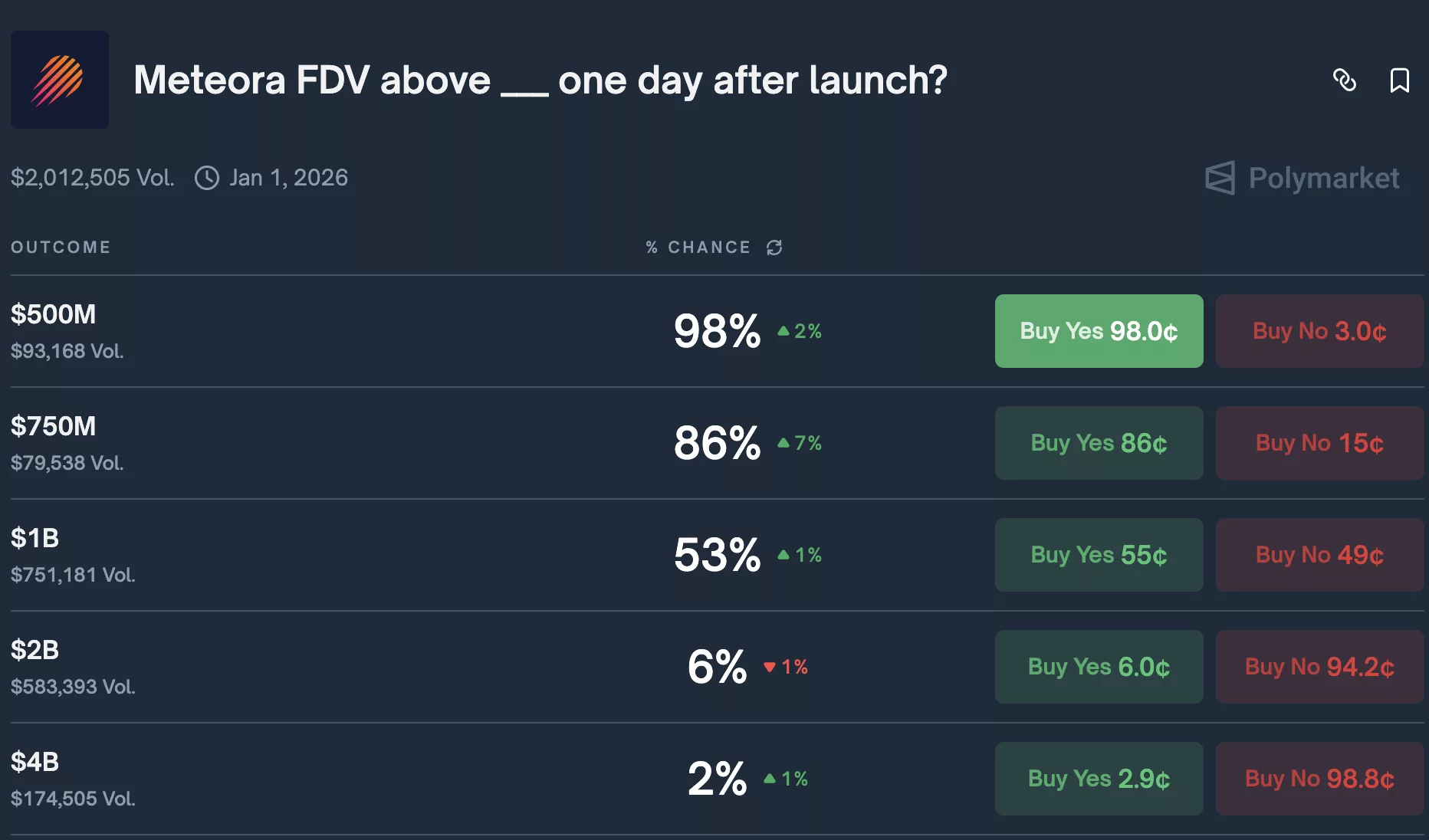 Meteora FDV one day after launch | Source: polymarket.com
The prevailing sentiment in the community is that Meteora’s biggest challenge lies in the circulating supply being too large. As @0xashensoul summed it up:
“Meteora fundamentals are strong, generating 8 times more fees than Raydium, which supports a premium valuation. But, the 48% token unlock on day one is unprecedented for a Solana launch. This large immediate supply will likely cause significant selling pressure. Thats why i think the best risk-adjusted bets are YES on $750M and NO on $2B+, leveraging the disconnect between strong fundamentals and unprecedented 48% float risks.”
Disclaimer: The content of this article solely reflects the author's opinion and does not represent the platform in any capacity. This article is not intended to serve as a reference for making investment decisions.
You may also like

CoreWeave, the "Eye of the Storm" in the Latest AI Crash amid "Double Blow to Stocks and Bonds"
CoreWeave's stock price plummeted 25% in a single week, with junk bond yields soaring to 15% and the default probability exceeding 60%, triggering a financing crisis in AI infrastructure. This "double whammy" in both stocks and bonds has led to an 11% drop in the Philadelphia Semiconductor Index and the Nasdaq 100 experiencing its worst weekly performance of the year. Market participants warn that this marks a turning point in AI hype credit pricing—the high-leverage, heavy-debt expansion model is now facing a severe test amid elevated interest rates.

Japan taps Chainlink’s CCIP to accelerate tokenization — Details

Bank of America’s Hartnett, who accurately predicted major declines: “Sell signal” is over, investors will "return to tech stocks in mid-November”, the key lies in “chip prices”
Bank of America’s “sell signal” has ended, but this is by no means a call to bottom fish. Currently, the AI financing gap is widening, and technology stocks are extremely crowded. Strategists warn that the key to whether technology stocks can rebound in November depends entirely on “semiconductor prices.” In the short term, it is advised to avoid technology stocks, maintain a defensive stance, and position in small caps and REITs.

Crypto prices
More


