
Could “Debasement Trade” Be The Biggest Bitcoin Narrative for 2026?

The debasement trade—shifting from fiat and bonds to assets like Bitcoin and gold—is becoming the dominant crypto narrative again.
The phrase “debasement trade” as a crypto narrative has become popular. It’s this idea of getting out of government-backed assets, such as bonds or fiat currencies, and into “hard” assets like gold or Bitcoin.
Bitwise CIO Matt Hougan recently posted on X that the debasement trade theory is gaining steam and will be popular into 2026. So, what is this theory, and why is it gaining traction now?
What is the Debasement Trade Theory in Bitcoin
The Debasement Trade theory in Bitcoin refers to investors buying Bitcoin as protection against the declining value of fiat currencies.
As governments expand money supply through debt and monetary stimulus, each unit of currency loses purchasing power. This process is known as currency debasement.
Things the market is underestimating:1) The likelihood that sovereigns buy bitcoin in size; in the next few years2) The likelihood that the US passes the Clarity Act in late-2025/early-2026;3) The speed at which tokenization and stablecoins will grow;4) The fact that the…
— Matt Hougan (@Matt_Hougan) October 28, 2025
Bitcoin’s fixed supply of 21 million coins and independence from central banks make it an attractive hedge against this erosion.
In this view, Bitcoin functions as a “digital hard asset,” similar to gold. It preserves value when trust in traditional money weakens.
The trade has gained momentum as global debt rises and inflation concerns persist. It allows investors to treat Bitcoin as part of a broader strategy to safeguard wealth from monetary dilution.
Increasing Uncertainty
Satoshi Nakamoto created Bitcoin as a response to the 2008 financial crisis. Its genesis block, when the network first went live in 2009, contained a message referencing bank bailouts.
So there’s really no question, despite the mystery surrounding Bitcoin’s founders, that the cryptocurrency was created as a salve for traditional financial chaos.
“I think that BTC’s fundamental thesis was always some variation of the debasement trade,” said Andrew Tu, an executive at crypto market maker Efficient Frontier. “Starting from the genesis block in which Satoshi references the bailout for banks.”
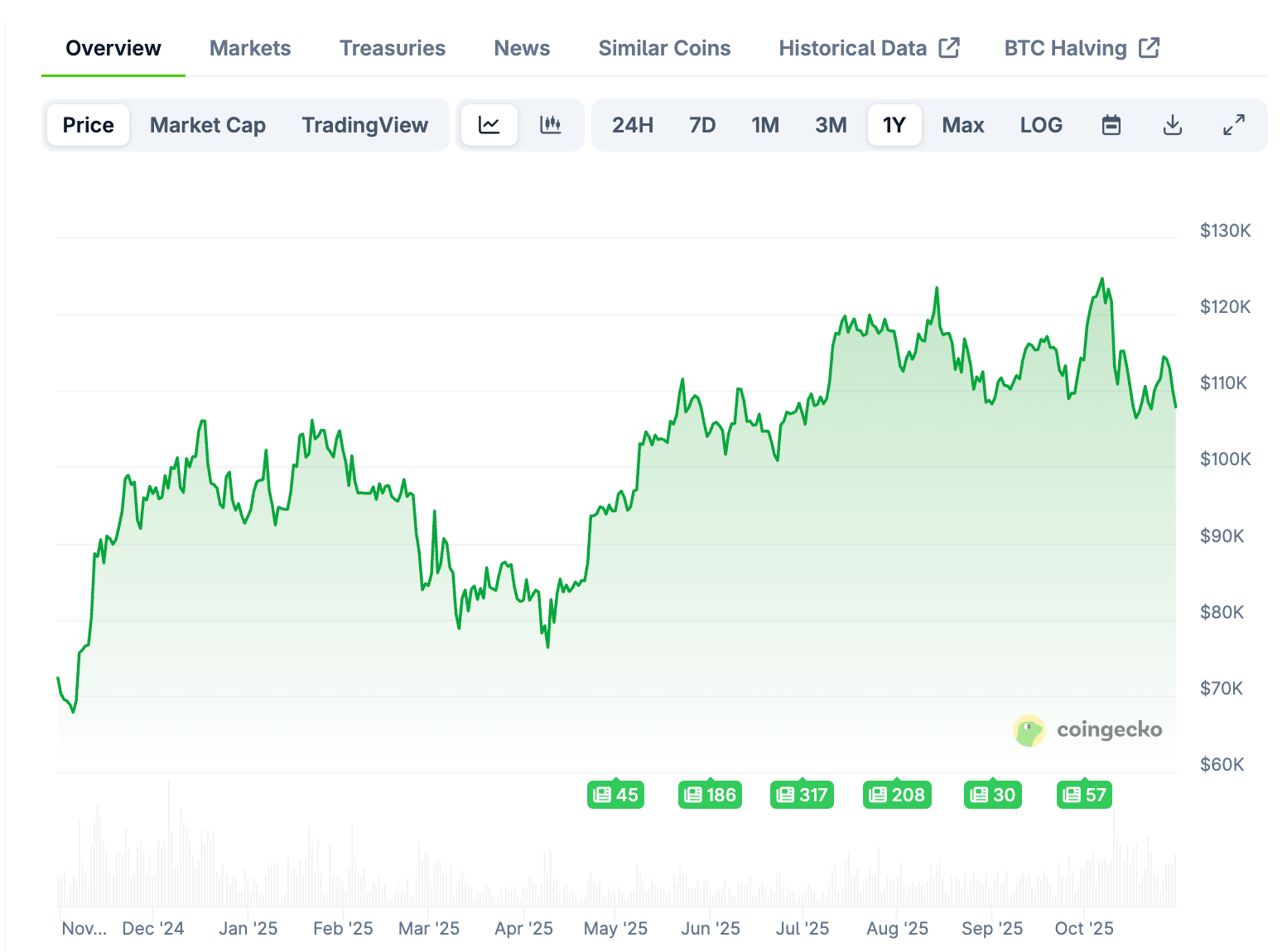 Bitcoin’s Price Over the Past Year. Source:
CoinGecko
The financial markets overall seem to be very reactionary to US policy. That’s why the market seems to change abruptly or on a whim with the Trump administration.
The latest October 10 market crash due to tariff fears is an example of this. Although recovery was almost as swift.
In fact, zooming out, the price of Bitcoin has risen 50% over the past year, despite market choppiness from week to week.
Debasement Bullish or Bearish for Crypto Traders?
The term “debasement” sounds serious, something that should be a concern for market participants.
However, the term may be more of a story to tell for gyrating markets, often at the whim of US policymakers or other global events.
Those studying the markets daily may have a different opinion on debasement, pulling in bearish sentiment overall.
“Despite all of the uncertainty and economists saying a recession and/or bear market was extremely likely in 2023, most likely in 2024, and 50/50 in 2025,” noted Jeff Emrby, Managing Partner of Globe 3 Capital. “It’s too early to call right now, but we are expecting to call for another bull market year in 2026.”
If the debasement trade idea becomes something lots of people talk about in 2026, as Bitwise’s Hougan predicts, those who have believed in Bitcoin for a long time won’t be surprised.
This used to be called being “libertarian” or a “cypherpunk.” It wasn’t necessarily in vogue at the time, and was part of Bitcoin’s counterculture vibe up until around 2016. It might be in vogue now.
“It’s pretty much the very foundation of the Bitcoin value story,” said Witold Smieszek, Director of Investments for Paramount Digital. “So in that way it’s nothing new for the old guard who got into crypto through a mix of economics and cypherpunk values.”
Bitcoin Rotation
Potential crypto investors have many more options in front of them versus the cypherpunk days when only Bitcoin was available.
The prevalence of Layer-1s and more favorable regulations has led to corporations expressing interest in various chains, which could result in significant value increases for those underlying tokens.
But it’s likely Bitcoin that fits the debasement story best.
“BTC with its hard supply cap has always been seen by Bitcoiners as a hedge against the fiat system that we currently have,” said Efficient Frontier’s Tu.
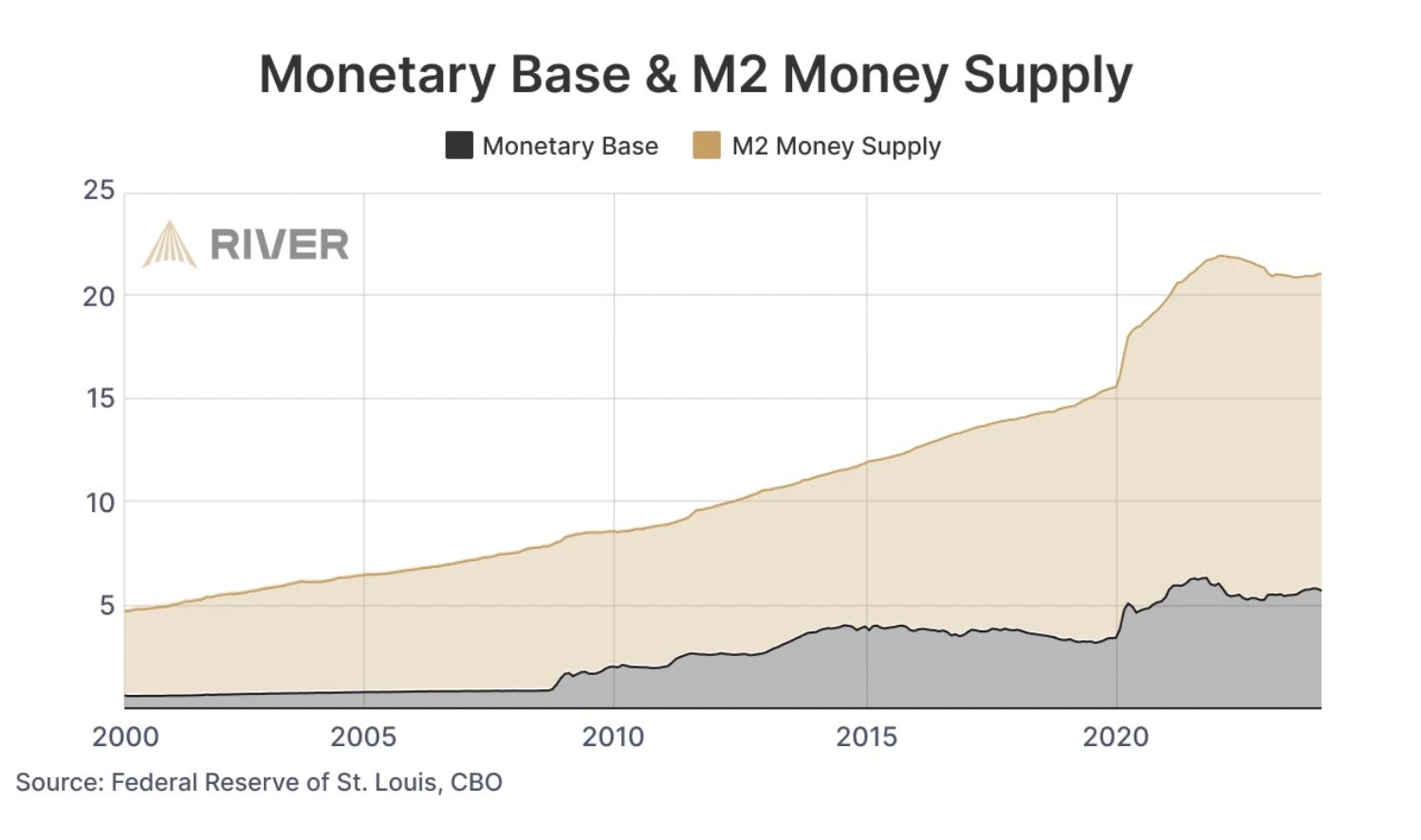 Federal Reserve Calculations of the Total Money Supply over the Past 25 Years. Source:
River Financial
Since the 2020 pandemic-era money printing, the total M2 money supply, which is cash and its equivalents, jumped from around $15 trillion to over $20 trillion.
Cheap and easy money has led to rotation into Bitcoin and a higher price – BTC was as low as $4,000 during the 2020 lockdowns. But that doesn’t mean there won’t be a rotation out in the face of other macro events.
Volatility might not always seem fun for inexperienced crypto holders, but it’s really good for traders, with daily Bitcoin volume across exchanges at $17 billion, per data aggregator .
“If the market crashes because the AI bubble pops or something, then we will probably still see the BTC and overall crypto market, and probably gold in the short-term before outperformance in the medium-term, crash as well,” added Andrew Tu from Efficient Frontier
Disclaimer: The content of this article solely reflects the author's opinion and does not represent the platform in any capacity. This article is not intended to serve as a reference for making investment decisions.
You may also like
Funds swarm into US Treasuries, helping the "anchor of global asset pricing" fall below 5%! After "Black Friday," can tech stocks take advantage and rebound?
On November 20th, Eastern Time, the yields on 10-year and 30-year U.S. Treasury bonds fell to 4.92% and 5.31% respectively, while the Philadelphia Semiconductor Index plunged by 10.73%. On "Black Friday," long-term bonds realized their value as safe-haven assets, while AI computing power and semiconductors continued to digest investors' concerns about returns on AI capital expenditures.
After Starship recovery success, Citigroup raises SpaceX (SPCX.US) target price: Launch leading advantage is "rapidly expanding into a 20-year gap", Starlink will become the core for value realization
After SpaceX successfully caught the Starship upper stage with the launch tower for the first time, Citi released a research report, raising its target price for the stock from $240 to $280. The report also pointed out that the gap between SpaceX and other players in the aerospace launch industry is widening further.

After a week of "bloodbath" in US stocks, valuations now show investment value, but no one dares to say the bottom has arrived.
Last week, U.S. stocks experienced a massive sell-off, but in fact, there have been no fundamental changes in the underlying factors. Multiple valuation indicators now highlight their investment value, and the willingness of contrarian funds to buy the dip should be strong.
The script at the end of 2018: The Federal Reserve continued to raise interest rates, US stocks plunged 20% from the September highs, forcing the Federal Reserve to "pivot" in January.
Goldman Sachs' head of trading believes the current US stock market is repeating the scenario of late 2018, with monetary tightening and equity market pressure. The Goldman Sachs Financial Conditions Index has tightened by about 8 points in two weeks, reaching the highest level in a year. The selloff has broadened from tech stocks to defensive sectors. Gold and equities are declining simultaneously, possibly indicating investors are selling assets to raise cash, making gold a key indicator for observing liquidity stress.

Crypto prices
More


