
Cryptocurrencies continue to "crash" on Monday, with some tokens falling back to the flash crash lows of October

Institutional demand for Bitcoin has fallen below the rate of new coin mining for the first time in seven months, suggesting that major buyers may be pulling back.
Institutional demand for bitcoin has, for the first time in seven months, fallen below the rate of new coin mining, a shift that suggests large buyers may be pulling back.
Written by: Ye Zhen
Source: Wallstreetcn
In the shadow of October’s historic deleveraging event, the cryptocurrency market is facing a new wave of selling pressure. A key indicator shows that demand from large institutional investors is weakening, intensifying the market’s cautious sentiment.
On Monday, the cryptocurrency market remained under pressure, with bitcoin prices falling below $107,000 (UTC+8). The broader altcoin market performed even more weakly, with some token prices dropping back to the lows seen during October’s flash crash, when tens of billions of dollars in leveraged positions were liquidated.
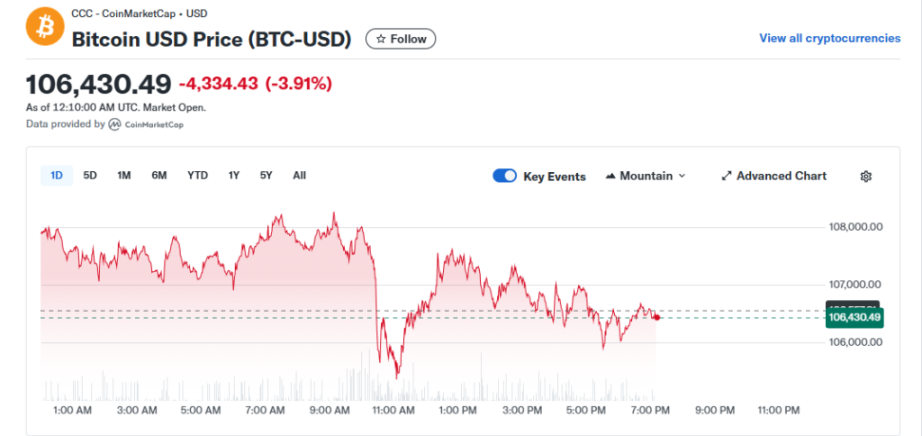
A signal worth noting is that, according to Capriole Investments founder Charles Edwards, institutional demand for bitcoin has, for the first time in seven months, fallen below the rate of new coin mining. This shift suggests that large buyers may be retreating, and together with other market activity, points to a risk-off tone across the entire cryptocurrency market.
Market Sentiment Cautious, Institutional Demand Cools
On Monday, bitcoin once fell 4.3% to around $105,300 (UTC+8). Although it is still up about 14% since December last year, its recent performance has been noticeably weak. Meanwhile, the MarketVector index, which tracks the performance of the latter 50 of the top 100 digital assets, fell for the third consecutive trading day, dropping as much as 8.8% (UTC+8). The index has fallen about 60% so far this year.
Market participants say that although three weeks have passed since the violent shock in October that wiped out about $1.9 billion in long positions, its “after-effects” are still lingering. Jordi Alexander, CEO of crypto trading and market-making firm Selini Capital, said the crypto market is in a “hangover phase” after the October liquidation shock. He believes it will take time to rebuild the destroyed capital base, and investor sentiment remains cautious.
Alexander added, “The market must first prove that a convincing price bottom is about to form before it can attempt to break upward again.” In his view, investors will not easily enter the market until there is a clear signal that prices have found support.
In addition to fragile market sentiment, a key technical indicator has also flashed red. Charles Edwards of Capriole Investments pointed out that institutional demand for bitcoin has slowed, falling below the rate of new coin production for the first time in seven months. This data suggests that one of the key forces that previously drove the market higher may be weakening.
Other Sources of Selling Pressure? Profit-Taking and “Dormant” Bitcoins Activated
Not everyone attributes this round of decline entirely to the market shock in October.
Matthew Kimmell, digital asset analyst at CoinShares, described this pullback as “somewhat puzzling.” He believes that although the market “is still experiencing some aftershocks from the liquidation event,” other factors are also worth watching.
Kimmell pointed out that, through bitcoin’s public transaction records, it can be seen that some wallets that had been dormant for a long time have been activated. “These tokens have started to move and are likely re-entering the market, providing some selling pressure as investors take profits,” he said. “This is something I am continuously monitoring.”
Jake Hanley, Managing Director at Teucrium ETFs, also believes that the reason for the price decline is that “people are taking profits.” He noted that the current technical picture shows a divided market. “Since the summer, prices led by bitcoin have been trending lower, and XRP has also clearly been on a downward trend since midsummer,” Hanley said. “In this process, the price itself is telling you that people are cashing in profits.”
Disclaimer: The content of this article solely reflects the author's opinion and does not represent the platform in any capacity. This article is not intended to serve as a reference for making investment decisions.
You may also like
10-year Yield Plunges 17 Basis Points in One Week! AI Trading Turbulence Rekindles Safe-Haven Appeal of US Treasuries
AI trading has loosened, reactivating the safe-haven attribute of US Treasury bonds. Last week, the 10-year yield dropped 17 basis points in a single week, synchronizing with the decline in tech stocks—a phenomenon not seen since the tariff storm in April 2025. The unusually concentrated short positions amplified the bond market rally, and large-scale short-covering by CTA funds has also become a key driver in this round of bond rebound.
From Digital Assets to Reshaping Financial Pipelines! BlackRock (BLK.US) Accelerates Integration of Tokenized Funds into the Core of Wall Street
Wall Street’s embrace of blockchain technology is moving beyond simply creating digital versions of stocks, bonds, and money market funds, aiming instead for a broader goal—to transform the way these assets circulate within the financial system.

AI bubble alarm rings across Wall Street! Oaktree Capital's Marks disagrees: The market hasn't reached its most dangerous moment yet, and investors are not completely oblivious to risks.
Although investors are displaying typical FOMO (fear of missing out) sentiment regarding further gains in tech stocks, the market continues to draw comparisons between the current situation and past bubbles, indicating that investors are not unaware of the risks.

Barclays: Dual restrictions of physical and capital, data center growth will slow significantly in 2027!
Barclays' latest report reveals that the global data center construction boom is approaching a turning point—the year-on-year growth rate of new capacity will plummet from over 100% in 2026 to about 35% in 2027, and stabilize by 2028. Facing both physical constraints and tightened financing, hyperscale cloud providers will absorb more than 60% of new capacity, while the risk of project suspension for small and medium developers will sharply increase.
Crypto prices
More


