
The Dollar Is Back — And Bitcoin May Be in Trouble

The U.S. Dollar Index’s surge above 100 is shaking up the crypto landscape, reigniting concerns over liquidity and risk sentiment. As DXY strengthens, analysts warn that Bitcoin’s next trend will depend on whether the dollar rally holds — or fades.
After nearly three months of range-bound trading, the US Dollar Index (DXY) has broken above the 100 mark, its highest level since August, reigniting concerns across risk asset markets.
The strengthening greenback is prompting investors to ask: Is this merely a short-term technical rebound, or the beginning of a new liquidity-tightening cycle that could pressure Bitcoin and the broader crypto market?
The US Dollar Enters a Phase of Strength Consolidation
According to TradingView, the US Dollar Index (DXY) has surged past the 100 threshold, signaling a strong return for the dollar after months of weakness since the third quarter. The DXY spiked to 99.98, marking a two-month high after the Fed left interest rates unchanged in its last meeting.
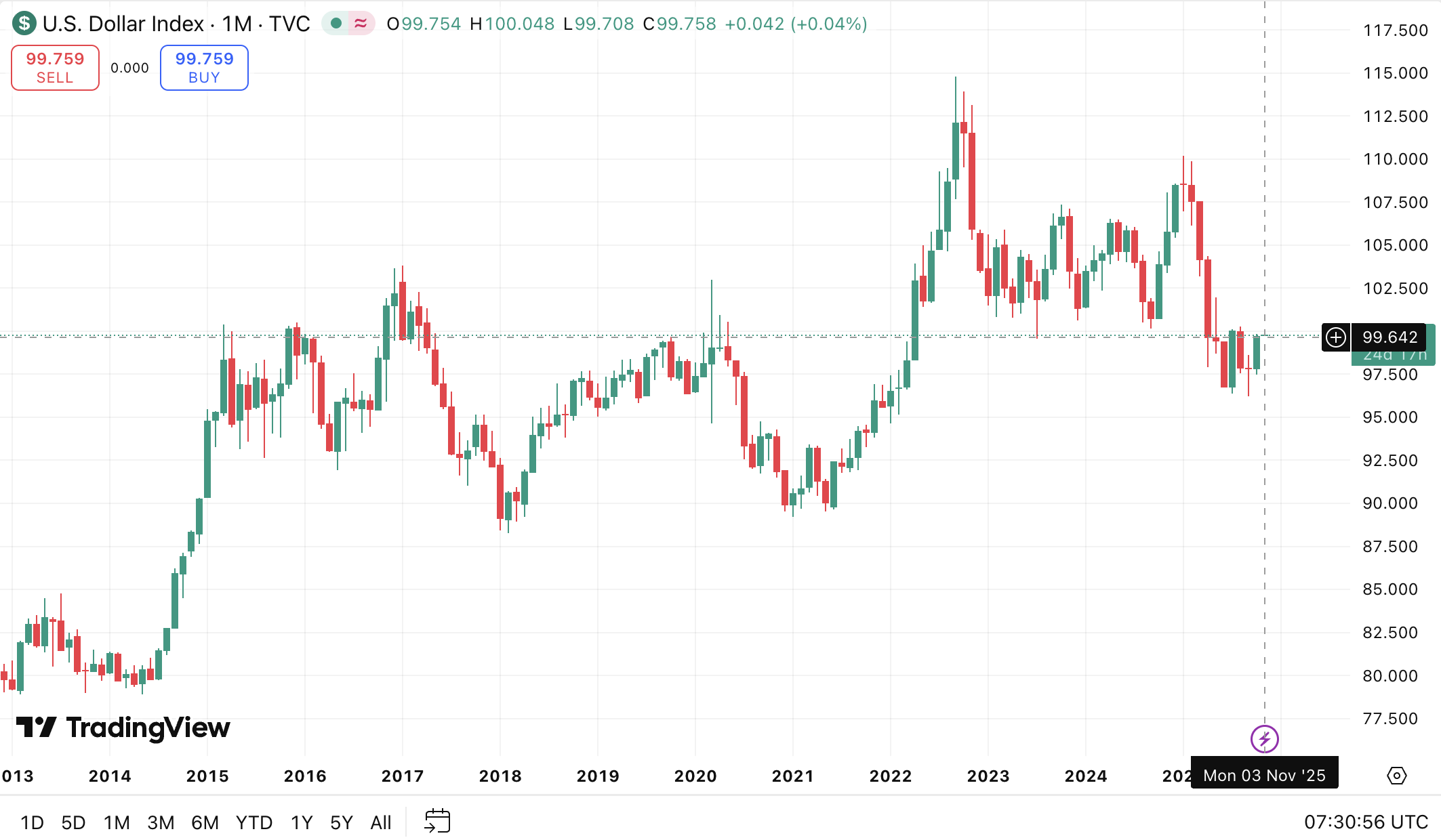 DXY chart. Source:
TradingView
Analyst Ted notes that DXY is forming a golden cross on the daily chart, a technical pattern often associated with a sustained bullish trend.
“The dollar keeps on getting stronger, and this isn’t a good sign for the crypto market,” he commented.
Meanwhile, an expert on X warns that this could be a “big test” for the ongoing rally as DXY approaches a key horizontal resistance and the 200-day moving average. This decisive zone could determine the next trend.
Some analysts believe this move could be a technical back-test before a potential reversal. According to another X user, DXY’s monthly structure suggests a bearish retest, implying a possible short-term pullback before resuming a medium-term uptrend.
Regardless of the short-term direction, the dollar’s resurgence again exerts psychological pressure on risk assets, from equities to crypto.
Bitcoin Faces the Headwind: Understanding the BTC DXY Correlation
Historically, Bitcoin (BTC) has negatively correlated with the DXY. When the dollar strengthens, risk appetite tends to fade, often leading to price corrections in BTC. According to a chart shared on X, Bitcoin has closely “followed” DXY’s movements throughout the past quarter, highlighting the inverse BTC DXY correlation that continues to define macro sentiment.
According to data from Ted Pillows, DXY rose from 98 to nearly 99.7 from September onward, while Bitcoin dropped over 12% and gold fell by around 6%.
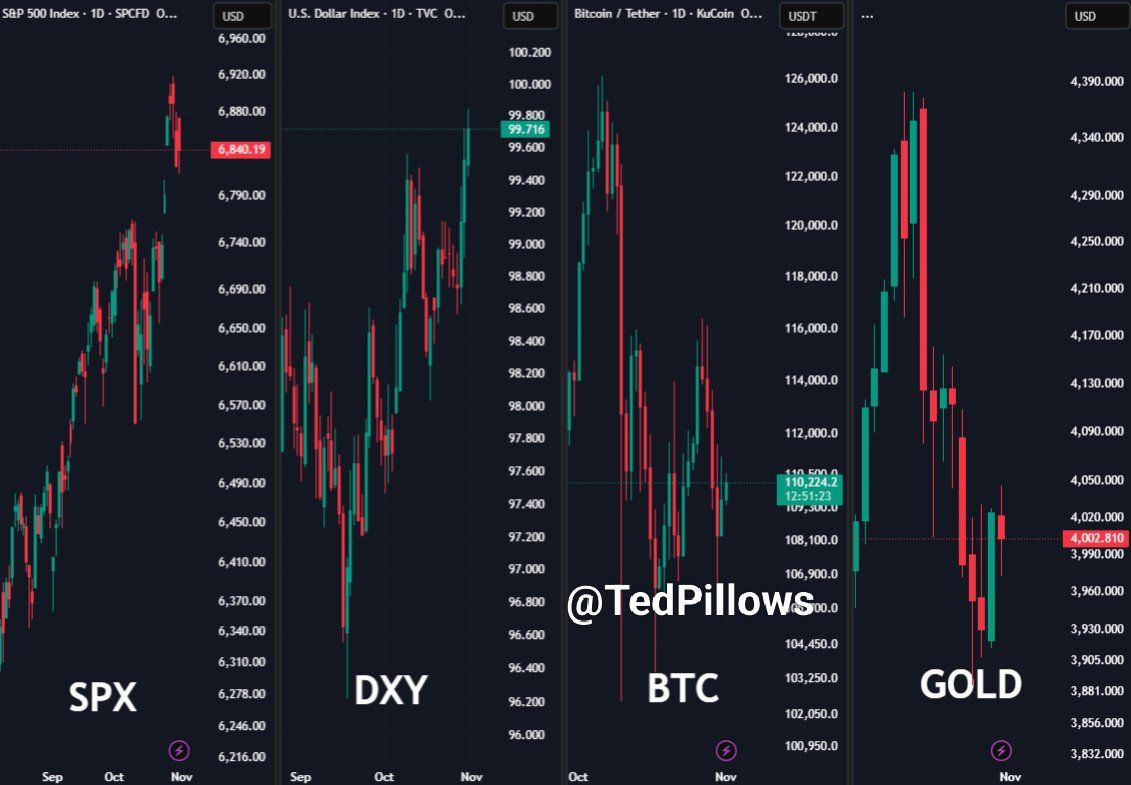 BTC–DXY correlation chart. Source:
Ted
Brett’s analysis shows that the 100 level remains critical support on the weekly DXY chart. The last time DXY rebounded from this level, in May 2025, Bitcoin broke to new all-time highs, fueled by a temporary USD pullback. While history could repeat itself, the risk of an inverse outcome looms large if the dollar’s current recovery proves more durable.
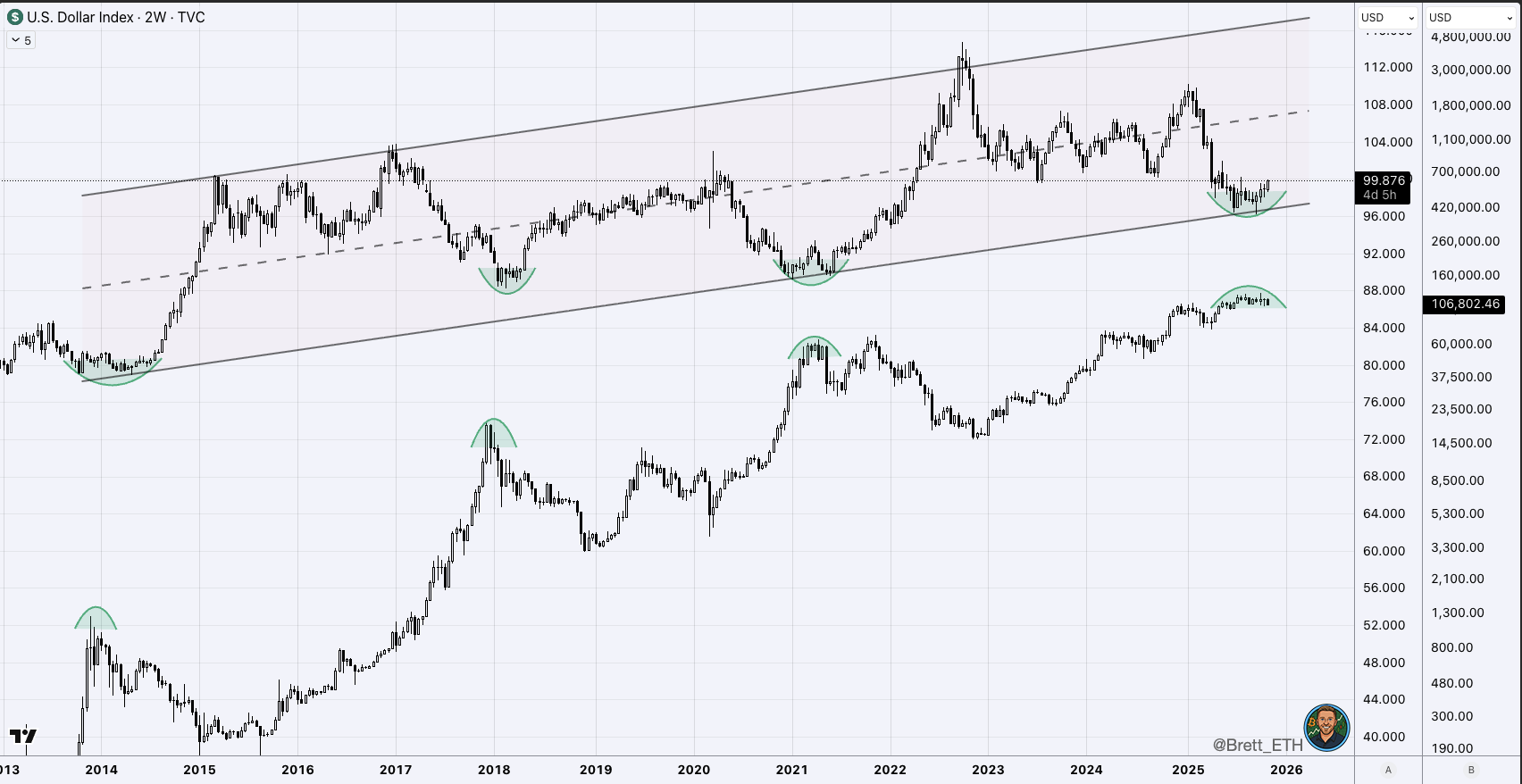 DXY analysis. Source:
Brett
Another trader emphasizes that Bitcoin’s next major move will likely hinge on DXY’s trajectory: if the dollar breaks above 101, a bearish continuation scenario for BTC could unfold; conversely, if DXY fails to hold the 100 zone, it might signal a short-term relief rally for crypto markets.
The BTC DXY correlation remains one of traders and investors’ most crucial macro indicators. As the dollar strengthens, Bitcoin’s short-term upside may face resistance. Yet, if DXY’s momentum fades, crypto could regain its footing heading into the year’s end, once again proving that macro tides, not just on-chain dynamics, dictate the rhythm of digital assets.
Disclaimer: The content of this article solely reflects the author's opinion and does not represent the platform in any capacity. This article is not intended to serve as a reference for making investment decisions.
You may also like
AI bubble alarm rings across Wall Street! Oaktree Capital's Marks disagrees: The market hasn't reached its most dangerous moment yet, and investors are not completely oblivious to risks.
Although investors are displaying typical FOMO (fear of missing out) sentiment regarding further gains in tech stocks, the market continues to draw comparisons between the current situation and past bubbles, indicating that investors are not unaware of the risks.

Barclays: Dual restrictions of physical and capital, data center growth will slow significantly in 2027!
Barclays' latest report reveals that the global data center construction boom is approaching a turning point—the year-on-year growth rate of new capacity will plummet from over 100% in 2026 to about 35% in 2027, and stabilize by 2028. Facing both physical constraints and tightened financing, hyperscale cloud providers will absorb more than 60% of new capacity, while the risk of project suspension for small and medium developers will sharply increase.

Bitcoin and Solana test key support as NEAR and HYPE face selling pressure
AI Capital Flow Chart: Nvidia Takes 690 Billion, Remaining 499 Companies Share 340 Billion
Morgan Stanley has released its first comprehensive overview of AI capital expenditure: In 2027, among $1.58 trillion in spending by hyperscale cloud service providers, Nvidia alone will take 67%, while the remaining 499 S&P component companies will collectively receive only $339 billion. A more hidden risk lies in over $1.1 trillion of "off-balance-sheet leases," which are essentially disguised debt. 2027 is predicted to have the largest free cash flow shortfall, and the risks of both volume and price declines are being severely underestimated by the market.

Crypto prices
More


