
Is This the Start of Ethereum’s November Crash?

The Federal Reserve just delivered its second consecutive interest rate cut, lowering the benchmark rate to a 3.75–4% range. On paper, looser monetary policy should fuel risk assets like crypto. But the market’s reaction told a different story. Ethereum (ETH) price fell over 5% , signaling traders aren’t convinced this cut is a clear bullish signal. Let’s break down why.
Ethereum Price Prediction: What the Fed’s Move Really Means

The Fed’s rate cut was expected , but Chair Jerome Powell’s comments dampened enthusiasm. His refusal to commit to another cut in December introduced uncertainty. Investors had priced in aggressive easing, so the cautious tone felt like a cold shower.
The end of quantitative tightening (QT) on December 1 was also a major announcement. It means the Fed will stop shrinking its balance sheet, effectively injecting more liquidity into the system. Normally, that’s bullish for crypto, but the backdrop of weak employment data and sticky inflation complicates things.
So while the policy shift favors risk assets in the long run, short-term volatility is back—especially as markets reassess how “dovish” the Fed really is.
Ethereum Price Prediction: Bears Regain Control
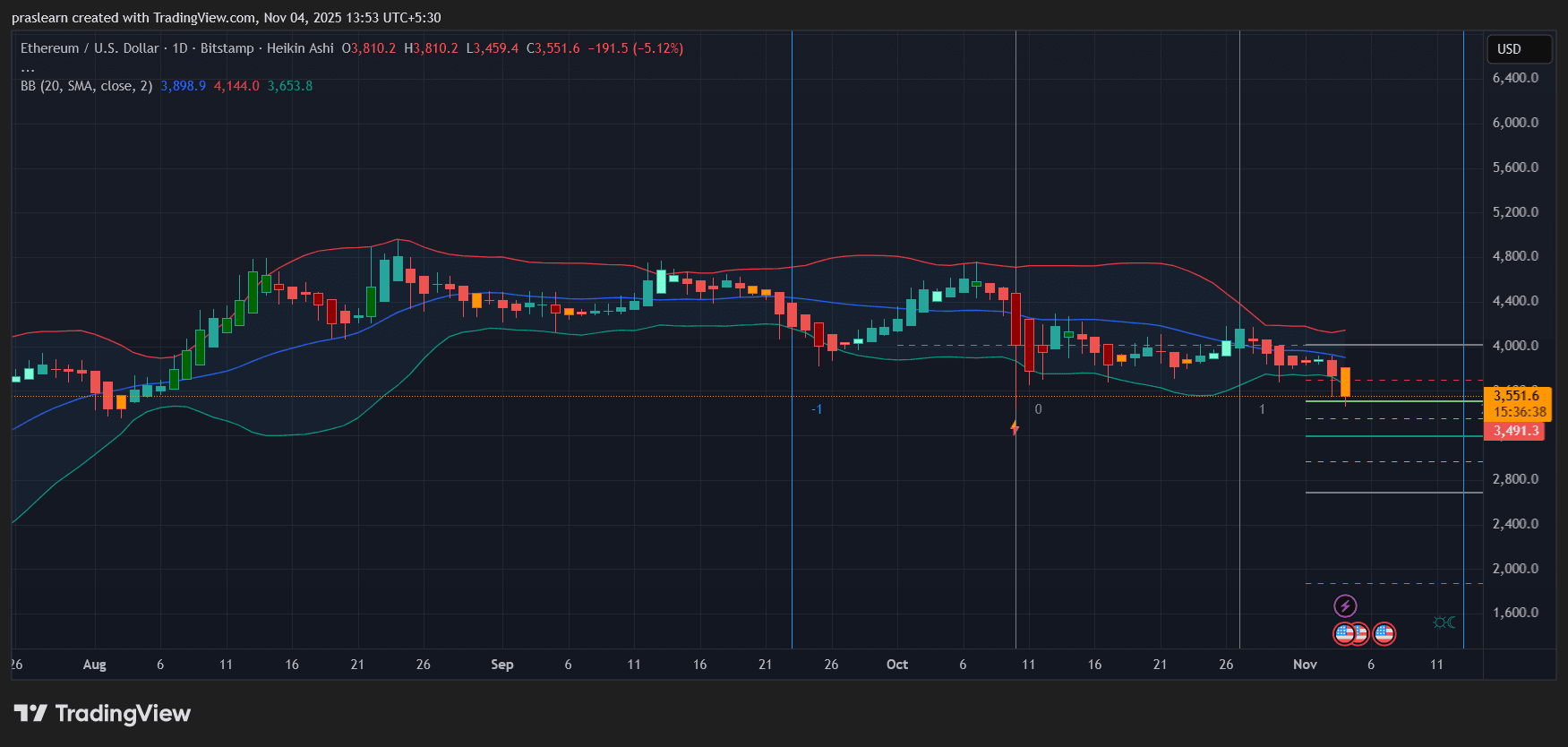 ETH/USD Daily Chart: TradingView
Ethereum price daily chart shows a decisive rejection near the mid-Bollinger Band (around $3,900), followed by a sharp breakdown toward $3,550. The Heikin Ashi candles turned solid red, confirming renewed bearish momentum.
The Bollinger Bands (BB) are widening—classic sign of volatility expansion—and ETH just closed below the 20-day simple moving average (SMA). This breakdown puts immediate support at the lower Bollinger band near $3,650, which has now been breached intraday. If the slide continues, the next downside targets sit near $3,490 and $3,250.
The chart also hints at a failed recovery attempt in late October, where ETH price couldn’t reclaim $4,000 resistance. That rejection reinforced a lower-high structure, suggesting sellers remain in control.
In short: the $3,500 zone is a key battleground. Lose that level convincingly, and ETH risks accelerating toward $3,000.
Macro Meets Market: Liquidity vs. Sentiment
Crypto market thrives on liquidity, and the end of QT should theoretically add fuel. But traders are wary because Powell’s tone wasn’t outright dovish. Add in labor-market weakness and inflation still above 3%, and you get uncertainty—something markets hate.
The lack of fresh economic data (due to the ongoing government data freeze) only adds to that uncertainty. Investors don’t know how deep the slowdown runs, so they’re hedging instead of rotating fully into risk assets. For Ethereum , this hesitation translates into cautious positioning and low conviction rallies.
Still, there’s a twist. If inflation data cools again before the December meeting, traders could quickly flip bullish on the next rate move. That’s the wild card to watch.
What Comes Next for Ethereum Price?
Here’s the thing: Ethereum’s longer-term structure remains intact as long as it holds above $3,200. That’s where the major trendline support from the July rally still aligns. A bounce from that level could trigger a short-covering rally back toward $3,800.
But for a sustained bullish reversal, ETH price needs two things:
- A clear signal from the Fed that further cuts are on the table.
- A decisive daily close above the mid-band (~$3,900) to reestablish bullish control.
If neither happens, $ETH could continue grinding lower through November, testing $3,250–$3,000 before buyers return.
Ethereum’s current drop isn’t just about charts—it’s about confidence. Traders wanted a clear dovish path; Powell gave them uncertainty. That combination typically leads to short-term weakness but sets up a potential rebound once clarity returns.
So while the near-term outlook looks bearish, medium-term traders should watch the $3,200–$3,000 region closely. If $Ethereum stabilizes there while the Fed signals another cut, a powerful rebound toward $4,000 could follow.
Until then, caution wins. The Fed may have cut rates, but the market isn’t celebrating just yet.
Disclaimer: The content of this article solely reflects the author's opinion and does not represent the platform in any capacity. This article is not intended to serve as a reference for making investment decisions.
You may also like
10-year Yield Plunges 17 Basis Points in One Week! AI Trading Turbulence Rekindles Safe-Haven Appeal of US Treasuries
AI trading has loosened, reactivating the safe-haven attribute of US Treasury bonds. Last week, the 10-year yield dropped 17 basis points in a single week, synchronizing with the decline in tech stocks—a phenomenon not seen since the tariff storm in April 2025. The unusually concentrated short positions amplified the bond market rally, and large-scale short-covering by CTA funds has also become a key driver in this round of bond rebound.
From Digital Assets to Reshaping Financial Pipelines! BlackRock (BLK.US) Accelerates Integration of Tokenized Funds into the Core of Wall Street
Wall Street’s embrace of blockchain technology is moving beyond simply creating digital versions of stocks, bonds, and money market funds, aiming instead for a broader goal—to transform the way these assets circulate within the financial system.

AI bubble alarm rings across Wall Street! Oaktree Capital's Marks disagrees: The market hasn't reached its most dangerous moment yet, and investors are not completely oblivious to risks.
Although investors are displaying typical FOMO (fear of missing out) sentiment regarding further gains in tech stocks, the market continues to draw comparisons between the current situation and past bubbles, indicating that investors are not unaware of the risks.

Barclays: Dual restrictions of physical and capital, data center growth will slow significantly in 2027!
Barclays' latest report reveals that the global data center construction boom is approaching a turning point—the year-on-year growth rate of new capacity will plummet from over 100% in 2026 to about 35% in 2027, and stabilize by 2028. Facing both physical constraints and tightened financing, hyperscale cloud providers will absorb more than 60% of new capacity, while the risk of project suspension for small and medium developers will sharply increase.
Crypto prices
More


