
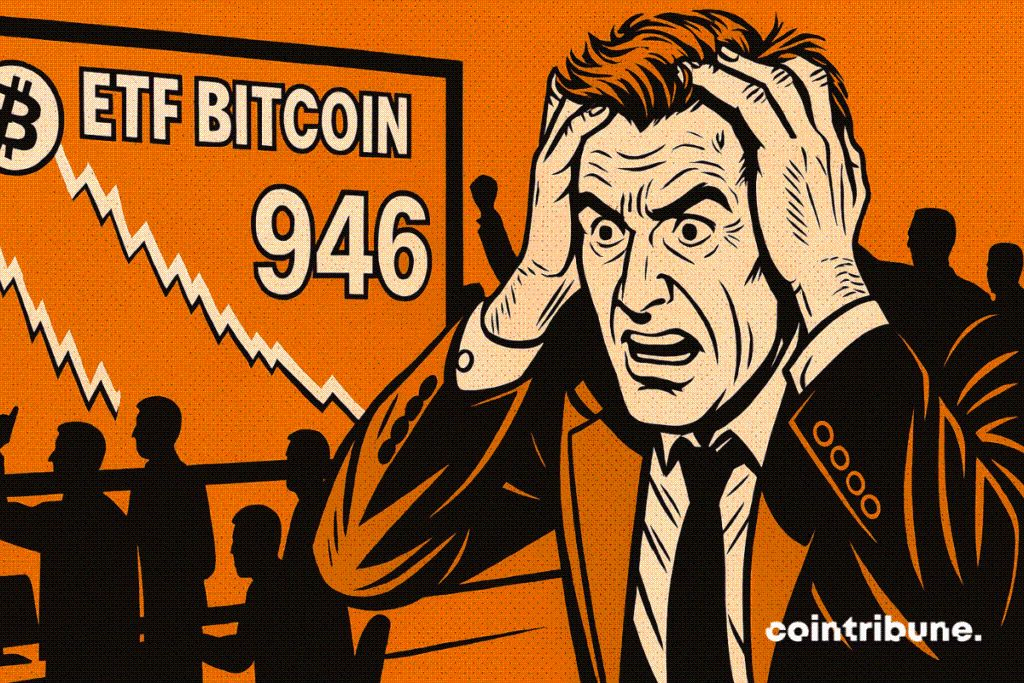
Bitcoin ETFs Undergo $946 Million in Withdrawals

American Bitcoin ETFs suffered a massive capital outflow last week. Institutional investors turned their backs after Jerome Powell dashed hopes of a rate cut in December. Against the tide, Solana ETFs carve out their niche with record inflows.
In brief
- American Bitcoin ETFs recorded $946 million in net outflows, with the iShares Bitcoin Trust alone losing $400 million.
- Jerome Powell’s restrictive tone regarding a rate cut in December cooled institutional investors’ enthusiasm.
- Solana ETFs attracted $421 million in one week, driven by enthusiasm for new American funds.
- Crypto markets experienced a correction on Monday with over one billion dollars in contract liquidations.
A hemorrhage of capital on Bitcoin ETFs
Bitcoin exchange-traded funds had a difficult week. According to asset manager CoinShares, $946 million flew out of the eleven American spot Bitcoin ETFs.
BlackRock’s flagship product, the iShares Bitcoin Trust, suffered the largest loss with $400 million in withdrawals . Overall, all digital asset-indexed products show $360 million in net outflows.
Investors interpreted Jerome Powell’s recent statements as a warning signal. The Federal Reserve chairman indeed cast doubt on a possible rate cut in December.
“ This restrictive tone, combined with the notable absence of key U.S. economic data releases, seems to have thrown investors into uncertainty.” explained James Butterfill, director of research at CoinShares.
This paralysis in economic data results from the U.S. government “shutdown” which has now lasted over 33 days. Investors are therefore navigating blindly, deprived of the usual indicators that guide their decisions. This situation creates a climate of uncertainty particularly unfavorable to risky assets like Bitcoin.
The debacle of American ETFs contrasts however with the performance of European funds. Germany and Switzerland recorded over $30 million in net inflows.
Canada and Australia respectively attracted $8.5 million and $7.2 million. A geographic diversification that illustrates the still-intact interest in digital gold, despite American turbulences.
Solana establishes itself as the alternative during the storm
While Bitcoin weathers the storm, Solana is becoming investors’ darling. SOL-based ETFs attracted $421 million in one week . This spectacular performance is explained by the recent launch of American funds at the end of October, which triggered a real enthusiasm.
The Bitwise Solana ETF (BSOL), listed on Nasdaq, already manages $105 million a week after its launch. Its competitor, the Rex-Osprey Solana Staking ETF (SSK), surpassed the $100 million mark in twelve days of trading. These figures reflect the growing appetite of institutions for the Solana ecosystem, long considered a serious alternative to Ethereum.
Crypto markets nonetheless experienced a gloomy Monday. Over one billion dollars in contracts were liquidated, with Bitcoin and Ethereum representing respectively $312 million and $303 million. At the time of writing, bitcoin was trading at $106,663 after a 2.5% drop. Ethereum lost 5.1% to reach $3,657.
A breath of fresh air in sight for 2026
The horizon could brighten in early 2026. The Fed plans to resume Treasury bond purchases in the first quarter, ending three years of balance sheet reduction.
This decision, though technical, could stabilize financial markets and give digital assets some breathing room. Analysts anticipate about $35 billion in monthly purchases, enough to maintain liquidity in the system.
For now, crypto investors must cope with an uncertain macroeconomic environment. The Fed’s caution, coupled with the lack of reliable economic data, creates a delicate cocktail.
But the enthusiasm for new financial products such as Solana ETFs shows that institutional appetite remains intact. The market is simply waiting for clearer signals from the U.S. central bank.
Disclaimer: The content of this article solely reflects the author's opinion and does not represent the platform in any capacity. This article is not intended to serve as a reference for making investment decisions.
You may also like
10-year Yield Plunges 17 Basis Points in One Week! AI Trading Turbulence Rekindles Safe-Haven Appeal of US Treasuries
AI trading has loosened, reactivating the safe-haven attribute of US Treasury bonds. Last week, the 10-year yield dropped 17 basis points in a single week, synchronizing with the decline in tech stocks—a phenomenon not seen since the tariff storm in April 2025. The unusually concentrated short positions amplified the bond market rally, and large-scale short-covering by CTA funds has also become a key driver in this round of bond rebound.
From Digital Assets to Reshaping Financial Pipelines! BlackRock (BLK.US) Accelerates Integration of Tokenized Funds into the Core of Wall Street
Wall Street’s embrace of blockchain technology is moving beyond simply creating digital versions of stocks, bonds, and money market funds, aiming instead for a broader goal—to transform the way these assets circulate within the financial system.

AI bubble alarm rings across Wall Street! Oaktree Capital's Marks disagrees: The market hasn't reached its most dangerous moment yet, and investors are not completely oblivious to risks.
Although investors are displaying typical FOMO (fear of missing out) sentiment regarding further gains in tech stocks, the market continues to draw comparisons between the current situation and past bubbles, indicating that investors are not unaware of the risks.

Barclays: Dual restrictions of physical and capital, data center growth will slow significantly in 2027!
Barclays' latest report reveals that the global data center construction boom is approaching a turning point—the year-on-year growth rate of new capacity will plummet from over 100% in 2026 to about 35% in 2027, and stabilize by 2028. Facing both physical constraints and tightened financing, hyperscale cloud providers will absorb more than 60% of new capacity, while the risk of project suspension for small and medium developers will sharply increase.

Crypto prices
More


