
Ethereum Turns Negative for 2025 as Crypto Liquidations Exceed $1.1 Billion

Ethereum’s drop below $3,400 has erased its 2025 gains as crypto markets suffer over $1.1 billion in liquidations. With Bitcoin hovering near $100,000 and whales selling into weakness, traders fear the worst may not be over yet.
Ethereum and Bitcoin extended their sharp declines on November 4, triggering over $1.1 billion in crypto liquidations within 24 hours as traders rushed to the exits amid mounting market stress.
The drawdown has plunged the Ethereum price to a milestone last seen a year ago.
Ethereum Turns Negative for 2025 as Crypto Liquidations Exceed $1.1 Billion
Ethereum broke below the critical $3,400 mark, officially turning negative year-to-date (YTD) after starting 2025 near $3,353. The move marked a 7% daily plunge, its steepest drop in months.
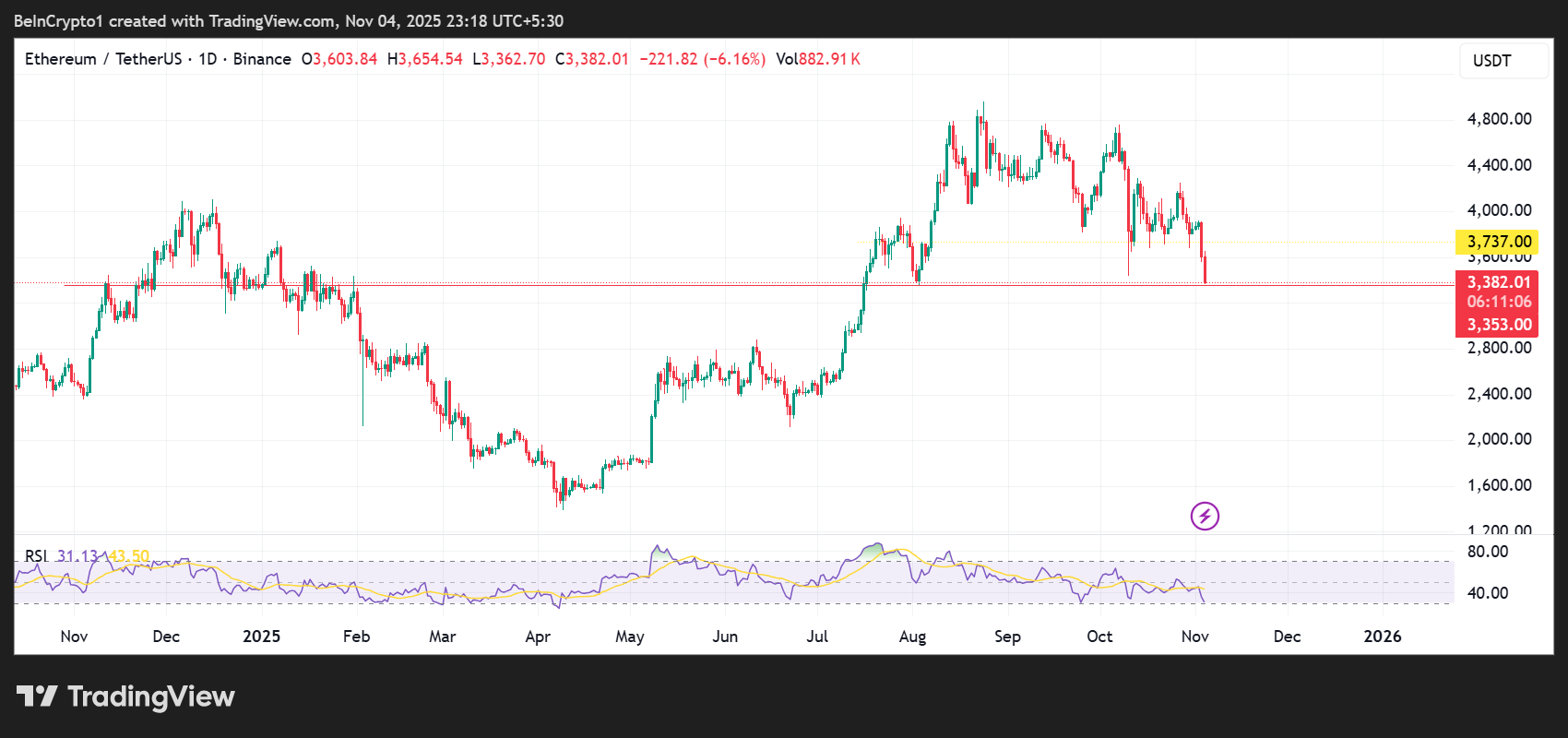 Ethereum (ETH) Price Performance. Source:
TradingView
The decline has effectively erased all of ETH’s year-to-date gains, signaling a shift in sentiment after months of relative stability in the altcoin market.
Bitcoin, meanwhile, slid to an intraday low of $100,721, putting the leading cryptocurrency within striking distance of the psychologically crucial $100,000 support zone, a level not seen since June 23.
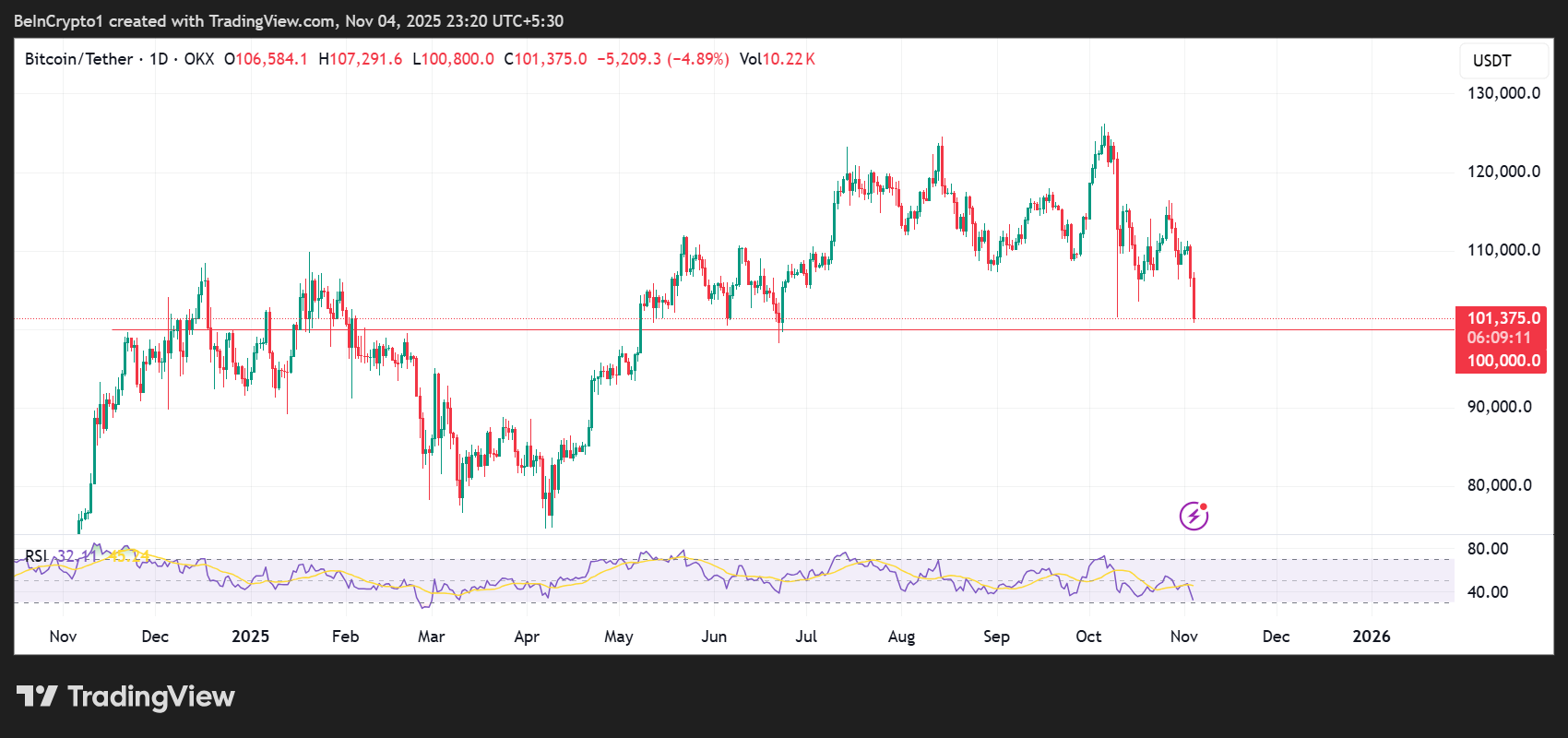 Bitcoin (BTC) Price Performance. Source:
TradingView
For both assets, the RSI (Relative Strength Index) trended at near-oversold territories, indicating the magnitude of investor sentiment.
The synchronized selloff sent shockwaves across the market, with major altcoins following suit amid widespread deleveraging.
$1.1 Billion in Liquidations as Leverage Unwinds
Data from Coinglass shows that over 303,000 traders were liquidated in the past 24 hours, resulting in a total of $1.10 billion in forced liquidations across major exchanges.
Within a single hour, over $300 million in positions were wiped out, with approximately $287 million representing long positions. This highlights how overleveraged bullish bets were punished as prices broke key support levels.
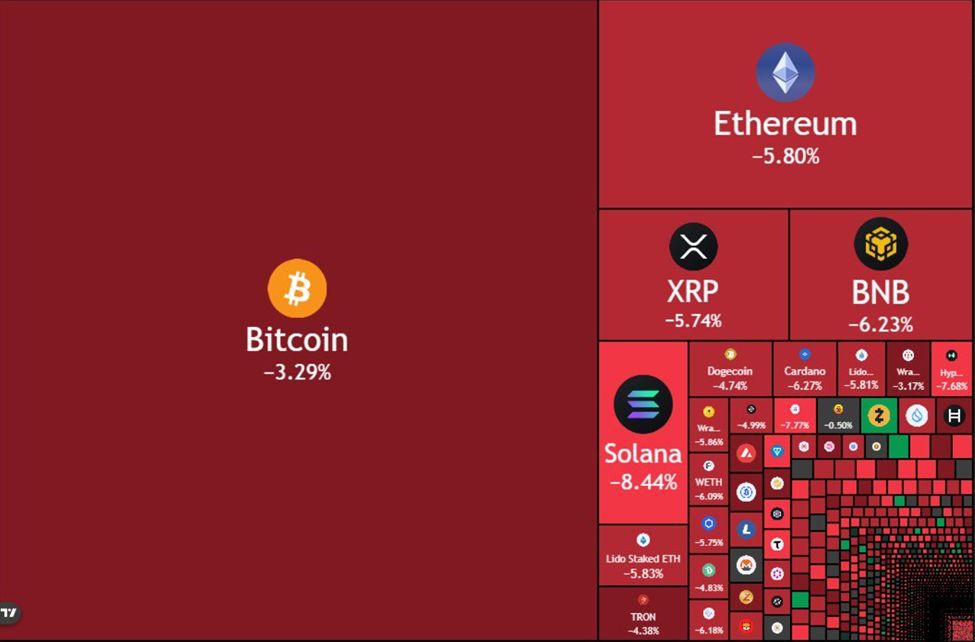 Total Crypto Liquidations. Source: TradingView
Bitcoin and Ethereum accounted for the bulk of these liquidations, but high-beta assets like Solana, BNB, and XRP also experienced aggressive unwinding as traders rushed to reduce their exposure.
Amidst the chaos, however, one controversial trader, James Wynn, has been vindicated. According to Lookonchain, Wynn is finally in the green, sitting on an unrealized profit of $66,465.
James Wynn has finally won! In the past two months, he's been liquidated 45 times, whether going long or short.But now, he's finally in the green — sitting on an unrealized profit of $66,465.
Whale Dumping Deepens Bearish Pressure
On-chain analytics firm Santiment reported a notable behavioral split between large and small Bitcoin holders.
Wallets holding between 10 and 10,000 BTC, often referred to as whales and sharks (respectively), have offloaded over 38,366 BTC since October 12. This represents a 0.28% decline in their overall holdings.
These addresses currently control 68.5% of Bitcoin’s total supply, meaning their selling has an outsized market impact.
Conversely, retail traders holding less than 0.01 BTC (“shrimps”) have been accumulating, adding 415 BTC (+0.85%) during the same period.
Santiment noted that this accumulation pattern is typically seen during market drawdowns but warned that a sustained rebound would only begin when whales flip from distribution to accumulation.
“Markets rise when key stakeholders accumulate the coins that small wallets shed. Micro traders need to show capitulation and fear, losing patience and selling off their coins at a loss as whales scoop them up. When this happens — and it will — it will signal a market bottom and an ideal time to buy,” Santiment wrote.
With both Bitcoin and Ethereum now flirting with critical psychological and technical thresholds, traders are closely watching for signs of stabilization or further breakdown.
A decisive breach below $100,000 for Bitcoin could accelerate outflows and compound negative sentiment across the digital asset space.
Disclaimer: The content of this article solely reflects the author's opinion and does not represent the platform in any capacity. This article is not intended to serve as a reference for making investment decisions.
You may also like
10-year Yield Plunges 17 Basis Points in One Week! AI Trading Turbulence Rekindles Safe-Haven Appeal of US Treasuries
AI trading has loosened, reactivating the safe-haven attribute of US Treasury bonds. Last week, the 10-year yield dropped 17 basis points in a single week, synchronizing with the decline in tech stocks—a phenomenon not seen since the tariff storm in April 2025. The unusually concentrated short positions amplified the bond market rally, and large-scale short-covering by CTA funds has also become a key driver in this round of bond rebound.
From Digital Assets to Reshaping Financial Pipelines! BlackRock (BLK.US) Accelerates Integration of Tokenized Funds into the Core of Wall Street
Wall Street’s embrace of blockchain technology is moving beyond simply creating digital versions of stocks, bonds, and money market funds, aiming instead for a broader goal—to transform the way these assets circulate within the financial system.

AI bubble alarm rings across Wall Street! Oaktree Capital's Marks disagrees: The market hasn't reached its most dangerous moment yet, and investors are not completely oblivious to risks.
Although investors are displaying typical FOMO (fear of missing out) sentiment regarding further gains in tech stocks, the market continues to draw comparisons between the current situation and past bubbles, indicating that investors are not unaware of the risks.

Barclays: Dual restrictions of physical and capital, data center growth will slow significantly in 2027!
Barclays' latest report reveals that the global data center construction boom is approaching a turning point—the year-on-year growth rate of new capacity will plummet from over 100% in 2026 to about 35% in 2027, and stabilize by 2028. Facing both physical constraints and tightened financing, hyperscale cloud providers will absorb more than 60% of new capacity, while the risk of project suspension for small and medium developers will sharply increase.

Crypto prices
More


