
Did the Institutionalization of Bitcoin Spark Zcash’s Revival?

Zcash’s explosive 2025 rally reflects crypto’s shifting culture—where growing institutional control over Bitcoin has revived interest in privacy, decentralization, and the original cypherpunk ethos.
Zcash (ZEC), a privacy-focused cryptocurrency, has continued to defy market expectations in 2025. The altcoin has posted significant gains even as major coins have declined in the past month.
But what caused the coin to dominate the crypto mindshare in 2025? The growing institutionalization of Bitcoin (BTC) and renewed demand for privacy appear to be key factors driving Zcash’s growth.
Why Did Zcash Surge in 2025?
Zcash was originally known as Zerocoin before rebranding to Zcoin and later to Zcash. It was launched in 2016 as a privacy-focused fork of Bitcoin. While the coin initially attracted market attention, that soon died down.
Google Trends data showed that search interest for the term “Zcash” remained relatively low since 2020. However, this trend shifted in late 2025, when interest surged to 100, its highest level in years.
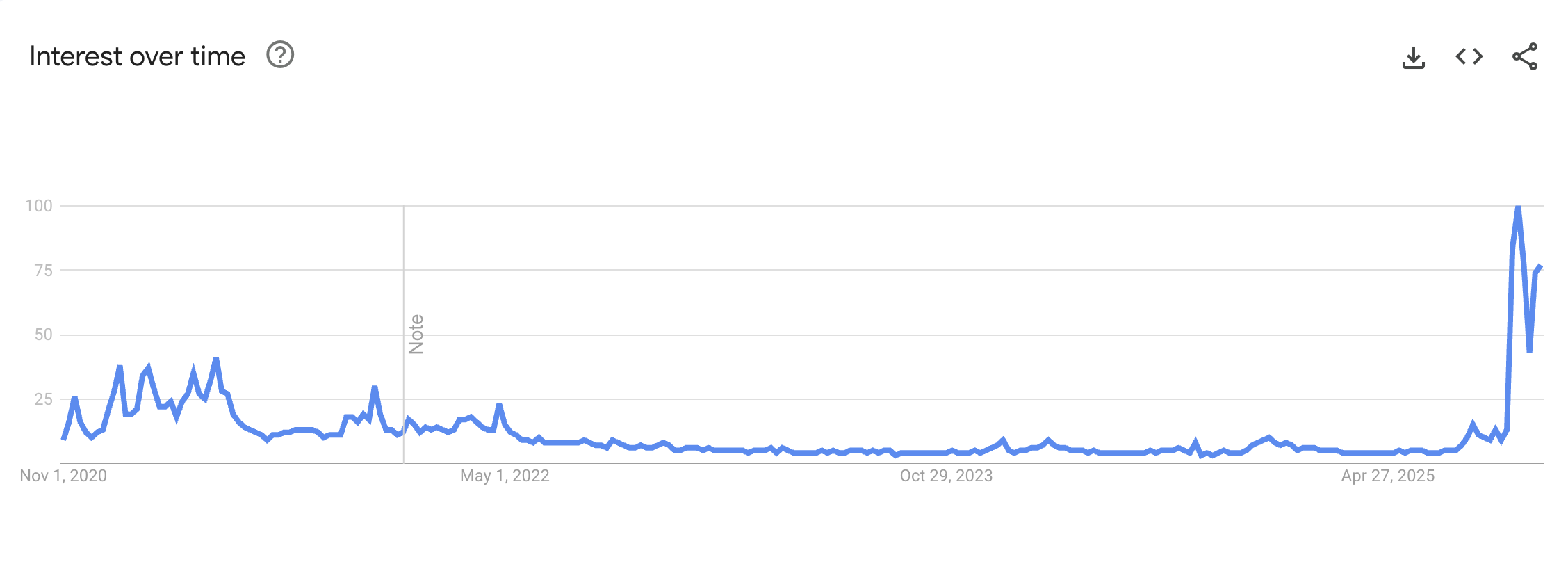 Market Interest in Zcash. Source:
Google Trends
The change was also evident in the price. In early October, Grayscale’s launch of its Zcash Trust pushed the altcoin to a 3-year high. Notably, the rally has since continued.
Even as the broader market crashed amid tariff-driven fears, ZEC continued to rally, reaching multi-year highs. The coin has appreciated by over 500% since last month.
Moreover, CoinGecko data showed that in November, ZEC even overtook Monero (XMR) to become the largest privacy coin by market capitalization.
Zcash’s rally did not occur in isolation. Its resurgence coincides with Bitcoin’s growing institutional adoption. While this shift has legitimized the asset class, it has also reignited an old philosophical divide on privacy within the crypto community.
In its latest report, Galaxy Digital highlighted that critics express frustration over Bitcoin’s growing institutionalization. Since the approval of spot Bitcoin exchange-traded funds (ETFs) and the emergence of digital asset treasury firms, firms such as BlackRock, Fidelity, and others have become dominant players in the Bitcoin market.
This has led to record inflows and supported price growth. Yet, it has raised concerns that Bitcoin, once a symbol of financial sovereignty, is becoming Wall Street’s crypto.
“Many Bitcoin critics lament the ‘institutionalization’ of Bitcoin, calling it ‘dominated by ETFs’ and centralized custodians. Bitcoin itself has always been fully transparent; ETFs haven’t made it any less so, only more intermediated,” Galaxy Digital’s research analyst, Will Owens wrote.
For many, Zcash represents the other side of the Bitcoin story — a network designed to preserve financial privacy while maintaining decentralization.
“Zcash’s advocates, by contrast, frame it as ‘encrypted Bitcoin,’ a return to cypherpunk principles that resonate amid widespread on-chain surveillance by everyone from analytics vendors like Chainalysis to social media sleuths (ZachXBT and Lookonchain, among others),” Owens added.
This renewed focus on privacy is especially critical now, as investors grow increasingly concerned about the visibility of their on-chain activity. Galaxy Digital’s report noted that while Zcash’s technical fundamentals have remained largely the same, the perception of its privacy technology has evolved dramatically — from niche to necessary.
Supporting this trend, data from a16z’s 2025 State of Crypto report revealed a sharp increase in Google searches for privacy-related topics, underlining growing public awareness and concern over financial anonymity.
“Zcash’s sudden +700% move appears to reflect broader cultural shifts within crypto….This rally is driven by both constant vocal support from some of crypto’s top voices and also a reminder of how important privacy is for permissionless money,” the report read.
Zcash’s recent surge demonstrates substantial demand for privacy-centric coins. Whether this momentum leads to sustained growth or marks another market cycle remains to be seen.
Disclaimer: The content of this article solely reflects the author's opinion and does not represent the platform in any capacity. This article is not intended to serve as a reference for making investment decisions.
You may also like
Evaporating nearly 40 trillion yen and with its market value down to one-third: Kioxia falls from Japan's number one, AI storage narrative faces double backlash
The main pressure comes from two fronts: the return on capital expenditure in AI is being questioned, compounded by the accelerated expansion of Chinese manufacturers, impacting global NAND price expectations. Further downside risks are amplified by Bain Capital's reduction of its holdings and high retail leverage positions. The earnings report at the end of October will serve as a critical validation point, but analysts are still projecting an expected return of 118%.

Amp Price Prediction: AMP Rallies 29% in a Week as Strong Momentum Meets Selling Pressure


US Stocks Last Week: Institutions Set Record for "Selling", Retail Investors Set Record for "Buying the Dip"
Last week, hedge funds recorded the largest net sell-off in the TMT sector in history, with net exposure dropping to the 0th percentile. However, at the same time, retail investors made record purchases through leveraged ETFs, with SOXL alone absorbing $7 billion. The issue is that the overall institutional exposure remains as high as 213.9%. In other words, fund managers opted for hedging rather than genuinely deleveraging and exiting the market.
Crypto prices
More


