
Canada Takes a Major Step Toward Regulating Stablecoins

Canada is finally drawing clear lines around how stablecoins will operate within its financial system. The 2025 federal Canada budget unveiled a plan to introduce national legislation that regulates fiat-pegged stablecoins, aiming to make them safer for consumers and more transparent for businesses. This move follows months of discussions between government officials, regulators, and industry players—and reflects Canada’s growing intent to catch up with global efforts to bring order to the digital asset economy.
The proposed framework is designed to balance innovation with accountability, ensuring that stablecoins don’t undermine financial stability or national security. Here’s what Canada’s new approach means for the industry, the economy, and the broader global crypto landscape.
Stronger Oversight for Stablecoin Issuers
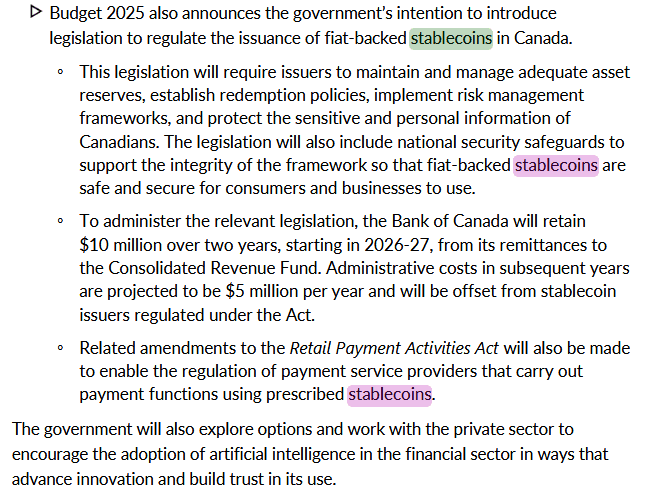
The new legislation will require stablecoin issuers to hold adequate reserves, establish clear redemption policies, and implement robust risk management frameworks. It will also enforce strict privacy measures to protect users’ personal data. According to the budget, these measures are meant to ensure fiat-backed stablecoins remain secure, trustworthy, and fully redeemable. National security safeguards will be embedded into the framework to prevent misuse or systemic risks.
The Bank of Canada’s Role and Cost Recovery
To manage the framework, the Bank of Canada will retain $10 million from its Consolidated Revenue Fund remittances across two fiscal years starting in 2026–27. After that, ongoing costs—estimated at around $5 million annually—will be covered by fees from regulated stablecoin issuers. This model ensures the regulation is self-sustaining, shifting the cost burden from taxpayers to industry participants.
Expanding the Regulatory Net
In parallel, the government plans to amend the Retail Payment Activities Act to cover payment service providers that use stablecoins. This will close existing gaps in oversight and ensure that both traditional and digital payment systems operate under consistent regulatory scrutiny.
Behind the scenes, officials from the Department of Finance and other agencies have been engaging in deep talks with stakeholders to define stablecoin classifications and avoid capital flight toward U.S.-based tokens . While the final decisions on classification weren’t revealed, the consultations show that Canada is taking a collaborative, measured approach.
Encouraging Safe Digital Innovation
The Canada budget message is clear: innovation is welcome—but it must be safe. The legislation aims to create a trustworthy environment for fintech growth while maintaining strong consumer protections. By introducing clear rules and accountability measures, the government hopes to support responsible development of digital assets rather than stifle it.
Canada Joins a Global Regulatory Trend
Canada’s move comes on the heels of the United States passing the GENIUS Stablecoin Act in July, a law that’s already shaping the global conversation around fiat-backed digital assets. Europe’s Markets in Crypto-Assets (MiCA) regulatio n is already in force, while Japan and South Korea are developing their own frameworks.
With over $291 billion worth of stablecoins in circulation—mostly pegged to the U.S. dollar—the competition to regulate is heating up. Analysts at Standard Chartered even predict that up to $1 trillion could flow from emerging market bank deposits into U.S. stablecoins by 2028.
What It Means Going Forward
For Canada, this isn’t just about control—it’s about credibility. By introducing regulation now, the country is positioning itself as a responsible player in the digital finance space. If executed effectively, the framework could enhance investor confidence, attract legitimate innovation, and solidify Canada’s reputation as a forward-thinking but cautious regulator in the age of digital currencies.
Disclaimer: The content of this article solely reflects the author's opinion and does not represent the platform in any capacity. This article is not intended to serve as a reference for making investment decisions.
You may also like
 VIPAI Asset Sell-Off and Selective Rotation in Crypto
1. Technology stocks fell sharply as investor interest shifted toward energy and selected defensive assets. From October 10 to 16, the Nasdaq 100 declined 5.49% and the S&P 500 fell 1.95%, while the Dow gained 0.67% and WTI crude rose 10.41%. BTC, ETH, and SOL declined 1.27%, 2.65%, and 4.44%, respectively. This week's technology earnings will be an important test of whether revenue growth, margins, and cash flow can justify current valuations. Better-than-expected results could help stabilize markets in the near term. 2. Crypto continues to see pockets of strong activity, but a broad-based altcoin season has yet to materialize. CoinMarketCap's (CMC) Altcoin Season Index stood at 54 as of the October 18 UTC daily observation, below the altcoin-season threshold of 75, while BTC dominance rose to 60.08%. Our proxy leverage ratio fluctuated between 4.00 and 4.07 during the week, showing no sustained increase and suggesting limited appetite for additional leverage. Meanwhile, as major exchanges expand access to traditional financial assets, the recent sell-off in AI-related equities could attract short-term speculative capital away from crypto. Such capital rotation could make it more difficult for a new altcoin season to take hold. 3. Papertrade's loss-to-mine model has generated significant interest across the crypto community. The protocol combines high-leverage derivatives trading with zero slippage and a mechanism that rewards trading losses with PAPER tokens. Across the eight complete UTC days from October 10 to 17, cumulative reported revenue reached approximately $56.08 million, including $51.90 million distributed to token holders. With growing participation from key opinion leaders (KOLs), Papertrade has reportedly ranked among the top three platforms by profitability in the broader market recently. Assets to watch: BTC, ETH, SOL, ARB, OP, SKHYNIX, SKHY, META, TSLA, LRCX, and SPCX. Key research priorities this week: Cash flow performance in technology earnings; the relative discount and holding costs of the two SK Hynix contracts; and U.S. initial jobless claims and PMI data. Weekly market data cover the period through October 16, while research information was verified through October 18. Observation periods are specified separately for each chart.

Why Bernstein Thinks the AI Stock Sell-Off Could Help Small Caps

Morgan Stanley Builds Crypto Lab to Test Stablecoins, Tokenization and DeFi at Scale

Top 4 Earnings Reports This Week: What Tesla, Meta, SpaceX, Netflix Must Show

Crypto prices
More


