
AI quietly invades—can cryptography be the last line of defense?

Cryptography-supported proof of humanity may enable us to regain genuine communication and better understand the real thoughts and feelings of actual people.
Cryptography-backed proof of humanity may allow us to regain genuine communication and once again understand what real people think and feel.
Written by: Byron Gilliam
Translated by: AididiaoJP, Foresight News
Online surveys are facing a severe "AI bot" crisis. Today, as many as 30% of survey responses come from AI-driven automated programs rather than real humans. These "AI bots," motivated by monetary rewards or aiming to manipulate public opinion and interfere with elections, are polluting data on a large scale, rendering research results in fields like economics, public health, and political science—which rely on such surveys—on the verge of becoming invalid.
In the long run, blockchain-based cryptographic technology (cryptographic proof of humanity) may be the only way to rebuild genuine communication. It can verify that there is a real human on the other end of the network, allowing us to once again hear the voices of "real people" rather than machine simulations.
Sometimes you need to know what real humans think, not simulated human answers.
"We found that the greatest enemy of communication is the illusion of communication."
— William Whyte
The latest online survey research shows that AI bots exhibit a particular preference for "high-risk behaviors."
This is what AI bots claim in questionnaires. But self-reported survey results are not reliable—who knows how these AI bots actually operate in private?
Regardless, this has become a serious problem: AI is making it increasingly difficult for us to understand what people are really doing.
Researchers in economics, public health, consumer behavior, and political science have always relied on surveys to understand human behavior.
Now, as no one answers phone calls, these surveys have moved entirely online.
But it turns out that AI is more enthusiastic about participating in online surveys than humans.
Why are they so active?
Money is the primary motivation.
To address the declining response rate, researchers have started paying internet users to answer questions, with each questionnaire sometimes offering up to $5.
This has led to a new problem: residents of low-income countries impersonating respondents from high-income countries, since $5 is still quite substantial in those regions.
Completing a $5 survey takes 15-20 minutes, and if one keeps searching for paid surveys to make money, the hourly wage is actually not ideal.
But for AI, the entire process takes only a few seconds, and the $5 reward far exceeds the cost of a few seconds of data center computation.
More concerning is that bots may distort polls to interfere with elections or deliberately create information gaps to disrupt geopolitical rivals.
Whatever the motivation, data shows that AI now accounts for 30% of online survey responses, a proportion sufficient to render survey results meaningless.
Even more severe is that 37% of web traffic comes from malicious "attack bots."
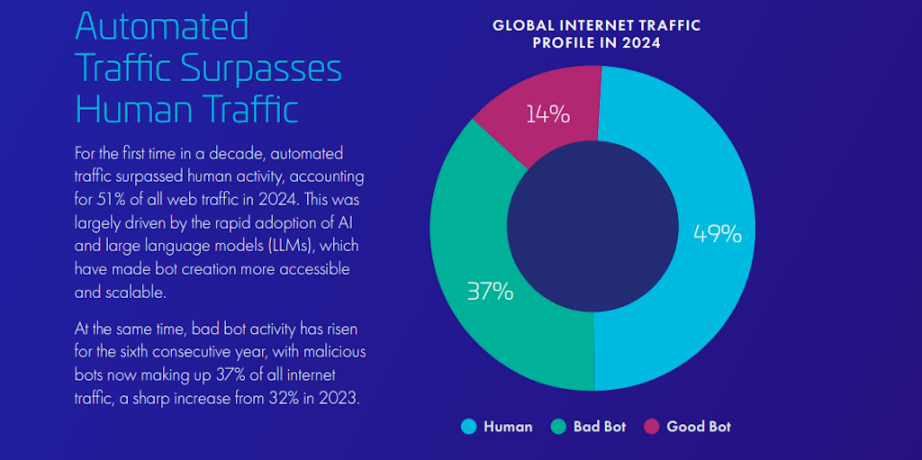
With such a massive scale of malicious bots, and CAPTCHA protections already failing, the $120 billions market research industry is facing a serious blow.
Researchers can still adopt other defensive strategies: for example, setting "decoy questions" invisible to humans to screen out AI, or filtering out abnormal responses.
But ultimately, this is a cat-and-mouse game—bots will eventually adapt to new rules.
A more thorough solution is to give up on finding real human respondents: the "artificial society" project directly replaces human survey subjects with trained bionic AI.
By using professionally designed predictive bots to replace malicious (or random) bots, "a collection of AI agents can complete experiments in minutes that would otherwise take months."
This approach is effective for testing new marketing campaigns or predicting how Midwest audiences will accept new potato chip flavors (like pumpkin spice).
But what about major events like presidential elections?
This is a question worth pondering: current phone survey response rates have dropped below 5%, and online questionnaires have become the core method for answering the following questions:
1) Voter intentions
2) Voting motivations
The astonishing accuracy of prediction markets in forecasting elections often leads people to believe that traditional polls are no longer necessary.
But prediction markets themselves still rely on poll data: the French trader who made Polymarket's Trump prediction so accurate did so only after obtaining exclusive poll data.
These polls are, of course, conducted online. At this rate, by 2028, such data may become completely invalid due to bot pollution, and prediction markets will collapse as a result.
More importantly, if polling agencies cannot understand voters' motivations, politicians will find it even harder to truly represent public opinion.
Building a collection of AI agents is unlikely to help—how can they capture the ever-changing thoughts of humans?
AI can only be trained on existing data, while the most critical variables in elections are precisely those new pieces of information that make each election unique.
For major matters like presidential elections, only direct communication with real people is reliable.
Perhaps soon, we will be left with only one last line of defense: blockchain-based cryptographic technology.
The adoption of cryptographic proof of humanity has been disappointing. For example, Worldcoin's iris scanning solution has attracted few users, perhaps because the public doesn't care whether online content is produced by humans or machines.
But survey designers care: sometimes, you must know what real humans think, not simulated human responses.
If online surveys are a form of mass communication, then AI-simulated surveys are merely an illusion of communication.
Cryptography-backed proof of humanity may allow us to regain genuine communication and once again understand what real people think and feel (to the extent that was ever possible).
This technology needs to reach near-universal adoption: conducting surveys only among those who exchange iris scans for tokens clearly lacks broad representativeness.
At the same time, enough trust must be established so that we dare to disclose private behaviors to a sufficiently secure and private system.
But until that day arrives, effective communication between humans may become increasingly difficult.
Disclaimer: The content of this article solely reflects the author's opinion and does not represent the platform in any capacity. This article is not intended to serve as a reference for making investment decisions.
You may also like
When France and Germany pay for their deficits, fiscal discipline becomes the "moat" of the UK bond market; investors are positioning in advance for a rebound in gilt bonds.
Investors are betting that the new UK Chancellor, Healey, will uphold fiscal discipline and are purchasing gilts in advance. A smooth and steady budget plan is expected to turn the UK from a "risk" in the bond market into a "positive."
Anthropic's $2 Trillion IPO Faces Doubts: Risks of Mismatched Computing Commitments and Revenue
The independent institution New Constructs reported that the Anthropic IPO is absurd, with a valuation of only 150 billion. The main controversy lies in the mismatch between long-term computing power commitments and clients' short-term on-demand procurement models, coupled with macroeconomic headwinds and early investor sell-off pressure, leading to increased market volatility.

Anthropic allocates 5% of shares to set up a fund before IPO, Musk calls for direct distribution to the public
Anthropic announced the establishment of a public welfare fund, initially allocating 5% of its shares. When the company's valuation increases by 50%, another 2% will be added. The aim is to address the impact of AI on employment. Musk suggested directly distributing shares to the public.

AI Stocks Struggle to Rebound: Lacking Three Major Supports, July’s Rally Hard to Replicate
JPMorgan pointed out that due to the absence of ETF bargain-hunting funds, limited room for short covering, and the early termination of the $40 billion buyback by Samsung and SK Hynix, the rebound strength of AI stocks in October may not match that of July. The resurgence of leverage risk could intensify volatility.

Crypto prices
More


