
Fed Faces a Pivotal Choice: Managing Liquidity or Controlling Inflation
- Fed may expand balance sheet to address liquidity needs amid shrinking reserves, signaling potential end to 3-year QT program. - Officials pause QT as $6.6T reserves deemed "somewhat above ample," but warn of risks from inflation above 2% target and market volatility. - Governor Mester cautions against aggressive rate cuts, citing economic rebound risks and fiscal/regulatory factors boosting 2026 growth outlook. - External pressures including government shutdown delays and stablecoin demand growth compli
The Federal Reserve is at a critical crossroads as it works to strike a balance between ensuring sufficient liquidity and keeping inflation in check. In a recent speech, John Williams, President of the New York Fed, discussed the possibility that the central bank could soon move to increase its balance sheet—a step that would mark a departure from its prolonged period of quantitative tightening (QT).
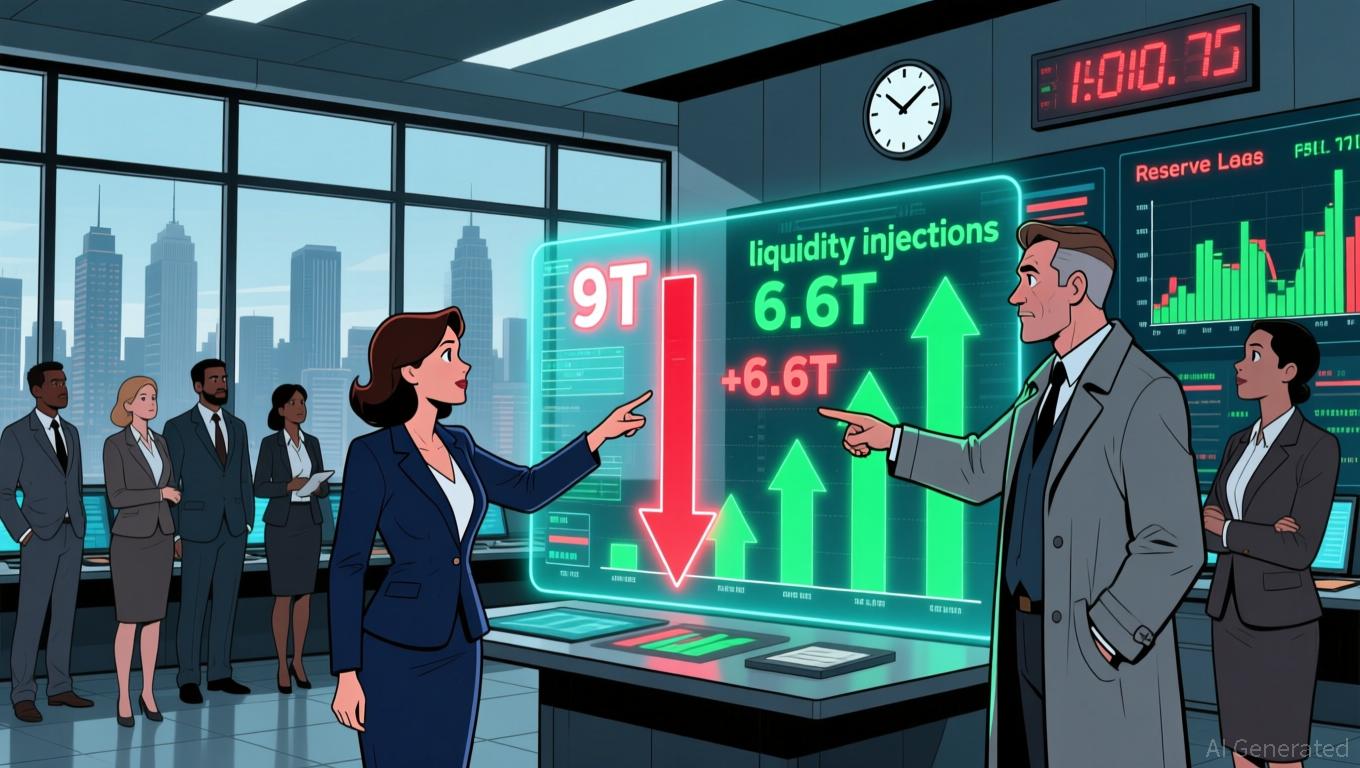
The Fed’s recent decision to halt QT, announced last week, signals its view that current reserve levels are adequate to keep money markets steady without providing too much stimulus. Williams stated that the three-year process of reducing the balance sheet “has gone as planned,” but he also emphasized the need to keep a close watch on market shifts to identify when reserves might reach “ample” territory
Elsewhere, Federal Reserve Governor Loretta Mester has urged caution regarding aggressive rate cuts in December, suggesting that the economy is set for a recovery in early 2026. Mester cited factors such as government spending, regulatory adjustments, and the delayed impact of earlier rate hikes as key influences. However, she cautioned that further rate reductions could risk overheating the economy, especially since inflation remains above the Fed’s 2% goal. Her remarks reflect a broader hesitancy among policymakers, who have indicated a preference for a gradual approach to loosening policy
The Fed’s efforts are further complicated by outside influences, including geopolitical tensions and unpredictable markets. For example, the recent U.S. government shutdown interrupted the release of economic data, making the Fed’s policy decisions more challenging. Analysts at First Abu Dhabi Bank observed that such disruptions could prompt the Fed to postpone rate cuts in December to maintain its policy credibility
Market responses to these developments have been varied. While the Fed’s pause in QT has brought some stability to money markets, digital assets have seen significant outflows, with
As the Fed looks ahead to its next policy meetings, attention will remain on how effectively it can address these complex challenges while upholding its dual mandate of price stability and full employment. The way forward will depend on ongoing evaluations of reserve requirements, market dynamics, and the shifting economic environment.
Disclaimer: The content of this article solely reflects the author's opinion and does not represent the platform in any capacity. This article is not intended to serve as a reference for making investment decisions.
You may also like
What Did Jack Dorsey Mean by “There Is No Moat”? Elon Musk and Michael Saylor Weigh In

Big Week Ahead: Ripple Heads to NYC With Wall Street Heavyweights

 VIPOil Risk Premiums and rToken Dividend Arbitrage Strategies
1. This week we focus on cross-asset positioning under an energy shock and arbitrage opportunities in tokenized-stock cash dividends. We recommend assessing market direction separately from income sources. Higher oil can weigh on growth valuations, lift inflation expectations, and spark expectations of Fed rate hikes, putting pressure on equities and crypto. 2. rToken net cash dividends can be distributed separately, but buying spot, shorting a perpetual, and holding across the record date does not automatically create an arbitrage. First confirm ex-dividend eligibility, platform snapshots, after-tax amounts, and the corporate-action rules for the short leg. Then compare funding fees, spreads, and execution costs. A dividend arbitrage strategy can be applied to STRC. 3. Next week's Fed decision and major technology earnings are key. Lower policy uncertainty can help restore risk appetite, but a sustained rebound still needs confirmation from rates, cloud growth, capital expenditure, and free cash flow. Our base case is a monthly-timeframe rebound in risk assets and crypto as earnings season, the Fed meeting, and the midterm elections pass and uncertainty recedes. Assets in focus: BTC, ETH, SOL, WTI, ASML, MSFT, GOOG, AMZN, CAT, and STRC

Goldman Sachs Names One Trade to Hedge an AI Market Shock

Crypto prices
More


