
Banmu Xia's forecast for the next two years: Bitcoin enters the early stage of a bear market, while the upward cycle of U.S. stocks is far from over.

The real massive liquidity injection may not happen until May next year, after Trump gains control of the Federal Reserve, similar to what happened in March 2020.
Original Title: "Logic Behind the Forecast for the Next Two Years"
Original Author: Ban Muxia, renowned trader
Preface
Those who have read my 2023 Weibo mid-term strategy sharing may remember that my market forecasting framework is "cycle + liquidity (expectation) + technical patterns." Later, after adding Elliott Wave Theory to the technical analysis layer, the issues at the cycle level became even clearer. After more than a year of refinement, now by integrating Elliott Wave Theory into the previous analytical framework, the accuracy rate of predictions in my own trading log can exceed 60%. Therefore, I would like to share with you the market forecast for the next two years formed by this analytical framework.
1. Cycle
Bitcoin has ended its traditional 4-year cycle and entered the early stage of a bear market. The recent explosive rallies of many old altcoins also confirm this point. At the end of every bitcoin bull market, old altcoins always experience a super rally. However, this bear market cycle is likely to be greatly shortened due to the arrival of the US stock AI bubble.
Gold is in the midst of a major cycle of transition between old and new monetary systems. As long as this transition cycle is not over, gold will continue to rise. Therefore, after this round of correction, gold can continue to be held long-term for 10 years.
The US stock cycle is basically the US debt cycle. According to the views of several economic experts, the US debt cycle has entered its later stage but is not over yet, because the key overheating indicators have not yet appeared, although there are already some signs of overheating.
Will this AI revolution definitely create a bubble? Almost certainly, because every major technological revolution sees participants afraid of missing out, leading to excessive capital expenditure, even heavy borrowing, and the start of storytelling.
The above forms the basis for a very bullish outlook for the next two years.
2. Liquidity (Expectation)
In terms of liquidity, only the US liquidity situation is considered. Recently, due to government shutdowns and ongoing balance sheet reduction, US liquidity has been extremely tight. The SOFR-RRP spread has reached levels seen during the COVID-19 period, which may also be part of the reason for the recent declines in US stocks and bitcoin. Therefore, I am not optimistic about the near-term US stock and bitcoin markets.
However, the US government shutdown is about to end, which will ease the recent liquidity crunch. Under this expectation, the market has rebounded rapidly. But this is only an improvement and does not constitute the conditions for a continued bull market.
Starting in December, the Federal Reserve will stop reducing its balance sheet and is very likely to resume expansion. At that time, the liquidity environment for US stocks and bitcoin will improve significantly. But this is just a return to normal liquidity, similar to October 2019. The real massive liquidity injection may not come until next May, after Trump takes control of the Federal Reserve, similar to March 2020.
The above forms the basis for expecting market volatility in the short term, modest upward movement in the mid-term, and a significant rally in the long term.
3. Technical Analysis
Bitcoin:
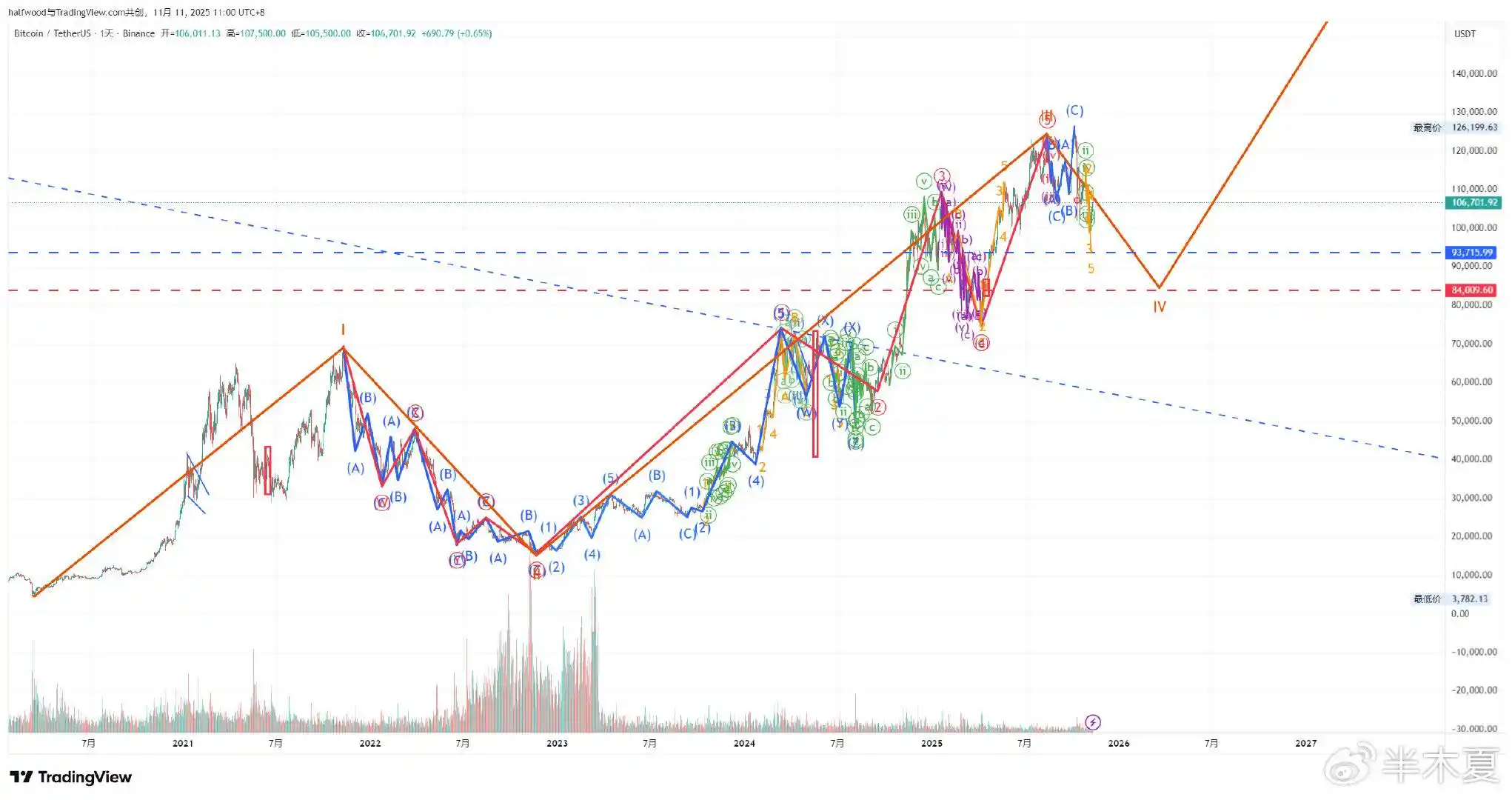
As shown in the chart, bitcoin is in a large-scale wave 4 correction (the mainstream view is that wave 1 should start from the inception of bitcoin, but here I take the low point on March 12, 2020 as the starting point for wave 1, as this does not affect subsequent analysis, so I have not changed it). Generally, wave 4 is a sideways correction, especially when wave 2 was a steep correction. This is why I expect bitcoin to move sideways in the coming months. Combined with the analysis of cycles and liquidity, there is also no support for a deep decline in bitcoin.
The judgment on the low point of this bitcoin bear market cycle and the high point of the next bull market cycle can be found in my Weibo post on November 3.
Gold:
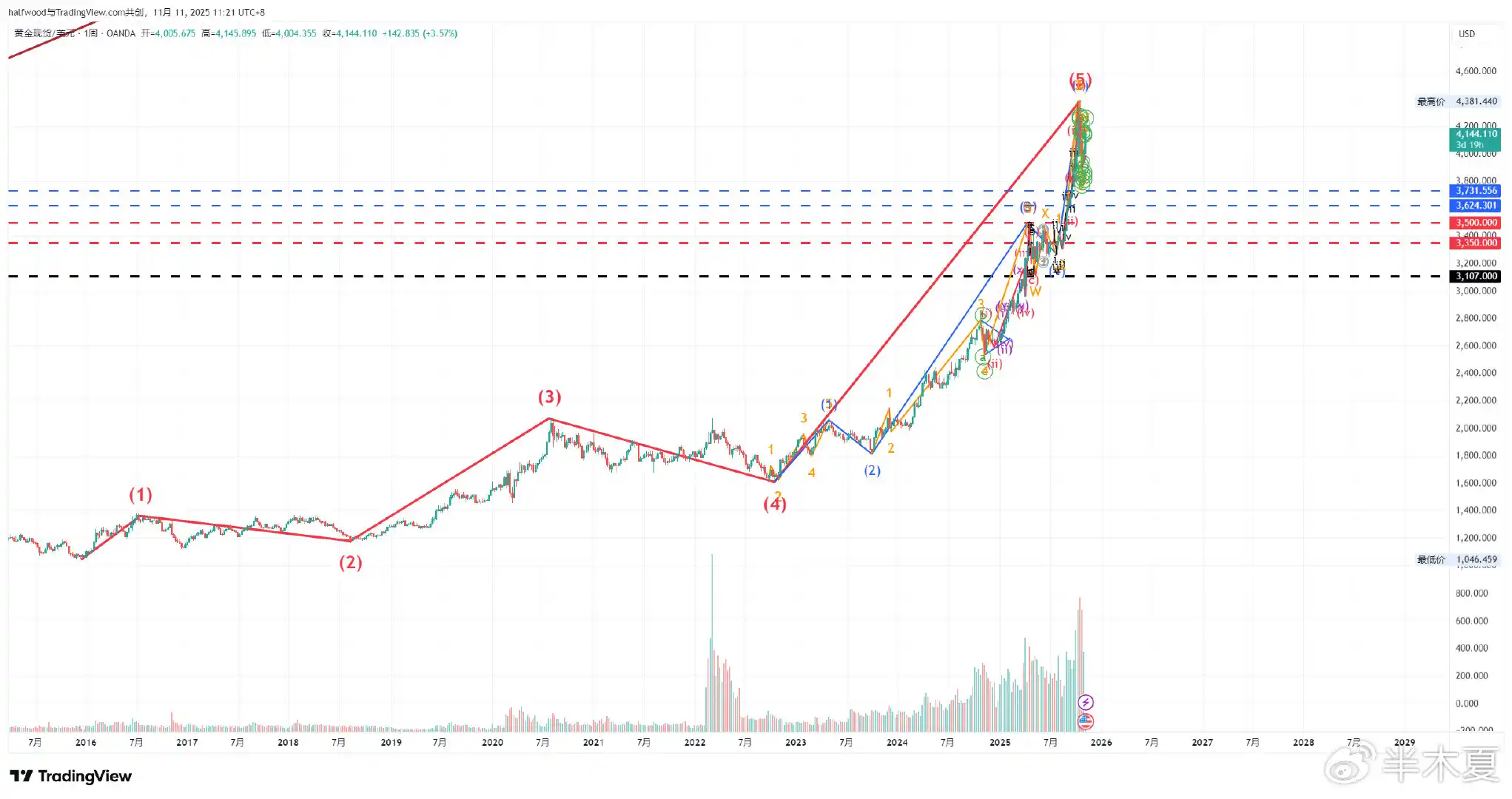
As shown in the chart, gold is in a correction against a 10-year bull market. Corrections of this magnitude are unlikely to be completed within two or three weeks. However, since gold is in the major cycle of transition between old and new monetary systems, with continued purchases by emerging market central banks as support, the magnitude of this correction cycle for gold will not be too large.
Therefore, the 0.382 retracement level at 3100 can be used as a target in extreme cases. More likely, the end of the correction will be found between 3350 and 3750. If you are afraid of missing out on the next 10-year rally in gold, you can buy directly below 3750.
US Stocks:
The correction in US stocks is the most uncertain, but as the upward cycle is far from over, every correction is a buying opportunity.
The AI bubble will definitely come, but will it definitely burst? This may be the fate of every early stage of a technological revolution. Companies that borrow heavily and engage in high-leverage mergers and acquisitions for fear of missing out may see low capital returns in the early stages of the technological revolution due to an immature market. Once this becomes apparent, the story may start to show cracks. If the Federal Reserve then tightens monetary policy due to excessive liquidity causing inflation to rise, the bubble will burst.
There are several indicators that can serve as a basis for exiting during the future bubble period: 1. Sky-high mergers and acquisitions occur. 2. Inflation rises, and expectations for the Federal Reserve to tighten monetary policy increase significantly. 3. Any AI-related stock soars, and valuations become extremely exaggerated.
Of course, it does not mean you should sell immediately when these events occur, but rather start to be vigilant, enjoying the bubble while also preparing a profit-taking plan.
Disclaimer: The content of this article solely reflects the author's opinion and does not represent the platform in any capacity. This article is not intended to serve as a reference for making investment decisions.
You may also like
Report: SK Hynix Plans to Launch KRW 50-60 Trillion Shareholder Returns, Setting a Historic Record
According to Seoul Economic Daily, SK Hynix plans to announce an additional shareholder return plan of 50 to 60 trillion Korean won, mainly through special dividends, when it releases its Q3 report on October 28. Including the previously completed share buybacks and cancellations, the total shareholder return for this year will reach a record 90 to 100 trillion Korean won.
The UK plans to issue more short-term bonds, which may lower gilt yields, and investors are also watching closely to see if the Autumn Budget can maintain fiscal discipline.
The UK is set to increase its use of short-term debt. This shift could lower yields on UK government bonds and alleviate the country's increasingly strained public finances. Meanwhile, the potential market reaction to the upcoming autumn budget remains a risk factor for the British bond market.
Tech Earnings Week Arrives: US Stock Market Pre-Market - SK Hynix Rises Over 1%, Petrobras Falls Over 20%, Oil Prices Retreat, US Treasury Bonds Strengthen
Before the U.S. market opens, SK Hynix rises over 1%. The company plans to distribute a special dividend of $12.1 billion, using proceeds from the sale of its Kioxia equity to reward shareholders. U.S.-listed Neocloud companies generally fell before market open: Nebius dropped 4.5%, CoreWeave fell 4.4%, and Iren decreased 4.1%. Petrobras ADRs dropped over 20% before market open, while Itaú Unibanco fell more than 27%. Brent crude retreated 1.5% from a six-month high, currently trading at around $114.95 per barrel.
Cybercab goes viral, Berlin factory achieves record production! Behind the Tesla (TSLA.US) buzz, Phillip Securities still sees a 38% downside
Tesla (TSLA.US) rose nearly 1% in pre-market trading on Monday, following a series of events including the intensive debut of the Cybercab at the Austin F1 circuit, a production milestone at the Berlin factory, and the release of new details about the Roadster.

Crypto prices
More


