
Crypto: BitMine crosses the milestone of one million ETH staked on Ethereum

Sharplink is accelerating its pace in the race for digital finance, but BitMine is not far behind. Tom Lee’s company is quietly establishing itself as a key player in Ethereum, the favored asset of finance giants. Gone are the days when Bitcoin grabbed all the attention. Behind the scenes of the crypto sphere, Ethereum now attracts the eyes of strategists, funds, and visionaries. And BitMine plays its part with an ambition beyond mere speculation.
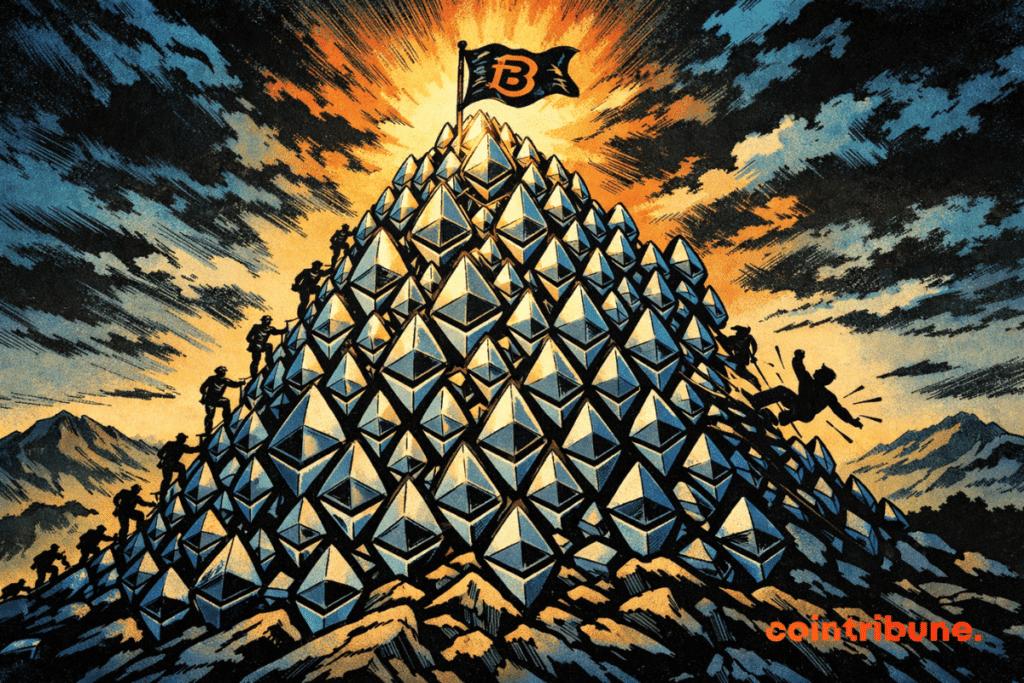
In brief
- BitMine holds more than four million ETH, including one million now staked.
- Annual yield reaches about three percent according to crypto analyses.
- Tom Lee wants to transform BitMine into a bridge between blockchain and traditional finance.
- Massive staking reduces liquidity and strengthens Ethereum scarcity in the market.
From Bitcoin to Ethereum: BitMine’s new score
BitMine Immersion Technologies is no longer the mining company it used to be. Under Tom Lee’s leadership, it has swapped its Bitcoin farms for a colossal digital treasure in Ethereum. The company has reached a symbolic milestone: over one million ETH staked. A landmark that places it among the world’s top Ethereum treasuries, holding over 4 million ETH in total.
For Lee, this strategy is not a whim but a conviction:
We believe Ethereum is the future of finance — a supercycle driven by the reinvention of Wall Street on the blockchain.
This shift towards Ethereum illustrates a profound change in the crypto industry. Giants no longer just mine, they invest in productive scarcity: staking. A model where each deposited token yields returns and strengthens the network. At BitMine, the calculation is clear: build an empire based on patience, not speculation.
When Ethereum staking rewrites the rules of scarcity
Ethereum staking has changed the game. By locking an increasing share of the supply, BitMine removes over one million ETH from the market, about 3.4% of the total circulating. This movement amplifies scarcity and creates a silent upward pressure. The 86,400 ETH added in a single day, according to Lookonchain, signals long-term confidence rather than a mere bet.
On X, an enthusiastic observer summarized:
BitMine is building an Ethereum treasury and yield engine designed to grow over the long term. Wall Street has yet to grasp this.
The stakes go beyond profit pursuit: it is a power repositioning. In this crypto industry, controlling liquidity means influencing market tempo. BitMine acts like a private central bank of Ethereum, turning each locked token into a reserve asset. And as supply decreases, tension rises in derivatives, where leverage climbs over 60%. Traders are skirting the red line.
Crypto, yield and tokenization: Tom Lee’s macro bet
Since taking over BitMine in 2025, Tom Lee has orchestrated a major plan: to make his company a bridge between traditional finance and the Ethereum ecosystem. For him, staking is just a first step. The ultimate goal? To tokenize global finance on Ethereum’s blockchain.
His projections, shared on X, illustrate his faith in the asset: an ETH at $12,000 could value BMNR at $500, while an ETH at $62,000 would propel the stock to $5,000.
This approach is not limited to speculation. It prepares for a world where company balance sheets will include productive tokens, and where the boundary between stock market and blockchain fades.
BitMine is no longer just a crypto player. It is a company that, with staking and vision, participates in building the future market of digital assets.
Ethereum and BitMine in a few key figures
- Current ETH price: $3,154;
- 1,080,512 ETH staked, generating about 3% annual yield;
- 4 million ETH in BitMine’s treasury (≈ 3.4% of total supply);
- 80% drop in BMNR price since 2025 despite staking expansion;
- Declared goal: 5% of Ethereum’s total supply in the long term.
Fusaka, recently activated, has breathed new life into the Ethereum ecosystem. This deployment revitalized the community and attracted new investors. There’s now talk of a 110% increase in the number of Ethereum holders. A statistic that confirms one thing: the network is growing, enriching, and attracting. BitMine’s story fits into this global movement of trust and expansion.
Maximize your Cointribune experience with our "Read to Earn" program! For every article you read, earn points and access exclusive rewards. Sign up now and start earning benefits.
Disclaimer: The content of this article solely reflects the author's opinion and does not represent the platform in any capacity. This article is not intended to serve as a reference for making investment decisions.
You may also like
MSTR stock falls 6.8% in 2026 despite Strategy’s $20.9B Q3 income – Why?

Bank of Japan shifts to “anti-inflation” mode! Kazuo Ueda hints at further room for rate hikes, December move under watch
The Bank of Japan kept its policy rate unchanged at 1.25% on Friday, but Governor Kazuo Ueda's remarks at the post-meeting press conference sent policy signals that are more noteworthy than the rate decision itself.

Betting Big on AI Burns Through Cash Cows—This Time, the Market No Longer "Rewards Burning Money"!
The AI spending race faces profitability scrutiny: Google’s search advertising growth rate has dropped to its lowest in five quarters, and Amazon’s single-quarter free cash flow has plunged to -$33.5 billion. Yet both companies continue with capital expenditure plans exceeding $400 billion. As their core cash-generating businesses lose momentum and debt and financing needs surge, the market is shifting from rewarding AI investment to questioning returns, forcing a re-evaluation of the valuation logic for tech giants.

Wall Street Sees AWS’s Ambition, But Can’t See the Future of Amazon’s Advertising Business
Amazon's Q3 financial report presents a mixed picture: AWS order backlog soared by 189% to $578 billion, and the CEO made the rare promise that growth will exceed 40% in 2027-2028, aiming for $1 trillion in revenue within five to ten years. However, advertising business growth plunged from 26% to 12%, and capital expenditure reached $77.3 billion, far exceeding expectations, causing the stock price to fall 7% after hours. While major Wall Street banks collectively maintain their “buy” ratings, they admit that the structural risks posed by AI agents to the advertising ecosystem remain unresolved.
Crypto prices
More


