What started as a routine question quickly turned into a heated exchange.
During a recent interview, Michael Saylor pushed back against skepticism around the growing number of companies adopting Bitcoin as a treasury asset. The interviewer questioned whether the market is becoming crowded with firms that simply issue equity or debt to buy Bitcoin, without building real businesses.
Saylor was not having it.
The interviewer acknowledged that Strategy (formerly MicroStrategy) stands in a league of its own, holding more than 650,000 Bitcoin, but argued that many smaller treasury-focused companies are struggling and trading at deep discounts, hurting shareholders.
Saylor flipped the argument on its head.
He compared Bitcoin ownership to families and individuals investing. Not everyone will own the same amount, he said, and that is fine. In his view, criticizing companies simply for buying Bitcoin makes little sense when millions of other companies do not own any Bitcoin at all.
“Why criticize the ones that bought Bitcoin,” he argued, “and ignore the hundreds of millions that did not? Why don’t you focus upon criticizing the money-losing companies that don’t own Bitcoin?”
Saylor made a clear distinction. The real problem is not Bitcoin. It is bad business.
He said companies losing money are weak, whether or not they own Bitcoin. But if a struggling company holds Bitcoin on its balance sheet, that asset can help offset operating losses over time.
To explain, Saylor offered a simple example:
- A company loses $10 million a year from operations
- It holds $100 million in Bitcoin
- If Bitcoin rises 30%, that equals $30 million in gains
In that case, Bitcoin does not increase risk, he said. It keeps the company afloat.
Saylor also criticized alternatives such as stock buybacks or Treasury bills for companies that are already losing money.
Buying back shares of an unprofitable company, he said, only accelerates failure. Parking cash in low-yield government bonds may slow losses slightly, but it does not change the outcome.
Bitcoin, in Saylor’s view, is the only option with the potential to outpace losses over time.
As the exchange grew more intense, Saylor accused critics, even within crypto, of targeting Bitcoin adopters while giving traditional companies a free pass.
He argued that some investors are more comfortable attacking Bitcoin treasury firms than questioning why many cash-burning companies without Bitcoin still attract capital.
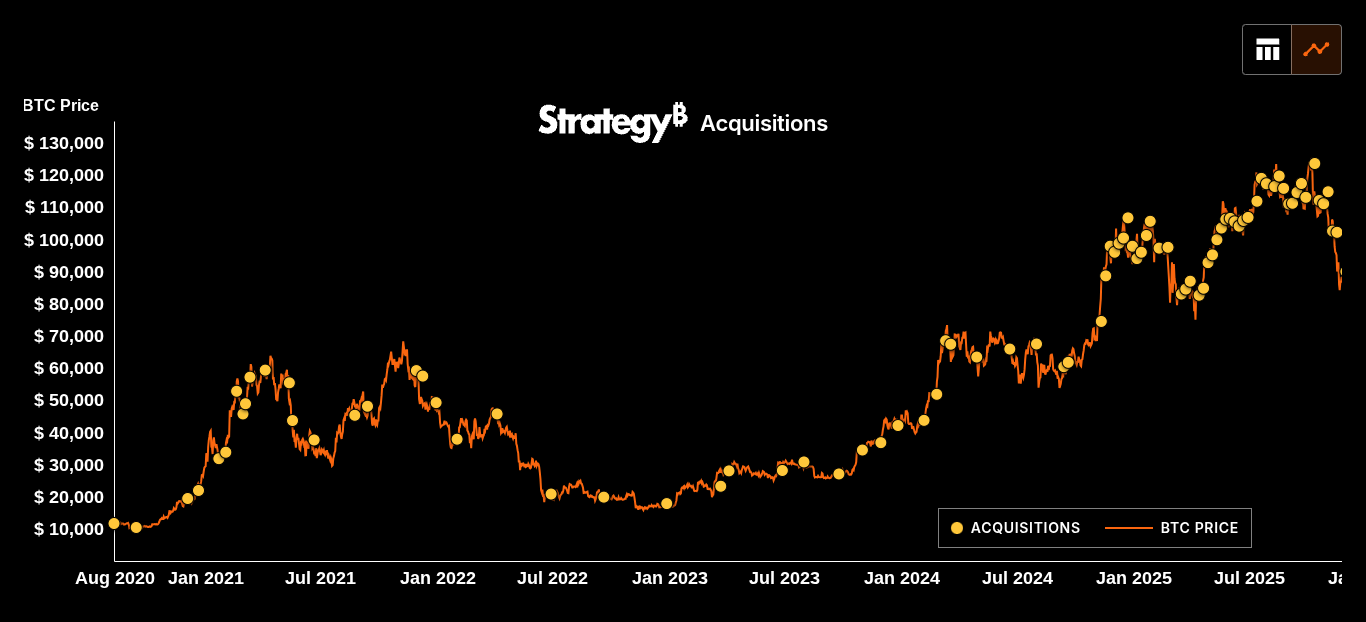
(adsbygoogle = window.adsbygoogle || []).push({});Saylor began building his Bitcoin position in August 2020, when MicroStrategy invested $250 million to buy over 21,000 BTC. The company continued buying later that year using funds raised through convertible notes, pushing its holdings past 70,000 BTC by December.
 Source:
Strategy
Over the next few years, the firm kept accumulating steadily through equity sales and other financing. By March 2025, its Bitcoin holdings crossed 500,000 BTC. Under Saylor’s leadership, the now-renamed Strategy Inc. continued aggressive purchases into late 2025 and early 2026, lifting total holdings to well over 680,000 BTC.
Related: Bitcoin Quantum Testnet Launches With NIST-Approved Quantum-Resistant Security