
Here's How Ethereum Turns a Historic Crisis into a Unique Opportunity

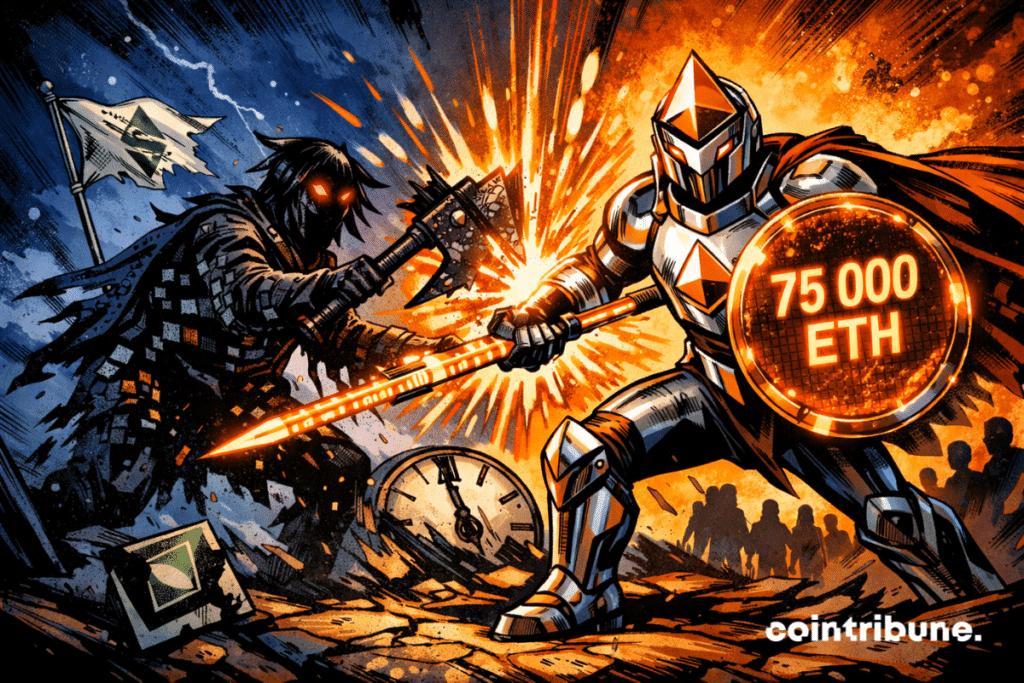
The crypto community is buzzing again and for good reason, an old DAO hack resurfaces. This time, however, Ethereum turns the situation around. By converting the forgotten ETH from an old hack into a defense tool, the crypto network gains a new shield.
In brief
- Ethereum transforms 75,000 ETH from the DAO hack into a decentralized security fund.
- The crypto fund will finance audits, tools, and responses, with community governance and no centralized control.
An Old Crypto Hack Reactivated to Secure Ethereum
Nearly ten years after the DAO hack, Ethereum transforms a major mistake into a strategic resource. Originally, this 2016 bug divided the community. It even caused a split between Ethereum and Ethereum Classic. Today, 75,000 ETH stuck in secondary contracts take on a new role: protecting the crypto ecosystem.
Valued at about $220 million, these crypto assets will be injected into a security fund. Objective: to finance audits, monitoring tools, and incident responses. Most of the assets, 69,420 ETH, will be staked to generate sustainable income. The rest will be used to pay any claims or urgent expenses.
Behind this initiative, Griff Green supports in an interview that the DAO triggered the security industry in Ethereum. Yesterday’s attack thus becomes tomorrow’s defensive foundation.
Community and Decentralized Crypto Governance
The crypto fund governance model contrasts with traditional schemes. No direct control from core developers. The community members will guide allocations via open mechanisms: ranked voting, quadratic funding, and retroactive evaluation.
A team of influential curators will also oversee this system: Vitalik Buterin, Taylor Monahan (MetaMask), and Alex Van der Sande (ENS). Their role will not be to decide, but to facilitate grant cycles led by independent operators. This decentralized dynamic reflects the initial spirit of the DAO, renamed here TheDAO.
By rehabilitating a painful episode in blockchain history, Ethereum sends a clear message. The crypto network strengthens without denying its past. This fund may well inspire other blockchains facing frozen or unused residual assets.
This revival of a crypto scandal into a security lever thus highlights the growing maturity of the Ethereum ecosystem. Other projects could follow this path by revaluing past mistakes.
Maximize your Cointribune experience with our "Read to Earn" program! For every article you read, earn points and access exclusive rewards. Sign up now and start earning benefits.
Disclaimer: The content of this article solely reflects the author's opinion and does not represent the platform in any capacity. This article is not intended to serve as a reference for making investment decisions.
You may also like
Microsoft (MSFT.US) 365 services experience second major outage this year, affecting multiple government agencies and enterprises worldwide
Despite a "partial recovery," the latest Microsoft service outage continued into Asia-Pacific business hours.
Nvidia (NVDA.US) New CEO Candidates and Market Predictions: Trump Nominates Cook as Successor
As the successor remains uncertain, external voices have already begun to "make choices" for Nvidia.
Safe haven halo fails? US Treasury sell-off returns, Wall Street just breathed a sigh of relief and is startled again
Just as global bond investors began to believe that the worst phase of this year's sell-off had passed, the surge in U.S. Treasury yields has forced them to reassess that judgment.

Before the Jensen Huang scandal broke out, the Quant King precisely cleared out Nvidia!
The latest 13F filing shows that quantitative giant Renaissance Technologies almost completely sold off its holdings in Nvidia (reduced by 99.7%), Meta (reduced by 99.9%), as well as other tech giants like Apple and Amazon in the third quarter, and significantly reduced its position in Palantir. At the same time, it heavily increased its holdings in Micron Technology (up by 618.7%), AMD, and SanDisk, as well as other storage and chip stocks.
Crypto prices
More


