ZORA has staged a sharp rebound after weeks of compression, with the price jumping over 13% to around $0.0275 while daily volume surged 42% to $57.7M.
Market capitalization climbed alongside price to roughly $123M, reflecting renewed participation rather than thin liquidity moves.
This rebound comes after an extended decline; therefore, traders appear increasingly willing to engage at these levels.
However, the move did not occur in isolation. Rising activity across spot and derivatives markets suggests a coordinated response rather than random volatility.
As buying interest picked up, Zora [ZORA] reclaimed short-term momentum, setting the stage for a broader technical reassessment.
The question now centers on whether this burst reflects genuine accumulation or short-term leverage chasing the bounce.
Buyers defend a critical long-term zone
ZORA rebounded cleanly from the $0.020–$0.028 support region, a zone that previously capped downside during earlier selloffs. Price respected this range multiple times, therefore reinforcing its structural importance.
Buyers stepped in aggressively near the lower boundary, triggering a sharp intraday expansion toward $0.028.
However, price still trades well below prior distribution highs near $0.058 and $0.10, keeping the broader trend cautious. Despite that, the current defense suggests sellers lost control at these lows.
This behavior points toward stabilization rather than capitulation. As long as the price holds above $0.024, downside risk remains contained, while repeated tests of resistance could gradually weaken overhead supply.

Source: TradingView
Directional Movement Index data shows a constructive shift in momentum as +DI rose to 36.7 while −DI dropped toward 20.9.
At the same time, ADX climbed to 26, indicating strengthening trend conditions rather than range-bound chop. This alignment suggests buyers currently dominate directional control.
However, ADX remains below extreme levels, meaning trend strength still develops rather than accelerates. Therefore, price can still experience pullbacks without invalidating the structure.
Importantly, bullish DMI alignment appeared alongside price reclaiming key support, reinforcing the validity of the move. If +DI maintains separation from −DI, upside attempts should persist even during short-term consolidation.
Spot outflows hint at quiet absorption
Spot flow data shows continued net-negative exchange flows, with recent daily outflows reaching roughly $870K even as price rebounded.
This behavior implies holders move tokens off exchanges rather than rushing to sell into strength. Therefore, sell-side pressure appears muted despite volatility.
However, inflows previously spiked during higher price levels near $0.10, highlighting how market behavior shifts with valuation.
Current conditions differ. Outflows during a rebound often signal accumulation or long-term repositioning.
While this alone does not guarantee continuation, it reduces immediate downside risk. As long as spot outflows persist, price dips may attract buyers rather than aggressive sellers.

Source: CoinGlass
ZORA: Open Interest expands into the rally
Open Interest climbed nearly 10% to approximately $26.35M as ZORA’s price advanced, signaling aggressive speculative participation.
Traders clearly added leveraged exposure rather than closing positions into the move. However, rising Open Interest introduces fragility.
If momentum stalls, forced liquidations could amplify volatility. Still, the expansion aligns with improving technical structure rather than late-stage euphoria.
Therefore, leverage currently supports momentum rather than distorts it. The key risk lies in sudden sentiment shifts.
If Open Interest keeps rising without price follow-through, instability increases. For now, derivatives activity confirms heightened conviction among active traders.

Source: CoinGlass
Liquidation clusters sit above the current price
Binance’s liquidation heatmap reveals dense short-side liquidity stacked above the $0.028–$0.029 region, while downside clusters thin near $0.024.
This imbalance suggests upside moves could trigger cascading short liquidations if price pushes higher. Therefore, short sellers remain vulnerable above current levels.
At the same time, limited downside liquidity reduces the probability of sharp selloffs unless new leverage enters.
Price already moved through several minor liquidation pockets during the rebound, confirming this dynamic.
If the price approaches $0.029 again, volatility may accelerate quickly. The structure favors upward squeezes rather than deep flushes under current conditions.
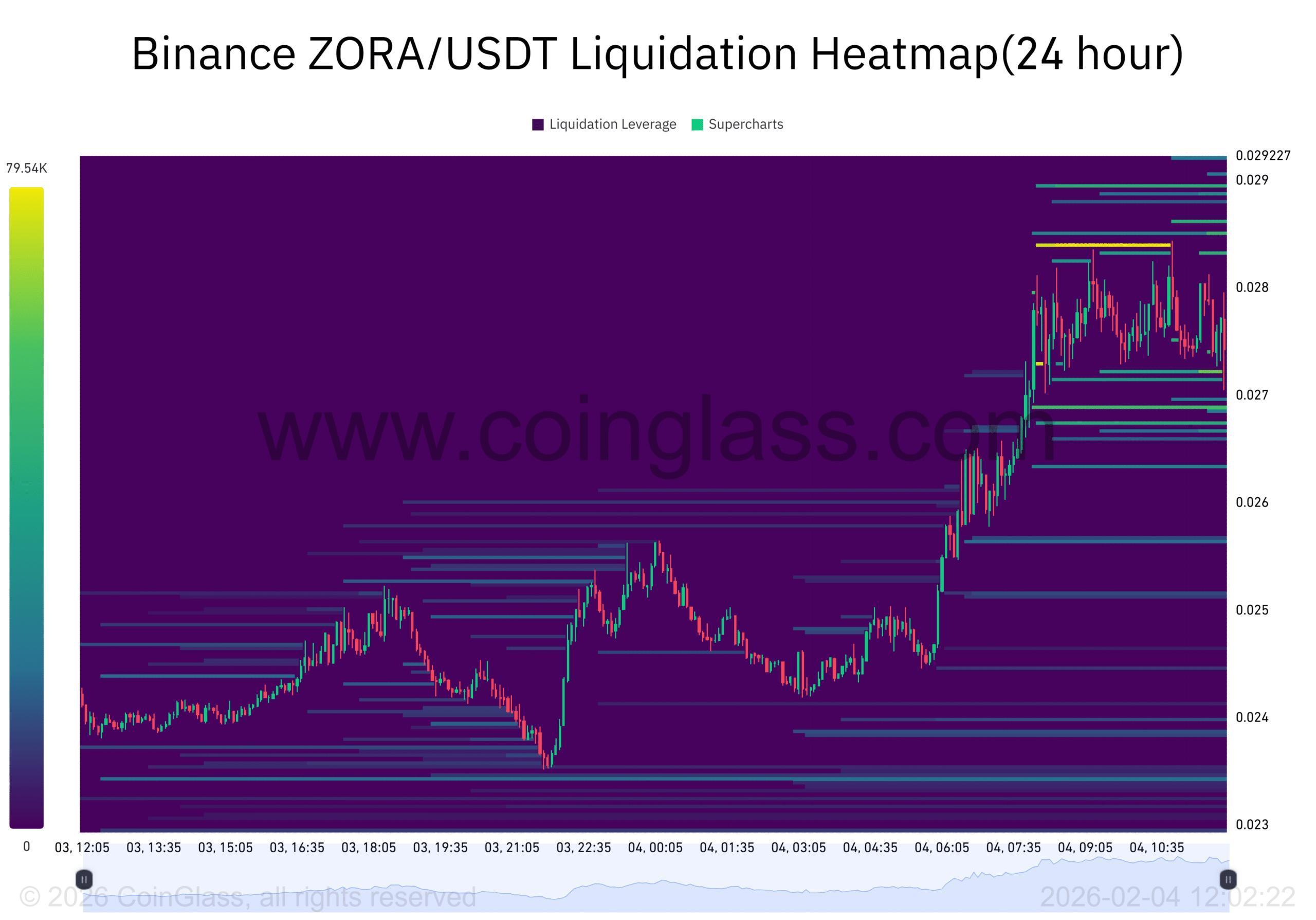
Source: CoinGlass
To sum up, ZORA’s rebound reflects more than a random bounce. Buyers defended long-term support, momentum indicators improved, spot flows stayed net-negative, and leverage expanded with intent.
However, Open Interest growth introduces risk if momentum fades. If the price holds above $0.024 and challenges overhead liquidity, continuation remains possible. Otherwise, consolidation may follow as leverage resets.
Final Thoughts
- Buyers have stepped in decisively at key support, yet the durability of this rebound depends on consistent demand through upcoming retests.
- Rising market participation supports upside attempts; however, growing leverage exposure keeps volatility elevated and raises the risk of sharp counter-moves.