
Bitcoin bulls blitz $69K as retail traders pressure short positioning

Bitcoin (BTC) rallied to $69,482 on Friday, and the rally coincided with data showing steady accumulation from smaller-sized holders in February.
Analysts say the breakout may evolve into a broader bullish trend, although other data suggest that a longer period of price consolidation will underlie the emerging bull trend.
Key takeaways:
BTC broke above the $69,000 resistance and its descending channel, triggering $92 million in short liquidations within four hours.
Small wallets added $613 million in February, while the whale wallets stalled with $4.5B billion in outflows.
Short-term holder profit-ratio indicator hit its lowest level since November 2022, underscoring weak sentiment over the past few weeks.
Will the Bitcoin relief rally last?
Bitcoin has pushed above the upper boundary of its descending channel and retested $69,000. The move marks a potential bullish break of structure (BOS), if BTC holds above $68,000.
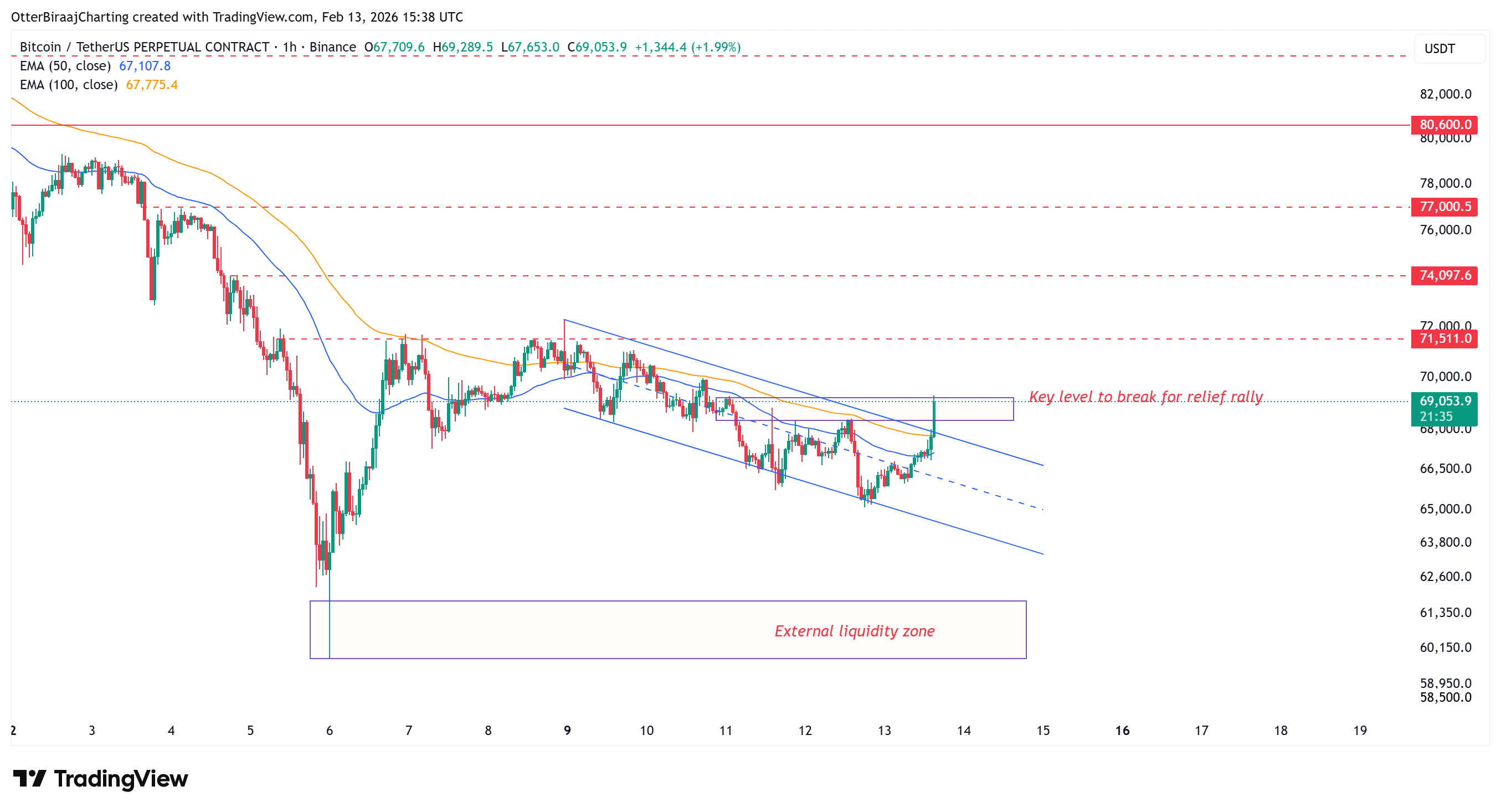 Bitcoin one-hour chart. Source:
Cointelegraph/TradingView
If BTC holds above this reclaimed level, the next internal liquidity zones sit near $71,500 and $74,000. The 50 and 100-period exponential moving averages (EMAs) are now compressing beneath the price on the one-hour chart, reinforcing the possibility of the short-term momentum continuing.
The latest price surge triggered roughly $96 million in futures liquidations over the past four hours, with nearly $92 million coming from short positions, signaling a short squeeze on bearish traders.
BTC liquidations were primarily concentrated on Bybit (22.5%), Hyperliquid (22%), and Gate (15%), suggesting these platforms account for a significant share of active leveraged positioning in the market.
Related: Multi-day negative Bitcoin funding signals ‘overcrowded’ short trade: Reversal coming?
BTC retail investor demand backs the breakout
The breakout is supported by the steady buying from the smaller-sized investors. Order flow data from Hyblock shows that the small wallets ($0–$10,000) have accumulated roughly $613 million in cumulative volume delta (CVD) in February, consistently bidding during the price correction.
The mid-sized wallets ($10,000–$100,000) remain around -$216 million for the month, but the cohort added roughly $300 million since BTC fell below $60,000, suggesting selective accumulation during discounted periods.
 Bitcoin CVD data across different wallet sizes. Source: Hyblock Capital
Whale wallets ($100,000 and above) saw their CVD bottom near -$5.8 billion earlier in February and have since moved sideways. This stabilization implies that the aggressive distribution has paused, though a clear accumulation trend from the large holders has yet to emerge.
For the rally to continue, whale buying may need to return, and the short-term holder spent output profit ratio (SOPR) may need to move back above 1, signaling that the recent buyers are no longer selling at a loss.
Notably, the short-term holder SOPR recently fell to its lowest level since November 2022, indicating that many recent buyers have been realizing losses, a sign that conviction may remain fragile despite the rebound.
 Bitcoin short-term holder SOPR. Source: CryptoQuant
Related: Bitcoin passes $69K on slower US CPI print, but Fed rate-cut odds stay low
Disclaimer: The content of this article solely reflects the author's opinion and does not represent the platform in any capacity. This article is not intended to serve as a reference for making investment decisions.
You may also like
Aave Expands Stock-Backed USDC Loans on Base for Eligible Investors

Deciding Next Week’s Market Trend! The Biggest Uncertainty in the US Midterms: Republicans Unexpectedly Hold the Senate vs. Democrats Win Over 53 Seats
Citigroup believes that the expectation of a Democratic sweep of both chambers is largely priced into U.S. stock valuations, with control of the Senate being the key variable. If the Republicans unexpectedly retain the Senate, U.S. stocks may be boosted by year-end; if the Democrats win more than 53 seats, expectations of corporate tax hikes, fiscal negotiations, and regulatory risks for AI data centers will put pressure on the market.
The "Perfect Storm" Script for AI: Bond Market "Sounds the Horn," Earnings Reports "Add Insult to Injury," Will the Election Deliver the "Final Blow"?
The AI boom faces triple threats from the bond market, earnings reports, and political risks: rising financing thresholds have nearly closed the bond market for AI cloud companies; tech giants are increasing capital expenditures and experiencing deteriorating free cash flow, putting pressure on stock prices; with midterm elections approaching, growing opposition to data centers may push for tighter regulations. The market is shifting from pursuing computing power to questioning investment returns.

Will Solana expansion fuel ONDO’s price hike back above $0.50?

Crypto prices
More


