
Berkshire 13F to be revealed soon: What moves did Buffett make in his final quarter?

Eastern Time next Tuesday (February 17) is the deadline for investment institutions to submit their 13F quarterly holdings reports to the US SEC, and it is expected that Berkshire Hathaway will also “cut it close” in releasing its report this time.
Given that Warren Buffett stepped down as Berkshire CEO at the end of last year, this holdings report has drawn a great deal of attention, as the public wants to understand what actions the “Oracle of Omaha” took in his last quarter at the helm of the company.
Key questions the market is watching include: whether Berkshire continued to reduce its holdings in Apple (AAPL.US) and Bank of America (BAC.US), and whether it sold positions previously built by Buffett’s former right-hand man, Todd Combs.
At the beginning of this year, Greg Abel officially took over as Berkshire CEO, succeeding Buffett. Combs was once a strong contender for the position, but left Berkshire last December to join JPMorgan Chase.
In the first three quarters of 2025, Berkshire’s overall trading activity was not very active; during this period, the company bought about $13.5 billion in stocks and sold about $24 billion. According to data from WhaleWisdom, the value of its investment portfolio was $267 billion.
In the third quarter of last year, Berkshire established a new position by purchasing about 17.85 million shares of Google Class A at an average price of about $210. This investment sparked discussion at the time, with speculation that the trade may have been executed by Combs or others. Now, the stock has risen to $305, making the value of this holding about $5.5 billion.
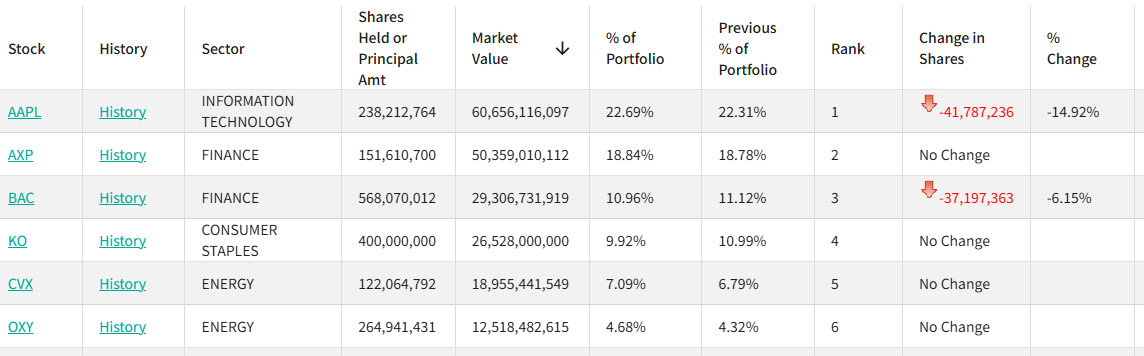
As of the end of the third quarter, Berkshire’s top six holdings were Apple, American Express (AXP.US), Bank of America, Coca-Cola (KO.US), Chevron (CVX.US), and Occidental Petroleum (OXY.US)—these major holdings are generally believed to be personally overseen by Buffett.
Among them, the changes in Apple and Bank of America holdings are noteworthy. In the third quarter, both stocks were significantly reduced: Apple’s holdings decreased by nearly 42 million shares (about 15% compared to the second quarter), while Bank of America’s holdings dropped by 37 million shares (over 6%).
Although both remain core positions for Berkshire, Apple’s holdings have shrunk by around 75% from their peak, and Bank of America’s holdings have nearly halved since the summer of 2024. Meanwhile, Berkshire’s cash reserves have reached a record high.
Another point of interest is whether Berkshire will sell some of the positions established during Combs’ tenure. Some investors believe that Amazon, Verisign, Capital One, Visa, and Mastercard holdings may have been led by Combs.
About 15 years ago, when investment manager Lou Simpson left Berkshire, the company sold most of the positions he managed. After acquiring Alleghany in 2022, the company also handled its stock portfolio in a similar manner.
Disclaimer: The content of this article solely reflects the author's opinion and does not represent the platform in any capacity. This article is not intended to serve as a reference for making investment decisions.
You may also like
Uber Tests Weekend Tokenized Fund Redemptions With HSBC on Canton

Aave Expands Stock-Backed USDC Loans on Base for Eligible Investors

Deciding Next Week’s Market Trend! The Biggest Uncertainty in the US Midterms: Republicans Unexpectedly Hold the Senate vs. Democrats Win Over 53 Seats
Citigroup believes that the expectation of a Democratic sweep of both chambers is largely priced into U.S. stock valuations, with control of the Senate being the key variable. If the Republicans unexpectedly retain the Senate, U.S. stocks may be boosted by year-end; if the Democrats win more than 53 seats, expectations of corporate tax hikes, fiscal negotiations, and regulatory risks for AI data centers will put pressure on the market.
The "Perfect Storm" Script for AI: Bond Market "Sounds the Horn," Earnings Reports "Add Insult to Injury," Will the Election Deliver the "Final Blow"?
The AI boom faces triple threats from the bond market, earnings reports, and political risks: rising financing thresholds have nearly closed the bond market for AI cloud companies; tech giants are increasing capital expenditures and experiencing deteriorating free cash flow, putting pressure on stock prices; with midterm elections approaching, growing opposition to data centers may push for tighter regulations. The market is shifting from pursuing computing power to questioning investment returns.

Crypto prices
More


