
XRP ETFs’ Sudden Demand Slump Could Cost Ripple Its Top-Four Crown as XRP Price Teeters

Institutional investors seem to be taking a breather after three months of aggressive buying into the world’s first XRP (XRP-USD) exchange-traded funds. According to data from February 15, 2026, the initial hype that fueled these funds has started to fade, leading to a worrying trend reversal in capital flows. While the funds managed to end the week in the green, the numbers were a far cry from the record-breaking volume seen during their November debut.
Let’s Break Down the Quiet Week for XRP ETFs
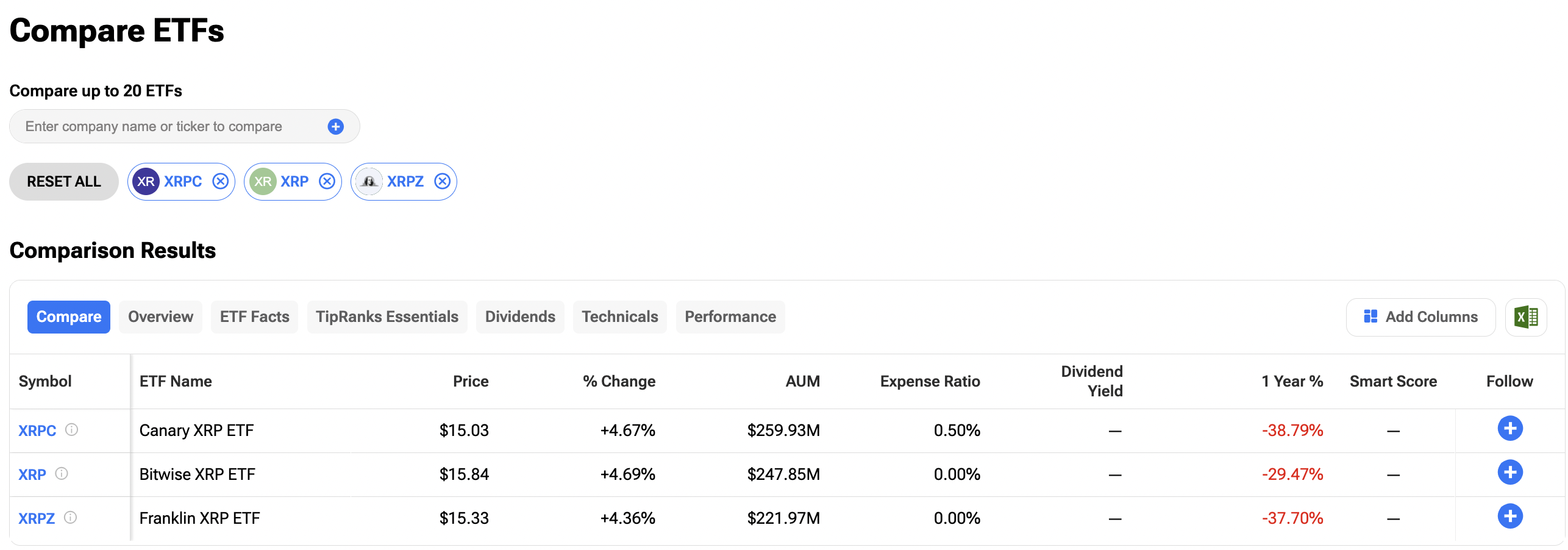
The market leader, Canary Capital’s XRPC (XRPC), still holds the top spot with over $410 million in total inflows, but the daily activity has slowed to a crawl.
- Monday: The week started with a modest $6.31 million in new money.
- Tuesday: Interest dipped further to $3.26 million.
- Wednesday: Trading volume completely flatlined, recording $0 in net flows.
- Thursday: Investors actually pulled money out, leading to a withdrawal of $6.42 million.
- Friday: A small bounce brought in $4.5 million to close the week.
XRP Price Defies the ETF Slump
Even as the funds saw declining demand, the actual XRP token spent the weekend on a rollercoaster. The asset managed to claw its way back from a recent low of $1.11, eventually hitting a multi-week peak of roughly $1.65. However, the bulls couldn’t hold that level for long. The price was quickly rejected and has since settled back into the $1.55 range. Despite this pullback, XRP’s price is showing significant strength against its competitors. Its market cap is holding steady above $90 billion, keeping it firmly in the race for the fourth-largest cryptocurrency by market value, just ahead of BNB (BNB-USD).
XRP ETFs Have Still Hit the $1.2 Billion Milestone
Despite the slow week, the bigger picture for XRP ETFs remains positive. Total net inflows have stabilized above $1.20 billion since the first products launched. Bitwise’s XRP fund (XRP) and Franklin Templeton’s XRPZ (XRPZ) follow closely behind Canary, with $360 million and $328 million in assets, respectively. While the green streak that lasted for the first month has finally broken, many analysts believe this is simply a period of consolidation as the market waits for a new catalyst to drive the next round of institutional adoption.
Copyright © 2026, TipRanks. All rights reserved.
Disclaimer: The content of this article solely reflects the author's opinion and does not represent the platform in any capacity. This article is not intended to serve as a reference for making investment decisions.
You may also like
Uber Tests Weekend Tokenized Fund Redemptions With HSBC on Canton

Aave Expands Stock-Backed USDC Loans on Base for Eligible Investors

Deciding Next Week’s Market Trend! The Biggest Uncertainty in the US Midterms: Republicans Unexpectedly Hold the Senate vs. Democrats Win Over 53 Seats
Citigroup believes that the expectation of a Democratic sweep of both chambers is largely priced into U.S. stock valuations, with control of the Senate being the key variable. If the Republicans unexpectedly retain the Senate, U.S. stocks may be boosted by year-end; if the Democrats win more than 53 seats, expectations of corporate tax hikes, fiscal negotiations, and regulatory risks for AI data centers will put pressure on the market.
The "Perfect Storm" Script for AI: Bond Market "Sounds the Horn," Earnings Reports "Add Insult to Injury," Will the Election Deliver the "Final Blow"?
The AI boom faces triple threats from the bond market, earnings reports, and political risks: rising financing thresholds have nearly closed the bond market for AI cloud companies; tech giants are increasing capital expenditures and experiencing deteriorating free cash flow, putting pressure on stock prices; with midterm elections approaching, growing opposition to data centers may push for tighter regulations. The market is shifting from pursuing computing power to questioning investment returns.

Crypto prices
More


