
Stablecore's Jack Henry integration opens stablecoins to 1,600 banks

Stablecore, a digital asset infrastructure company, has joined the Jack Henry Fintech Integration Network, enabling banks and credit unions on the platform to offer stablecoin and tokenized asset services through their existing systems.
Jack Henry supplies core processing and digital banking technology to approximately 1,670 banks and credit unions in the United States. Many of those institutions also rely on its Banno Digital Platform, which powers online and mobile banking services for more than 1,000 financial institutions.
On Monday, Stablecore said the integration will connect blockchain-based products to traditional core banking infrastructure.
Participating institutions could roll out stablecoin accounts with 24/7 payment capabilities, crypto on- and off-ramps for assets such as Bitcoin (BTC), digital asset–backed lending, tokenized deposits and staking features where permitted.
Embedding these services within existing banking apps would reduce reliance on standalone wallets or external crypto platforms. It also reflects a broader shift toward incorporating blockchain-based assets into regulated financial channels as demand for compliant, onchain cash-management tools continues to grow.
Related: Wall Street’s crypto debate is over as banks go all-in on BTC, stablecoins, tokenized cash
Stablecoin infrastructure race accelerates
As Cointelegraph reported, Stablecore raised $20 million last year to help smaller banks and credit unions integrate digital asset services, especially stablecoins, following the passage of the landmark US GENIUS Act, which established a federal framework for payment stablecoins.
Stablecore is part of a growing cohort of companies building stablecoin infrastructure to expand access to digital dollars. Proponents argue stablecoins can reduce settlement times, cut cross-border payment costs and provide uninterrupted transfer capabilities compared to traditional banking rails.
Momentum has been building across both fintech and traditional finance.
Last week, payments operations provider Modern Treasury unveiled an integrated payment service that supports stablecoin transactions alongside wire and ACH transfers through a partnership with the Paxos network, signaling greater interoperability between blockchain-based dollars and legacy payment systems.
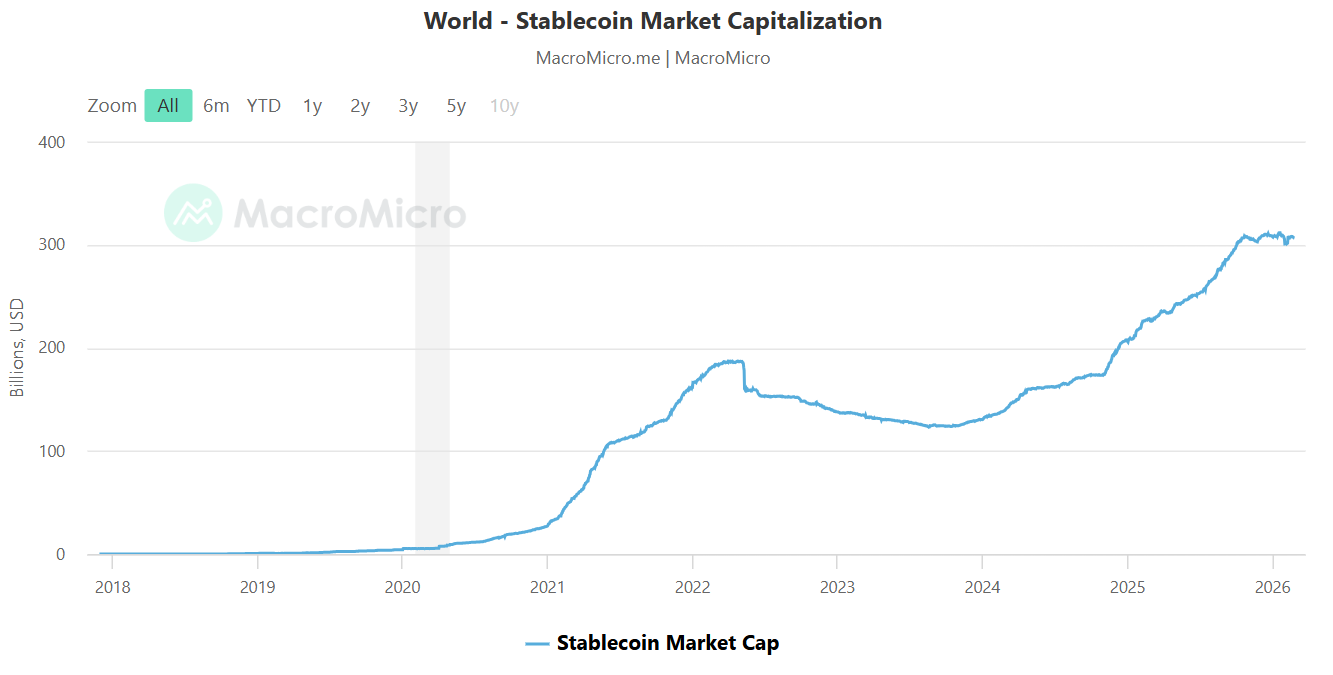 After a period of explosive growth, stablecoin issuance has plateaued in recent months, hovering just above $300 billion. Source:
MacroMicro
Meanwhile, asset management giant Fidelity Investments has introduced the Fidelity Digital Dollar, a stablecoin due to launch this month and designed to facilitate faster and more efficient international settlements.
Large banks are also exploring in-house issuance. Citigroup executives have publicly discussed the possibility of launching a native stablecoin as financial institutions seek to modernize cross-border payments and liquidity management.
Related: USDCx appears on Aleo as privacy-focused blockchains seek stablecoin access
Disclaimer: The content of this article solely reflects the author's opinion and does not represent the platform in any capacity. This article is not intended to serve as a reference for making investment decisions.
You may also like
Intel announces acquisition of Israeli unicorn Classiq, CEO Chen Liwu: Will build a full-stack quantum computing business
Intel announced the acquisition of Israeli quantum computing startup Classiq, with the deal expected to be completed in the first half of 2027. This acquisition will integrate Classiq's quantum algorithm software platform with Intel's silicon-based qubit hardware capabilities, creating a full-stack quantum computing business covering both hardware and software, thereby addressing Intel's shortcomings in the quantum software layer.
Apple responds to iPhone Duo foldable screen cracking issue: admits a small number of devices are affected, advises users to apply for replacement
Apple stated in its announcement that the company is "aware of an issue affecting a small number of iPhone Duo devices' internal screens" and recommends affected users contact AppleCare for replacement. Apple also emphasized that the vast majority of Duo devices are not affected by this issue, and defective units typically show symptoms in a short period of time. According to the teardown and review platform iFixit, the issue is caused by damage to internal hinge components, which subsequently leads to screen cracking, rather than a defect in the display panel itself.
Expectations for merger with SpaceX (SPCX.US) continue to rise; Wall Street bearish sentiment towards Tesla (TSLA.US) hits lowest level in over 11 years.
As the potential merger between Tesla and SpaceX becomes increasingly realistic, Wall Street analysts are rapidly turning bullish on the electric vehicle manufacturer.
Anthropic (ANT.US) pushes for US IPO! Goldman Sachs and Morgan Stanley lead 22 investment banks in underwriting. Google (GOOGL.US) and Amazon (AMZN.US) contribute nearly half of revenue. Risks in the computing power supply chain attract attention.
Anthropic is accelerating its IPO process, with Goldman Sachs and Morgan Stanley leading a syndicate of 22 investment banks as underwriters. However, the prospectus reveals that the company is highly dependent on sales channels and computing power supplied by tech giants such as Google, Amazon, and Microsoft. The significant commitments to procuring computing power and risks in the advanced chip supply chain have also attracted market attention.
Crypto prices
More


