
Bitcoin Manipulation By Jane Street? Ex-Market Maker Says No

By:Newsbtc
Bitget offers one-stop trading for cryptocurrencies, stocks, and gold. Trade now!
A welcome pack worth 6200 USDT for new users! Sign up now!
The latest Jane Street debate on X is meeting a blunt rebuttal from Ari Paul. The BlockTower founder, who says he used to work as a Wall Street market maker 15 years ago, argues that Bitcoin’s failure to push higher is better explained by spot sell-side than by a long-running suppression campaign.
Paul’s answer was direct. “In short: no,” he wrote, before adding that market makers do “game the system” in many ways, but that in liquid products such as BTC ETFs, the effect is usually limited to “meaningful but small costs to consumers,” not a lasting distortion of the underlying asset price. He framed the distinction as one between short-term microstructure games and a broader claim that one firm kept Bitcoin from reaching far higher levels.
Bitcoin Manipulation? Small Moves, Fast Reversions
To make that case, Paul pointed to the kind of behavior traders on desks know well. “For example, market makers may manipulate the price to run stop limit orders,” he wrote. “But that’s typically on an intraday timeframe. So they might run an asset like MSFT or BTC 2% in a weak market to trigger stops, then a few seconds or minutes later, the price is mostly back to where it was before.” In his telling, that is still manipulation, but it is not the same as structurally pinning Bitcoin below some imagined fair value for months.
var rnd = window.rnd || Math.floor(Math.random()*10e6); var pid607465 = window.pid607465 || rnd; var plc607465 = window.plc607465 || 0; var abkw = window.abkw || ''; var absrc = 'https://servedbyadbutler.com/adserve/;ID=172179;size=0x0;setID=607465;type=js;sw='+screen.width+';sh='+screen.height+';spr='+window.devicePixelRatio+';kw='+abkw+';pid='+pid607465+';place='+(plc607465++)+';rnd='+rnd+';click=CLICK_MACRO_PLACEHOLDER'; document.write('
');
if (!window.AdButler){(function(){var s = document.createElement("script"); s.async = true; s.type = "text/javascript";s.src = "https://servedbyadbutler.com/app.js";var n = document.getElementsByTagName("script")[0]; n.parentNode.insertBefore(s, n);}());}
var AdButler = AdButler || {}; AdButler.ads = AdButler.ads || []; var abkw = window.abkw || ""; var plc366606 = window.plc366606 || 0; (function(){ var divs = document.querySelectorAll(".plc366606:not([id])"); var div = divs[divs.length-1]; div.id = "placement_366606_"+plc366606; AdButler.ads.push({handler: function(opt){ AdButler.register(172179, 366606, [728,90], "placement_366606_"+opt.place, opt); }, opt: { place: plc366606++, keywords: abkw, domain: "servedbyadbutler.com", click:"CLICK_MACRO_PLACEHOLDER" }}); })();

That argument lands against a more conspiratorial narrative now circulating online, why Bitcoin is not already at $150,000. Paul’s pushback does not deny that large Wall Street firms can shape short-term trading conditions. It rejects the stronger claim that such activity is the central explanation for Bitcoin’s broader price path.
Paul’s core point was much less dramatic. “Why is BTC down? Because OGs sold tens of thousands of coins, and not enough people wanted to buy them.” That line closely matched the view from renowned on-chain analyst James Check, who argued that “Jane Street didn’t suppress the Bitcoin price” and that “HODLers all did,” by selling large amounts of spot into the market.
Jane Street didn’t suppress the Bitcoin price folks.
HODLers all did.
It’s just not that hard, stop summoning your inner salty goldbug but blaming manipulators.
People. Sold. A. Fucktonne. Of. Spot. Bitcoin.
— _Checkmate 🟠🔑⚡☢️🛢️ (@_Checkmatey_) February 26, 2026
He added: “My point has always been the same; manipulation is a thing that has always, will always, and is indeed the literal job of large wall street firms. However, you do not need that as the central argument to explain why the price didn’t go higher, nor why it went lower. That can be well and truly explained by looking at spot sell-side.”
var rnd = window.rnd || Math.floor(Math.random()*10e6); var pid607472 = window.pid607472 || rnd; var plc607472 = window.plc607472 || 0; var abkw = window.abkw || ''; var absrc = 'https://servedbyadbutler.com/adserve/;ID=172179;size=0x0;setID=607472;type=js;sw='+screen.width+';sh='+screen.height+';spr='+window.devicePixelRatio+';kw='+abkw+';pid='+pid607472+';place='+(plc607472++)+';rnd='+rnd+';click=CLICK_MACRO_PLACEHOLDER'; document.write('
');
if (!window.AdButler){(function(){var s = document.createElement("script"); s.async = true; s.type = "text/javascript";s.src = "https://servedbyadbutler.com/app.js";var n = document.getElementsByTagName("script")[0]; n.parentNode.insertBefore(s, n);}());}
var AdButler = AdButler || {}; AdButler.ads = AdButler.ads || []; var abkw = window.abkw || ""; var plc452518 = window.plc452518 || 0; (function(){ var divs = document.querySelectorAll(".plc452518:not([id])"); var div = divs[divs.length-1]; div.id = "placement_452518_"+plc452518; AdButler.ads.push({handler: function(opt){ AdButler.register(172179, 452518, [728,90], "placement_452518_"+opt.place, opt); }, opt: { place: plc452518++, keywords: abkw, domain: "servedbyadbutler.com", click:"CLICK_MACRO_PLACEHOLDER" }}); })();
Paul did leave room for exceptions. He wrote that there are rare cases where Wall Street manipulates an asset in major ways over a longer period, but said those cases are uncommon because they are risky and harder to profit from than people assume.

Is Jane Street Why Bitcoin Isn’t At $150K? Expert Debunks The Myth
“There are rare exceptions where Wall Street manipulates an asset in major ways longer term, but this is quite rare because it’s very risky and not as easy as it looks to profit. 99% of the time that an asset isn’t moving like you want and people are crying “manipulation”, it’s best to embrace the cognitive dissonance, avoid the “easy way out” of blaming manipulation,” Paul wrote.
That leaves the current Jane Street argument in a narrower frame. Yes, large firms can influence intraday flows, liquidity, and execution quality. But based on Paul’s account, that is a long way from proving that one market maker is the reason Bitcoin is not trading materially higher.
var rnd = window.rnd || Math.floor(Math.random()*10e6); var pid607473 = window.pid607473 || rnd; var plc607473 = window.plc607473 || 0; var abkw = window.abkw || ''; var absrc = 'https://servedbyadbutler.com/adserve/;ID=172179;size=0x0;setID=607473;type=js;sw='+screen.width+';sh='+screen.height+';spr='+window.devicePixelRatio+';kw='+abkw+';pid='+pid607473+';place='+(plc607473++)+';rnd='+rnd+';click=CLICK_MACRO_PLACEHOLDER'; document.write('
');
if (!window.AdButler){(function(){var s = document.createElement("script"); s.async = true; s.type = "text/javascript";s.src = 'https://servedbyadbutler.com/app.js';var n = document.getElementsByTagName("script")[0]; n.parentNode.insertBefore(s, n);}());}
var AdButler = AdButler || {}; AdButler.ads = AdButler.ads || []; var abkw = window.abkw || ''; var plc452519 = window.plc452519 || 0; (function(){ var divs = document.querySelectorAll(".plc452519:not([id])"); var div = divs[divs.length-1]; div.id = "placement_452519_"+plc452519; AdButler.ads.push({handler: function(opt){ AdButler.register(172179, 452519, [728,90], 'placement_452519_'+opt.place, opt); }, opt: { place: plc452519++, keywords: abkw, domain: 'servedbyadbutler.com', click:'CLICK_MACRO_PLACEHOLDER' }}); })();
Notably, the Jane Street theory picked up fresh attention after Terraform Labs’ wind-down administrator sued the firm in Manhattan federal court, alleging insider trading tied to Terra’s 2022 collapse. The complaint says Jane Street used a private chat called “Bryce’s Secret” to obtain non-public information and alleges an 85 million UST trade on Curve that helped trigger a selloff; Jane Street has denied wrongdoing and called the case opportunistic.
At press time, BTC traded at $66,090.
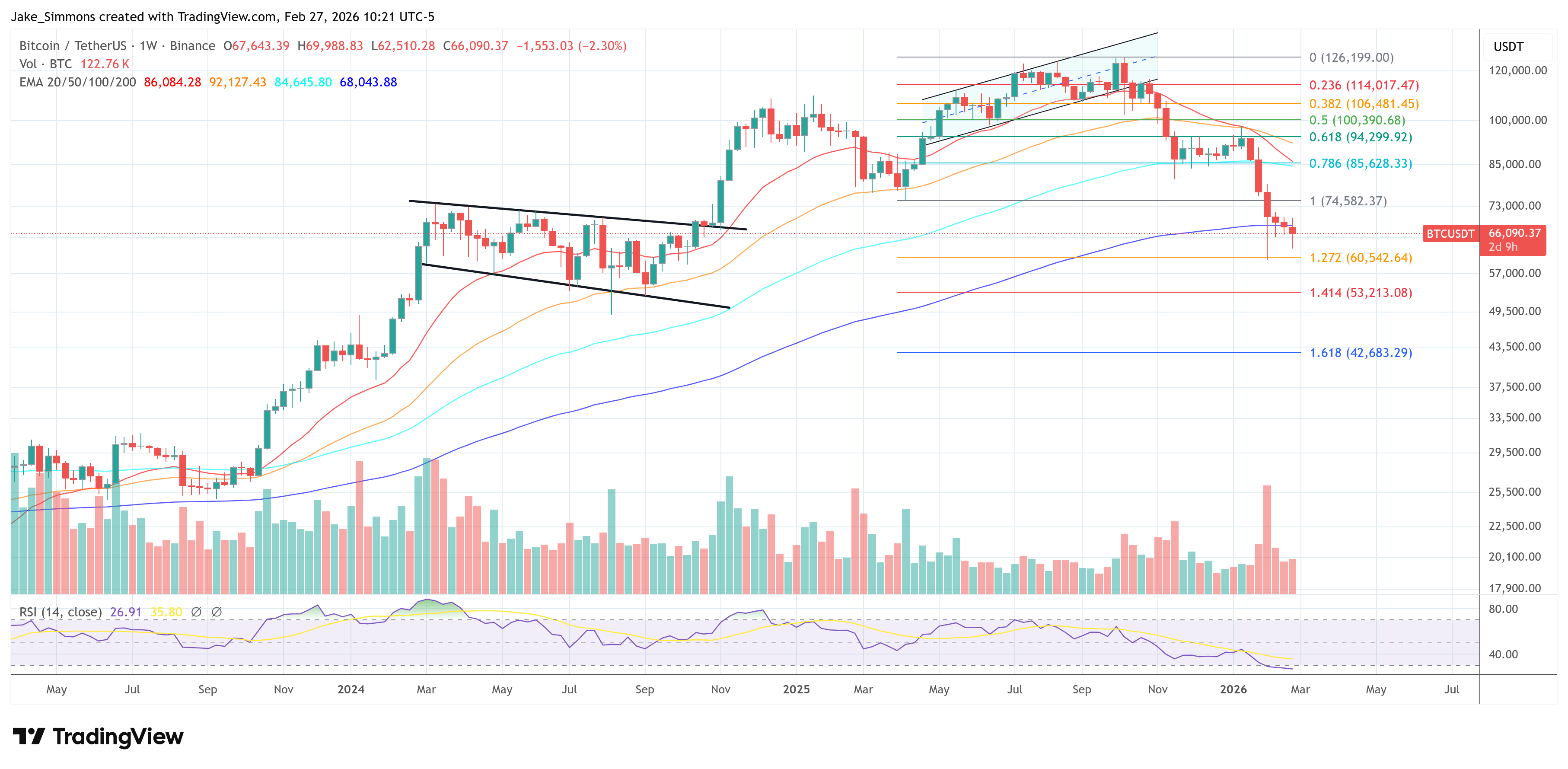 Bitcoin must close above the 200-week EMA, 1-week chart | Source:
BTCUSDT on TradingView.com
0
0
Disclaimer: The content of this article solely reflects the author's opinion and does not represent the platform in any capacity. This article is not intended to serve as a reference for making investment decisions.
Understand the market, then trade.
Bitget offers one-stop trading for cryptocurrencies, stocks, and gold.
Trade now!
You may also like
Ripple Partner Reaches One Million People With Safe Water
DailyCoin•2026/11/02 09:18

NASDAQ TRADE HALT CONTINUES <UCFIW.O> REASON NOT AVAILABLE AT 03:58 AM
Reuters•2026/11/02 08:58

 VIPCross-Asset Positioning Amid AI Earnings Scrutiny and the US Election
1. Markets diverged during the week. Between the October 23 and October 30 closes, BTC fell 4.78%, the Nasdaq 100 declined 1.98%, and gold and silver dropped 2.72% and 8.59%, respectively. The DAX, KOSPI, Nikkei 225 and Hang Seng advanced. We focus on differences in growth prospects, valuation sensitivity and risk exposures rather than applying a single directional view across assets. 2. Market reactions to Alphabet's and Intel's earnings brought returns on AI investment into focus. Attention is shifting from the scale of capital expenditure to revenue realization, margins and free cash flow. Lower interest rates can ease discount-rate pressure, but a sustained valuation recovery still requires support from both operating performance and financing conditions. 3. The November 3 US midterm elections and November 6 employment report are key events in the coming week. We monitor how post-election fiscal and legislative agendas may affect interest rates, the dollar and industry operating conditions. Our execution priorities are to manage leverage and concentration, retain margin and exit-liquidity buffers, and avoid treating a single political outcome as an automatic trading signal. 4. Following Binance's disclosure of a security incident, industry attention to endpoint protection, access segregation and coordinated incident response has increased. Key assets to monitor: BTC, the Nasdaq 100, crude oil and gold, alongside upcoming earnings from AAPL, AMD, PLTR, ARM, ANET and QCOM.
Bitget•2026/11/02 08:28

HYATT HOTELS CORP <H.N>: JEFFERIES RAISES TARGET PRICE TO $188 FROM $167
Reuters•2026/11/02 07:58
Crypto prices
More
Bitcoin
BTC
$77,997.55
+0.05%

Ethereum
ETH
$2,289.79
+0.92%

Tether USDt
USDT
$0.9987
-0.01%

BNB
BNB
$707.26
-0.44%

XRP
XRP
$1.25
+0.03%

USDC
USDC
$0.9997
-0.01%

Solana
SOL
$94.27
-1.18%

TRON
TRX
$0.3159
+1.80%

Hyperliquid
HYPE
$85.94
-1.98%

Zcash
ZEC
$1,247.93
+0.22%
How to buy BTC
Bitget lists BTC – Buy or sell BTC quickly on Bitget!
Trade now
Become a trader now?A welcome pack worth 6200 USDT for new users!
Sign up now