
Bitcoin Sentiment On Wall Street Turned Negative: Galaxy’s Thorn

By:Newsbtc
Bitget offers one-stop trading for cryptocurrencies, stocks, and gold. Trade now!
A welcome pack worth 6200 USDT for new users! Sign up now!
Wall Street’s attitude toward Bitcoin has flipped from euphoric to deeply skeptical after last year’s crowded long trade unraveled, according to Galaxy Digital head of research Alex Thorn. In an interview on What Bitcoin Did, Thorn said the shift has less to do with conspiracy theories or a single bearish catalyst than with exhausted demand, heavy long-term holder selling, and a market now struggling to find a fresh narrative.
Thorn pushed back on claims that firms such as Jane Street are to blame for Bitcoin’s weakness, calling that line of thinking “Twitter cope.” He argued that most of the outrage reflects frustration with price action rather than evidence of deliberate suppression.
“What do we think the actual incentive would be for them to suppress the price?” Thorn said. “Bitcoin’s a multi-trillion, well whatever it is, one-point-something-trillion-dollar asset. It’s hard to manipulate markets of scale in a specific direction because it is a free market and it’s a large one.”
var rnd = window.rnd || Math.floor(Math.random()*10e6); var pid607465 = window.pid607465 || rnd; var plc607465 = window.plc607465 || 0; var abkw = window.abkw || ''; var absrc = 'https://servedbyadbutler.com/adserve/;ID=172179;size=0x0;setID=607465;type=js;sw='+screen.width+';sh='+screen.height+';spr='+window.devicePixelRatio+';kw='+abkw+';pid='+pid607465+';place='+(plc607465++)+';rnd='+rnd+';click=CLICK_MACRO_PLACEHOLDER'; document.write('
');
if (!window.AdButler){(function(){var s = document.createElement("script"); s.async = true; s.type = "text/javascript";s.src = "https://servedbyadbutler.com/app.js";var n = document.getElementsByTagName("script")[0]; n.parentNode.insertBefore(s, n);}());}
var AdButler = AdButler || {}; AdButler.ads = AdButler.ads || []; var abkw = window.abkw || ""; var plc366606 = window.plc366606 || 0; (function(){ var divs = document.querySelectorAll(".plc366606:not([id])"); var div = divs[divs.length-1]; div.id = "placement_366606_"+plc366606; AdButler.ads.push({handler: function(opt){ AdButler.register(172179, 366606, [728,90], "placement_366606_"+opt.place, opt); }, opt: { place: plc366606++, keywords: abkw, domain: "servedbyadbutler.com", click:"CLICK_MACRO_PLACEHOLDER" }}); })();
Why Wall Street Is Wrong On Bitcoin
His broader explanation was more straightforward. From late 2024 through the period between the US election and inauguration, he said, being long Bitcoin was “the most popular trade in the world.” That changed as capital rotated elsewhere. AI-linked equities, semiconductor names, energy plays, quantum stocks and gold all began attracting attention, while Bitcoin’s momentum faded.

At the same time, Thorn said, long-term holders were consistently distributing coins into strength. He described that selling as structural rather than alarming. “That’s literally how distribution occurs and it’s how you make money in a trade,” he said, arguing that older holders taking gains is part of Bitcoin’s maturation rather than a sign of failure.
He went further, framing the whale distribution as constructive for the network over the long run. “Technically you want more selling. You want it distributed to people who buy it at a higher cost basis,” Thorn said. “The realized price is higher and that’s a good thing. That means people, with enormous amounts of money, are willing to buy Bitcoin at really high prices. To me that’s a core signal of adoption.”
var rnd = window.rnd || Math.floor(Math.random()*10e6); var pid607472 = window.pid607472 || rnd; var plc607472 = window.plc607472 || 0; var abkw = window.abkw || ''; var absrc = 'https://servedbyadbutler.com/adserve/;ID=172179;size=0x0;setID=607472;type=js;sw='+screen.width+';sh='+screen.height+';spr='+window.devicePixelRatio+';kw='+abkw+';pid='+pid607472+';place='+(plc607472++)+';rnd='+rnd+';click=CLICK_MACRO_PLACEHOLDER'; document.write('
');
if (!window.AdButler){(function(){var s = document.createElement("script"); s.async = true; s.type = "text/javascript";s.src = "https://servedbyadbutler.com/app.js";var n = document.getElementsByTagName("script")[0]; n.parentNode.insertBefore(s, n);}());}
var AdButler = AdButler || {}; AdButler.ads = AdButler.ads || []; var abkw = window.abkw || ""; var plc452518 = window.plc452518 || 0; (function(){ var divs = document.querySelectorAll(".plc452518:not([id])"); var div = divs[divs.length-1]; div.id = "placement_452518_"+plc452518; AdButler.ads.push({handler: function(opt){ AdButler.register(172179, 452518, [728,90], "placement_452518_"+opt.place, opt); }, opt: { place: plc452518++, keywords: abkw, domain: "servedbyadbutler.com", click:"CLICK_MACRO_PLACEHOLDER" }}); })();
Still, Thorn acknowledged that sentiment has deteriorated sharply, especially among professional investors. In his view, Bitcoin’s failure since September to behave like “digital gold” damaged the story many allocators had bought into. Wall Street, he said, took that label too literally.

Fidelity Thinks Bitcoin May Be Leaving Its 80% Crashes Behind
“We didn’t mean it was going to trade with a high beta to GLD,” Thorn said. “Its features are gold-like. Its trading behavior hasn’t fully caught up to that yet. The delta between those two things, if you believe it eventually closes, that’s your alpha.”
That mismatch has helped sour institutional mood just as broader macro fears have worsened. Thorn said investors are anxious about AI from both directions: that it may fail to justify massive capex, or succeed so thoroughly that it destroys jobs and destabilizes markets. If equities roll over on the back of that uncertainty, he suggested, Bitcoin may struggle to stay insulated.
var rnd = window.rnd || Math.floor(Math.random()*10e6); var pid607473 = window.pid607473 || rnd; var plc607473 = window.plc607473 || 0; var abkw = window.abkw || ''; var absrc = 'https://servedbyadbutler.com/adserve/;ID=172179;size=0x0;setID=607473;type=js;sw='+screen.width+';sh='+screen.height+';spr='+window.devicePixelRatio+';kw='+abkw+';pid='+pid607473+';place='+(plc607473++)+';rnd='+rnd+';click=CLICK_MACRO_PLACEHOLDER'; document.write('
');
if (!window.AdButler){(function(){var s = document.createElement("script"); s.async = true; s.type = "text/javascript";s.src = 'https://servedbyadbutler.com/app.js';var n = document.getElementsByTagName("script")[0]; n.parentNode.insertBefore(s, n);}());}
var AdButler = AdButler || {}; AdButler.ads = AdButler.ads || []; var abkw = window.abkw || ''; var plc452519 = window.plc452519 || 0; (function(){ var divs = document.querySelectorAll(".plc452519:not([id])"); var div = divs[divs.length-1]; div.id = "placement_452519_"+plc452519; AdButler.ads.push({handler: function(opt){ AdButler.register(172179, 452519, [728,90], 'placement_452519_'+opt.place, opt); }, opt: { place: plc452519++, keywords: abkw, domain: 'servedbyadbutler.com', click:'CLICK_MACRO_PLACEHOLDER' }}); })();
Even so, Thorn drew a line between short-term sentiment and long-term conviction. “We really should focus on explaining its fundamental purpose and use cases and value to a holder of Bitcoin as the reason that it goes up,” he said. “Stop begging for Jay Powell to buy your bags. That’s not nearly as durable as the reason it going up being that people deeply understand the savings technology that is Bitcoin.”
For Thorn, that is the real story now: Wall Street may have turned negative, but the longer-term battle is still about whether more investors come to see Bitcoin as a durable store-of-value asset rather than a passing macro trade.
At press time, BTC traded at $66,109.
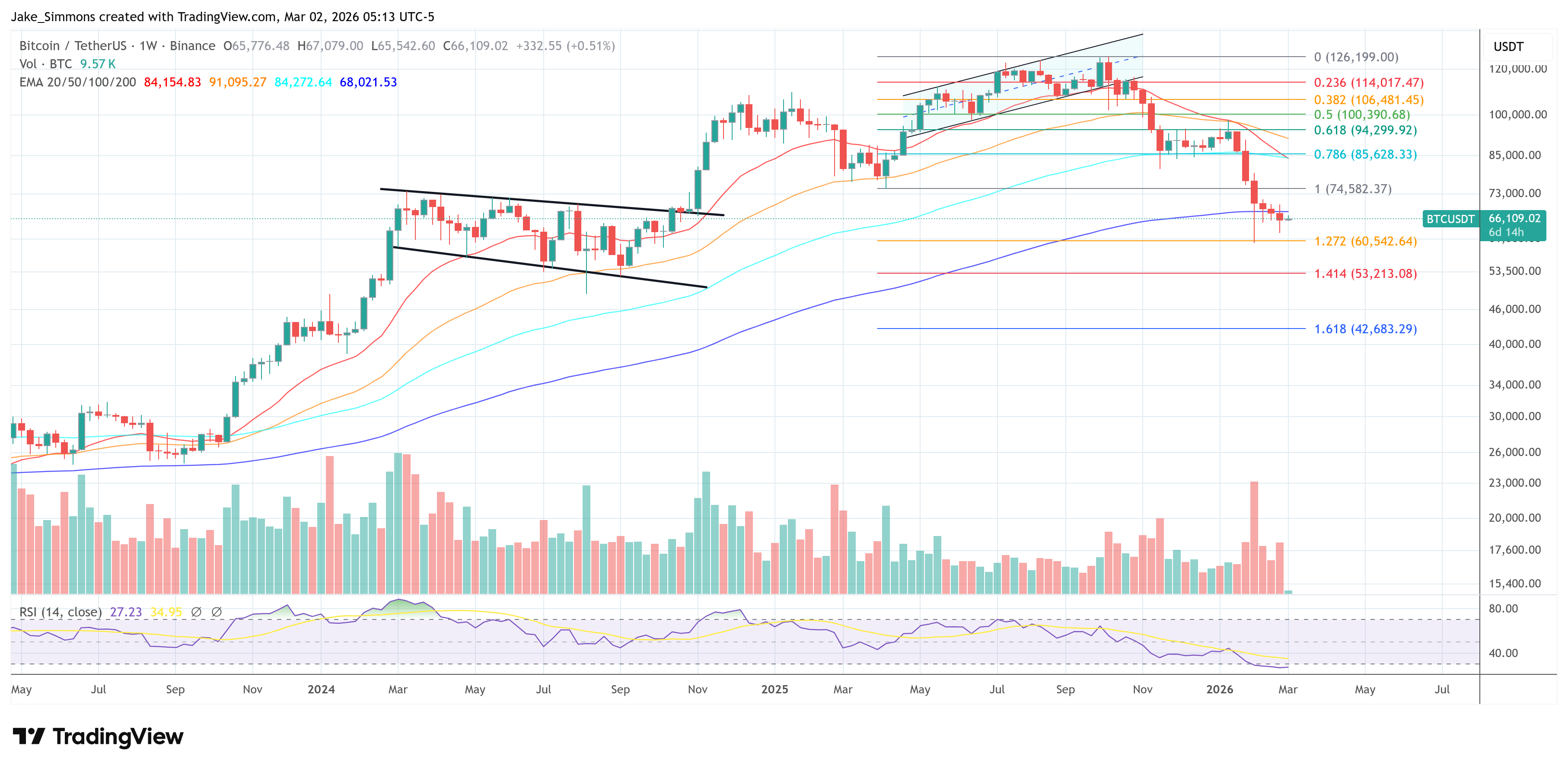 Bitcoin closed below the 200-week EMA, 1-week chart | Source:
0
0
Disclaimer: The content of this article solely reflects the author's opinion and does not represent the platform in any capacity. This article is not intended to serve as a reference for making investment decisions.
Understand the market, then trade.
Bitget offers one-stop trading for cryptocurrencies, stocks, and gold.
Trade now!
You may also like
Ripple Partner Reaches One Million People With Safe Water
DailyCoin•2026/11/02 09:18

NASDAQ TRADE HALT CONTINUES <UCFIW.O> REASON NOT AVAILABLE AT 03:58 AM
Reuters•2026/11/02 08:58
 VIPCross-Asset Positioning Amid AI Earnings Scrutiny and the US Election
1. Markets diverged during the week. Between the October 23 and October 30 closes, BTC fell 4.78%, the Nasdaq 100 declined 1.98%, and gold and silver dropped 2.72% and 8.59%, respectively. The DAX, KOSPI, Nikkei 225 and Hang Seng advanced. We focus on differences in growth prospects, valuation sensitivity and risk exposures rather than applying a single directional view across assets. 2. Market reactions to Alphabet's and Intel's earnings brought returns on AI investment into focus. Attention is shifting from the scale of capital expenditure to revenue realization, margins and free cash flow. Lower interest rates can ease discount-rate pressure, but a sustained valuation recovery still requires support from both operating performance and financing conditions. 3. The November 3 US midterm elections and November 6 employment report are key events in the coming week. We monitor how post-election fiscal and legislative agendas may affect interest rates, the dollar and industry operating conditions. Our execution priorities are to manage leverage and concentration, retain margin and exit-liquidity buffers, and avoid treating a single political outcome as an automatic trading signal. 4. Following Binance's disclosure of a security incident, industry attention to endpoint protection, access segregation and coordinated incident response has increased. Key assets to monitor: BTC, the Nasdaq 100, crude oil and gold, alongside upcoming earnings from AAPL, AMD, PLTR, ARM, ANET and QCOM.
Bitget•2026/11/02 08:28

HYATT HOTELS CORP <H.N>: JEFFERIES RAISES TARGET PRICE TO $188 FROM $167
Reuters•2026/11/02 07:58
Crypto prices
More
Bitcoin
BTC
$77,997.55
+0.05%

Ethereum
ETH
$2,289.79
+0.92%

Tether USDt
USDT
$0.9987
-0.01%

BNB
BNB
$707.26
-0.44%

XRP
XRP
$1.25
+0.03%

USDC
USDC
$0.9997
-0.01%

Solana
SOL
$94.27
-1.18%

TRON
TRX
$0.3159
+1.80%

Hyperliquid
HYPE
$85.94
-1.98%

Zcash
ZEC
$1,247.93
+0.22%
How to buy BTC
Bitget lists BTC – Buy or sell BTC quickly on Bitget!
Trade now
Become a trader now?A welcome pack worth 6200 USDT for new users!
Sign up now