
March Momentum: Why U.S. Equities are Primed for a Rally

In late January, I penned the commentary February Flinch: Why the Bull Market is Due for a Breather. At the time, the fundamentals of the market remained strong, but there were some short-term warning signs, including: a blow-off top in silver, deteriorating leadership in AI leaders like Microsoft (MSFT), bearish seasonality trends, and overheated sentiment. While the market did not fall apart, individual stocks were pummeled beneath the surface of the market indices, and the action was choppy and difficult for investors navigate.
As Wall Street enters March, the script has flipped from bearish to bullish. Below are 5 reasons March will be a strong month for U.S. equities, including:
March Seasonality is Bullish
In my February commentary, I wrote about how February seasonality has historically been bearish for equities and that it is the second-weakest month of the year. However, over the past two decades, stocks have bottomed in mid-March on average, including the bear-market bottoms of 2009 and 2020.

Image Source: Carson Investment Research
Jeff Hirsch of StockTrader’s Almanac (@almanactrader) gives us the lowdown on March seasonality:
“Over the recent 21-year period (2005-2025), March has tended to open positively with modest average gains accumulating over the first three trading days. A bout of weakness has followed before all indexes begin moving higher around mid-month through the month’s end. In midterm election years since 1950, March has also tended to open strongly, but strength has generally persisted until around the first day of Spring. At which point, the major indexes have tended to lose momentum and close out March with some choppy trading. One possible reason for stronger performance in midterm-election-year March is the tough time the market has had in historically tepid February.”
Sentiment is Bearish
The AAII Investor Sentiment Survey “offers insight into the opinions of individual investors by asking them their thoughts on where the market is heading in the next six months and has been doing so since 1987.” The latest AAII Sentiment Survey paints a contrarian bullish picture, with only 33.2% of respondents reporting bullish sentiment toward equity markets.

Image Source: AAII
Earnings and Margins Hit New Highs
Last week, both earnings and profit margins reached fresh all-time highs. In other words, though the market has been consolidating, fundamentals are improving.

Image Source: Carson Investment Research
Improving Technical Action
“So go the leaders, so goes the market.” NVIDIA (NVDA), the undisputed AI leader, is tagging its 200-day moving average for the first time since May – an attractive reward-to-risk zone.
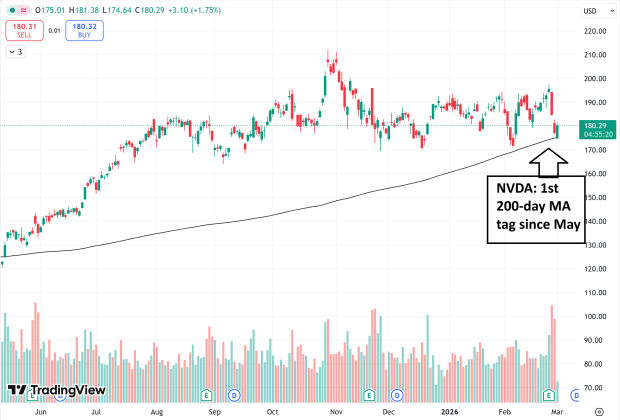
Image Source: TradingView
New Market Leadership Emerges
New market leadership tends to be a positive sign for stocks. Recently, new market leaders such as Fastly (FSLY) and Applied Optoelectronics (AAOI) have emerged. Both stocks gained more than 90% last month, signaling that as AI moves to the next wave, new opportunities will arise.
Bottom Line
While February tested investor patience with its choppy action and internal weakness, the data entering March tells a vastly different story. Between the confluence of record-setting corporate performance, a healthy technical reset in key AI leaders, and favorable seasonal tailwinds, the setup for a sustained rally is compelling.
Disclaimer: The content of this article solely reflects the author's opinion and does not represent the platform in any capacity. This article is not intended to serve as a reference for making investment decisions.
You may also like
Ripple Partner Reaches One Million People With Safe Water

NASDAQ TRADE HALT CONTINUES <UCFIW.O> REASON NOT AVAILABLE AT 03:58 AM

 VIPCross-Asset Positioning Amid AI Earnings Scrutiny and the US Election
1. Markets diverged during the week. Between the October 23 and October 30 closes, BTC fell 4.78%, the Nasdaq 100 declined 1.98%, and gold and silver dropped 2.72% and 8.59%, respectively. The DAX, KOSPI, Nikkei 225 and Hang Seng advanced. We focus on differences in growth prospects, valuation sensitivity and risk exposures rather than applying a single directional view across assets. 2. Market reactions to Alphabet's and Intel's earnings brought returns on AI investment into focus. Attention is shifting from the scale of capital expenditure to revenue realization, margins and free cash flow. Lower interest rates can ease discount-rate pressure, but a sustained valuation recovery still requires support from both operating performance and financing conditions. 3. The November 3 US midterm elections and November 6 employment report are key events in the coming week. We monitor how post-election fiscal and legislative agendas may affect interest rates, the dollar and industry operating conditions. Our execution priorities are to manage leverage and concentration, retain margin and exit-liquidity buffers, and avoid treating a single political outcome as an automatic trading signal. 4. Following Binance's disclosure of a security incident, industry attention to endpoint protection, access segregation and coordinated incident response has increased. Key assets to monitor: BTC, the Nasdaq 100, crude oil and gold, alongside upcoming earnings from AAPL, AMD, PLTR, ARM, ANET and QCOM.

HYATT HOTELS CORP <H.N>: JEFFERIES RAISES TARGET PRICE TO $188 FROM $167
Crypto prices
More


