
Bitcoin futures demand falls to 2024 lows: Are institutions exiting the market?

Key takeaways:
Bitcoin futures demand has hit its lowest level since 2024, signaling that many institutional traders are staying cautious.
Despite lower confidence from bulls, high CME open interest suggests that major institutions have not left the market.
Bitcoin (BTC) price has gained 10% since retesting $63,000 on Saturday, providing a glimpse of hope for bulls as stock markets moved in a different direction amid escalating tensions in the Middle East. However, demand for Bitcoin futures has been declining, with open interest reaching its lowest levels since 2024. This trend is causing traders to fear that institutional investors are leaving the market.
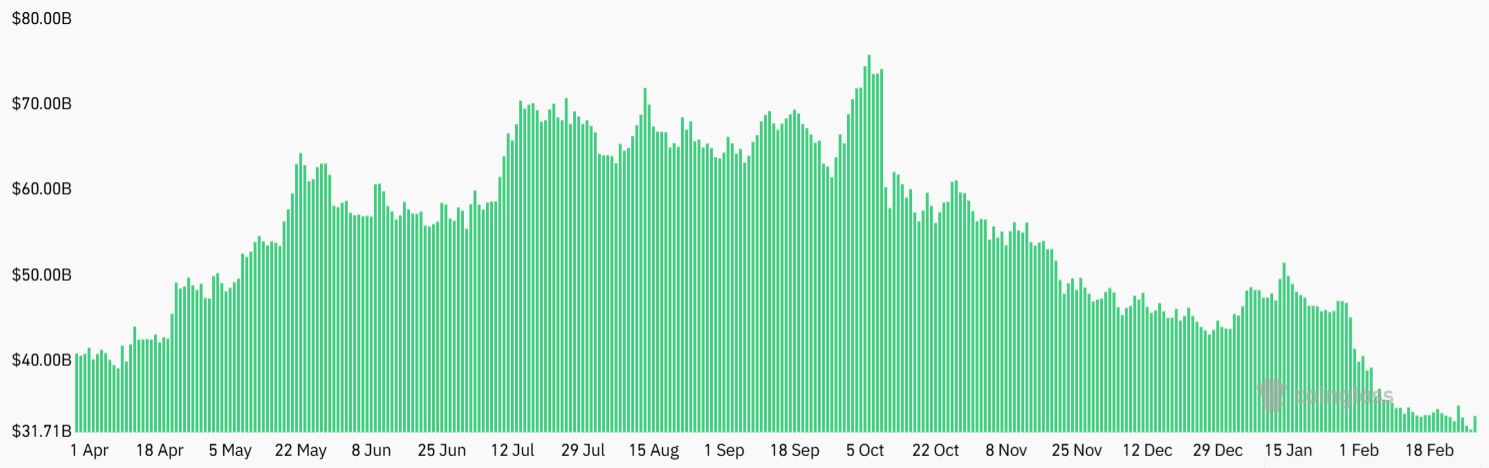 BTC futures aggregate open interest, USD. Source: CoinGlass
The Bitcoin futures aggregate open interest on major exchanges declined to $32 billion on Sunday, down 20% from one month prior. Even if measured in Bitcoin terms to adjust for the recent price decline, the current demand for BTC futures stood at the lowest level since August 2024 at 491,300 BTC. Part of this decline can be explained by the forced liquidations of bulls who were caught by surprise.
The demand for leveraged bullish positions has been largely absent since the $126,200 all-time high in October 2025.
 BTC 2-month futures annualized premium. Source:
The annualized premium (basis rate) on Bitcoin monthly futures contracts dropped to its lowest level in a year at 2%. Under neutral conditions, the metric should range between 5% and 10% to compensate for the longer settlement period. Even more concerning is the fact that the basis rate has failed to sustain bullish levels for the past 12 months, a period that happens to include a 50% rally between April and May 2025.
Bitcoin’s underperformance relative to gold and the stock market has likely shifted investors' attention away from the cryptocurrency market. Still, it would be far-fetched to claim that institutional investors have exited the market, given that spot Bitcoin exchange-traded funds (ETFs) trade over $3 billion per day on average. Among the ETF holders are some of the world’s largest mutual and pension fund managers.
Moreover, there are over $79 billion in Bitcoin held onchain by publicly listed companies, including Strategy (MSTR US), MARA Holdings (MARA US), XXI (XXI US), and Metaplanet (MPLTF US). Countries such as Bhutan, El Salvador, and the United Arab Emirates have also added Bitcoin exposure. One could argue that there is still a long way to go in terms of institutional adoption, but the present situation is very far from zero.
Bitcoin derivatives signal resilience as bulls hesitate
The Bitcoin options market confirms that derivatives continue to function as expected despite repeated failures to reclaim the $72,000 level.
 BTC options put-to-call premiums at Deribit. Source: Laevitas.ch
The Bitcoin put-to-call options premium stayed near 0.7 on Monday. This shows that demand for put (sell) options is lower than for call (buy) options. A brief jump in demand for bearish strategies on Friday did not last. Essentially, the options market shows no signs of major trouble or lasting stress from the past few months.
Derivatives data also shows a lack of confidence among bulls, especially since Bitcoin is trading 45% below its all-time high. However, there is no evidence that institutional players have left the market. The $7.5 billion in Bitcoin futures open interest on the CME is a clear sign of institutional activity. Despite the selling pressure, every short (sell) order must be matched by a long (buy) order, which keeps the market balanced.
Eventually, fear and uncertainty fade as more buyers return, marking the end of a downward trend. While it is unclear if $60,000 was the absolute bottom for this market cycle, Bitcoin has again shown it is a secure asset with a fixed supply. The $1.4 trillion cryptocurrency market has proven its strength and shows no signs of failing.
Disclaimer: The content of this article solely reflects the author's opinion and does not represent the platform in any capacity. This article is not intended to serve as a reference for making investment decisions.
You may also like
Ethena Pay Adds Earn+ Through Aave V4 Lending on Avalanche

DoorDash (DASH.US) Outperforms Nasdaq Amid Tech Stock Selloff! Officially Announces $17 Billion Acquisition of Instacart; Will Grocery Delivery and Retail Advertising Drive a Revaluation of Value?
The complete integration of the two major platforms may enhance their overall competitive and bargaining power in terms of delivery economics, consumer reach, and retail media monetization. Grocery retailers lacking their own delivery networks are bound to face more significant bargaining pressure, while Walmart and Target, which own Spark and Shipt, are relatively more capable of withstanding the impact.
Earnings Preview | A 121x P/E Ratio Gamble: If Palantir (PLTR.US) Guidance Is Not “Impressive Enough”, Its Stock Price May Plummet
Palantir released its Q3 earnings after the market closed on Monday. The market expects revenue of $2.18 billion, an increase of about 85%. The focus is on the raised annual guidance and the growth rate of the commercial business. With its high valuation, there is very little margin for error.

BTIG warns: US stocks have entered "uncharted territory," and gold may further decline to $3,500
The low volatility in the US stock market is actually an illusion created by extreme divergence among sectors, with the internal structure being extremely fragile. BTIG warns that the market urgently needs a panic-induced sharp correction, with the Nasdaq facing at least an 8.5% pullback and the S&P 500 potentially dropping to 7,300 points. Additionally, the semiconductor sector has already broken technical support, the AI sector may be adversely affected by election policies, and both gold and silver have already peaked; the true market bottom is still far from being reached.
Crypto prices
More


