-
Korean stock market crash erased $270 billion as KOSPI plunged 7.24% in one session.
-
The crash followed a 13% oil price surge as fears grew that Iran could block the Strait of Hormuz.
-
Despite this crash Bitcoin price has quickly recover hitting $70,000 before settling near $67K.
Today, the Korean stock market crashed sharply by 7.24% after reopening from a long weekend. This is one of the worst day carsh korean market has seen in 19 months. This crash came into effect following the strike on Iran by the U.S. and israel joinlty.
Stock markets across Asia, Europe, and the U.S. turned red, while the Bitcoin price surged towards $70K.
Korean Stock Market Crash Pushes KOSPI to 19 Month low
South Korea’s benchmark KOSPI index fell by 7.24% in a single session today. The drop wiped out about ₩390 trillion (around $270 billion) in market value. It was the biggest one-day fall since the 2024 yen carry trade crisis.
Many traders could not react earlier because Monday was a public holiday for Samiljeol (Independence Movement Day).
Later, when trading resumed, and institutional investors offloaded trillions of won worth of shares, reflecting strong fear in global financial markets.
Financial analysts say the fall was mainly caused by rising oil prices and supply fears. Crude oil jumped nearly 13%, moving close to $82 per barrel after Iran warned it could block the Strait of Hormuz, a key oil shipping route.
This move hit South Korea hard because the country imports about 2.76 million barrels of crude oil per day from the Gulf, much of it passing through the Strait of Hormuz, which Iran now threatens to block.
Global Markets Also Turn Red
The Korean market was not alone in whose stock market crashed. Major indexes across the world also declined, including the U.S. (S&P 500), Britain’s (FTSE 100), Japan’s (Nikkei), Hong Kong’s (Hang Seng), and India’s (Nifty 50), all dropped between 1% and 3%.
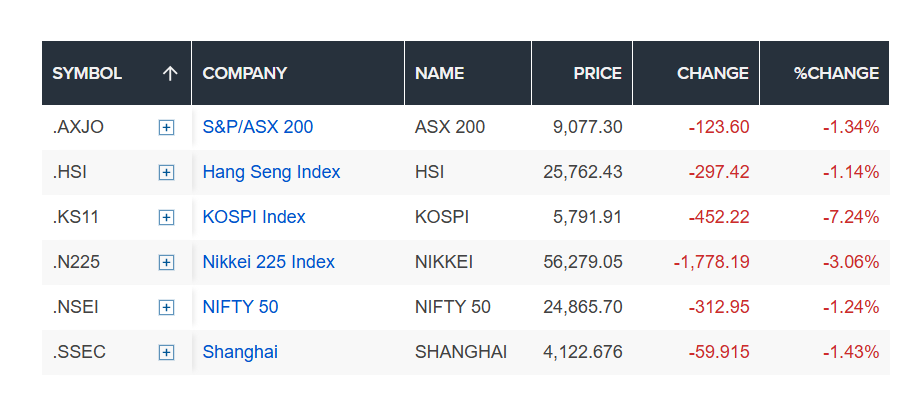
The sell-off showed how closely global markets are linked when geopolitical risks rise.
Bitcoin Drops to $63K Before Recovering
The crypto market also felt pressure. Flagship cryptocurrency Bitcoin fell near $63,000 after news of U.S. and Israeli strikes on Iran.
Other major cryptocurrencies, Ethereum, XRP, Solana, Doge, & other also saw a drop between 5 to 9%.
Perhaps as of now, Bitcoin quickly recovered and climbed back toward $70,000 before settling near $67,000, showing how fast crypto reacts to global events.
Iran Crypto Market Sees 80% Volume Collapse
Inside Iran, crypto trading volume dropped nearly 80% within two days of the strikes. Around $3 million in digital assets moved out of local exchanges as users rushed to send funds overseas.
As of now, both stock and crypto markets remain highly sensitive as tensions between the U.S., Israel, and Iran continue.