
Stablecoins weaken bank lending and monetary policy in Europe: ECB

The European Central Bank said rising stablecoin use can pull money out of bank deposits and weaken the way monetary policy flows through to lending, according to a new ECB working paper published Tuesday.
Growing adoption of stablecoins, which are digital assets often pegged to currencies such as the US dollar or euro, is expected to draw funds away from traditional bank deposits, the ECB said in its latest working paper series, “Stablecoins and Monetary Policy Transmission,” released Tuesday.
“Our analysis shows that rising interest in stablecoins is linked to a measurable decline in retail bank deposits and a reduction in lending to firms,” the report said, noting that stablecoins can reduce the amount of credit banks provide to the real economy.
The ECB noted that the effects are nonlinear and vary depending on the scale of stablecoin adoption, their design features, and how they are regulated.
The report is part of the ECB’s ongoing efforts to monitor stablecoins, whose market capitalization has more than doubled over the past three years to $312 billion and is projected to reach $2 trillion by 2028.
Stablecoin impact: Banks, monetary policy and why currency matters
In assessing the impact of growing stablecoin adoption on banks, the ECB highlighted a deposit-substitution effect, where households and firms move funds from retail bank deposits to digital assets.
“Banks rely heavily on deposits as a stable and low-cost source of funding to support lending to households and businesses,” the study said.
“When deposits decline, banks may be forced to rely more on wholesale or market-based funding, which is typically more expensive and less stable,” it added.
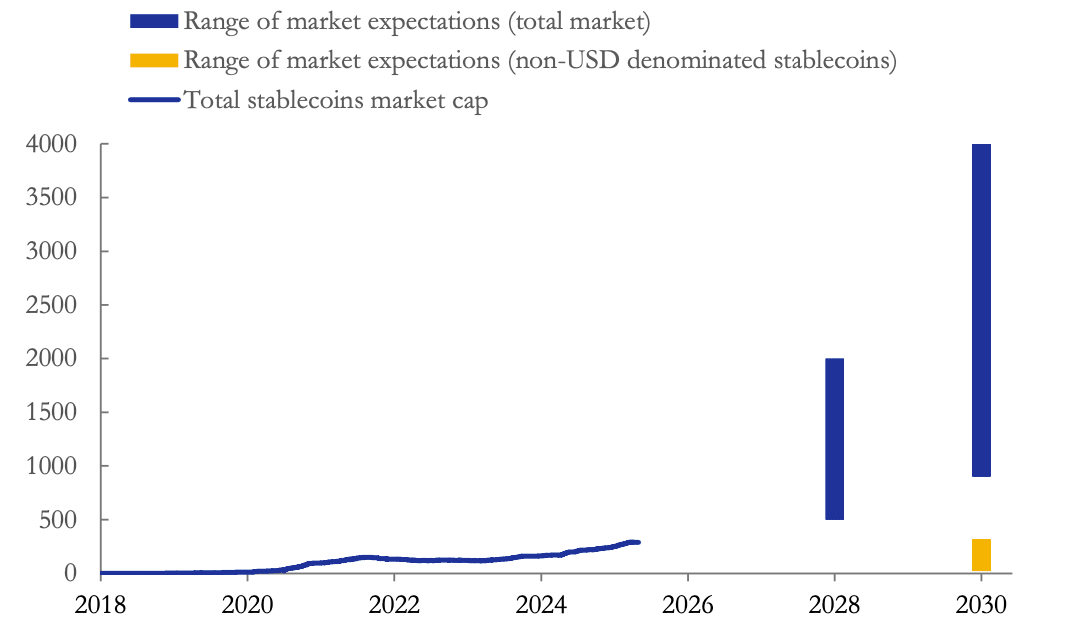 Actual and expected stablecoin market development. Source: ECB (Citigroup, Coinbase, JPMorgan)
The report also finds that stablecoins can change how policy interest rates affect bank funding costs and lending, with impacts varying by adoption scale, design and regulation.
“We find that stablecoin adoption interferes with multiple monetary policy transmission channels, potentially weakening the predictability of policy actions,” the ECB said.
The central bank warned that foreign-currency stablecoins could further weaken the connection between domestic monetary policy and bank lending, with risks amplified when the market is dominated by non-euro-denominated tokens.
The study reiterated that US dollar-backed stablecoins make up the vast majority of the stablecoin market. Data from CoinGecko shows these dollar-pegged tokens are valued at $301 billion, representing 97% of total stablecoin market capitalization at publishing time.
Disclaimer: The content of this article solely reflects the author's opinion and does not represent the platform in any capacity. This article is not intended to serve as a reference for making investment decisions.
You may also like
After the Nasdaq evaporated over $2 trillion in a single month, Wall Street is starting to look for buying opportunities! Deutsche Bank upgrades its technology rating, and Goldman Sachs’s “seven signals” outline the bull narrative.
Deutsche Bank is optimistic about U.S. tech stocks, overturning its downgrade rating from three weeks ago. The bank claims that the large sell-off has created attractive buying opportunities and that most of the risks related to artificial intelligence have already been excessively priced in by the market.

NEAR Enters Bitwise Large-Cap Indexes in October Rebalance
Ethena Pay Adds Earn+ Through Aave V4 Lending on Avalanche

DoorDash (DASH.US) Outperforms Nasdaq Amid Tech Stock Selloff! Officially Announces $17 Billion Acquisition of Instacart; Will Grocery Delivery and Retail Advertising Drive a Revaluation of Value?
The complete integration of the two major platforms may enhance their overall competitive and bargaining power in terms of delivery economics, consumer reach, and retail media monetization. Grocery retailers lacking their own delivery networks are bound to face more significant bargaining pressure, while Walmart and Target, which own Spark and Shipt, are relatively more capable of withstanding the impact.
Crypto prices
More


