
TradFi to adopt 24/7 crypto rails sooner than expected: Bitwise

Bitwise chief investment officer Matt Hougan says he’s drastically cut his estimates of when “on-chain finance” will take off after seeing investors pile into crypto platforms such as Hyperliquid to trade tokenized assets amid the US-Israel attack on Iran.
In a post on Tuesday titled “The weekend that changed finance,” Hougan said crypto perps futures platform Hyperliquid became the epicenter for trading real-world assets like crude oil and tokenized gold while the US, European and Asian stock exchanges were closed at the time of the first attack on Saturday at about 3:30 am UTC.
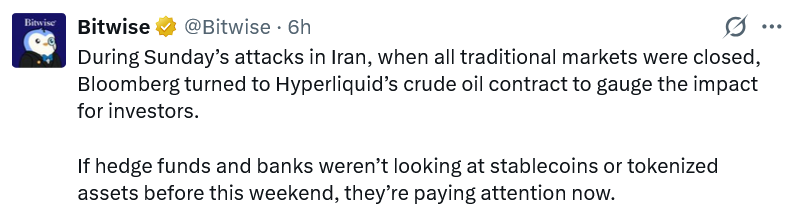 Source:
Bitwise
“For most of Sunday, onchain finance was the center of the financial world,” he said, adding that he previously expected traditional markets to take five to 10 years to move onchain but now sees that shift happening much sooner.
“This weekend proved me wrong. Now I’m convinced it’s going to happen much faster than that,” Hougan said, adding that blockchain’s 24/7 trading rails make “stock exchanges and T+1 settlement look archaic.”
Hougan said much of the weekend RWA trading activity took place on Hyperliquid, which saw over $11.5 billion in trading volume across Saturday and Sunday.
“When Bloomberg wanted to write about how crude oil responded to the bombing, it cited the Hyperliquid crude oil contract as the most relevant price,” Hougan said.
Tether’s tokenized gold product, Tether Gold (XAUt), also saw its 24-hour trading volume spike to over $300 million, while prediction markets volumes on Kalshi and Polymarket also rose, he noted.
NYSE is building a 24/7 tokenization platform
In January, the New York Stock Exchange and its parent, the Intercontinental Exchange, said it would enable 24/7 trading and instant settlement of stocks and exchange-traded funds with a blockchain post-trade system, including multi-chain support and custody features.
Related: Ray Dalio cautions on Bitcoin, says ‘there is only one gold’
However, no timeline was provided for the platform’s launch, nor were details shared about which blockchain it would be built on or whether it would operate in a permissionless or permissioned environment.
For now, Hougan said hedge funds, banks and other investors who want to “trade competitively” have no other choice but to set up a stablecoin wallet and learn how to trade on crypto perps platforms like Hyperliquid.
Magazine: South Korea gets rich from crypto… North Korea gets weapons
Disclaimer: The content of this article solely reflects the author's opinion and does not represent the platform in any capacity. This article is not intended to serve as a reference for making investment decisions.
You may also like
From "mining" to accelerated transformation into an AI data center operator! Cipher (CIFR.US) turns profitable in Q3 year-on-year, first HPC revenue recorded
The most significant change in Cipher Digital's third-quarter financial report, as bitcoin miners accelerate their transformation into large-scale developers and operators of high-density AI/HPC (High-Performance Computing) data centers, is the confirmation of AI/HPC leasing income for the first time.

Market Cap Surges by $1 Trillion in Nearly Four Months, 36x P/E Ratio Hits Highest Since 2008: Apple (AAPL.US) Earnings Leave No Room for Disappointment
Apple has reached its highest valuation since 2008 with a price-to-earnings ratio of 36, regaining the top spot globally with a market cap of $5.03 trillion. However, Wall Street remains cautious due to its high valuation and low growth, leaving little room for error in its earnings reports.

Quarterly refinancing statement due on Wednesday, U.S. Treasury market holds its breath for major signals
The U.S. Treasury will release its quarterly refinancing statement this Wednesday, and the market anticipates that this may be the largest adjustment to U.S. Treasury issuance guidance since the beginning of 2024. Citi even predicts that the Treasury might cut 20-year and 30-year bond issuances ahead of schedule, shifting to increase the supply of short- and medium-term bonds. However, with the proportion of Treasury bills already rising to 22%, the pressure from short-term financing and the demand for long-term borrowing are creating a dilemma for the adjustment of the issuance structure.

Crypto prices
More


