
"OpenAI Shadow Stocks" Crash! SoftBank's Share Price Halved Since Last November's Peak

SoftBank is paying the price for its big bet on OpenAI. As the most direct leveraged tool for ordinary investors to access OpenAI, the Japanese tech investment giant, led by Masayoshi Son, has seen its share price nearly halved in four months due to growing market concerns over the scale of SoftBank’s investment in OpenAI.
On Monday, SoftBank's share price plunged 9.8% in a single day, more than double the decline of the Japanese main index on the same day. The trigger was reports that OpenAI and Oracle have abandoned plans to expand the Stargate joint data center project in Texas, in which SoftBank is a key participant.
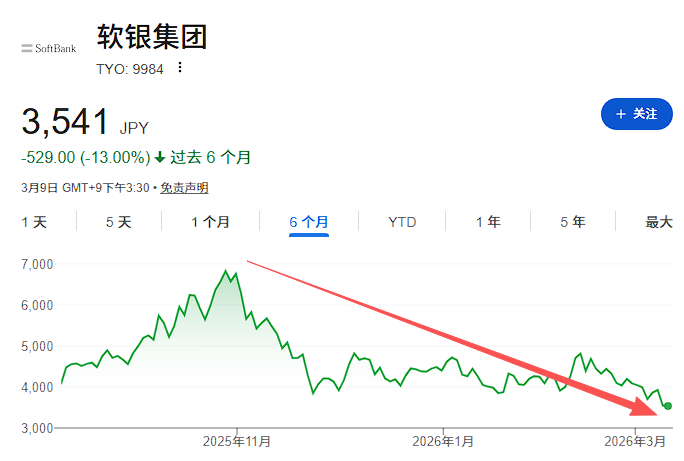
Just last month, SoftBank announced it would invest $30 billion in the latest $11 billion financing round of OpenAI, bringing its total investment in the ChatGPT developer to $64.6 billion and a stake of about 13%.
This steep share price drop has sparked widespread concerns about SoftBank’s liquidity position. This month, S&P has revised SoftBank’s already junk-rated credit rating outlook to negative, citing concerns over its liquidity and OpenAI’s credit quality.
At the same time, SoftBank is seeking bridge loans to cover the above investment until it can liquidate other holdings.
The Stargate Project Faces Uncertainty, Triggering Market Sell-off
The immediate reason for the latest share price fall is the news that the Stargate data center expansion plan has been stalled.
According to reports, OpenAI and Oracle have given up expanding the Texas-based, jointly backed data center project, and SoftBank is an important participant in Stargate.
This news has raised doubts about the strategic logic of SoftBank’s deep engagement with OpenAI. Just last month, SoftBank completed a $30 billion commitment in OpenAI’s latest financing round, bringing total investment to $64.6 billion and holding about 13% equity.
As uncertainties cloud the prospects of the Stargate project, expectations for returns on this colossal bet have wavered.
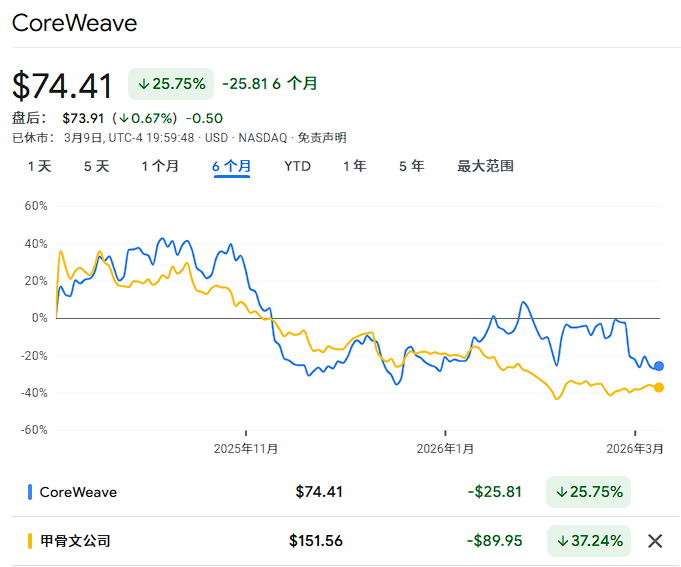
Other companies deeply involved in the OpenAI ecosystem have not been spared either. Since SoftBank’s share price peaked at the end of October last year, both Oracle and CoreWeave have seen their share prices drop by more than 40%.
Liquidity Pressure and Rating Downgrade
SoftBank’s asset structure makes it particularly vulnerable in the current market environment. According to S&P data, more than half of SoftBank’s $320 billion investment portfolio is made up of unlisted, illiquid assets. This structure becomes a significant constraint when the company needs to rapidly liquidate assets to meet massive investment commitments.
This month, S&P revised SoftBank’s rating outlook to negative for two main reasons: the overall liquidity situation of the company, and OpenAI’s own weak credit quality. Such comments only intensify SoftBank’s financing challenges and costs at a time when it is aggressively seeking bridge financing.
SoftBank’s current liquid assets include shares in chip designer Arm, worth about $80 billion.
Previously, SoftBank sold its Nvidia holdings to fund its early investments in OpenAI. Last week, despite turmoil in the Middle East, SoftBank pushed forward with the $1 billion IPO of its Japanese digital payment platform PayPay in New York.
Masayoshi Son's "Excitement Cycles" and Leverage Logic
From a broader perspective, SoftBank's development history is essentially a succession of "excitement cycles": Masayoshi Son identifies a new investment theme, the scale of investment expands, leverage rises, until shareholders or creditors—often both—begin to apply pressure.
Son is not without foresight. He earned rich rewards from an early bet on China's Alibaba, and in 2017 redefined the boundaries of venture capital with the $100 billion Vision Fund. However, this model has also led to notable failures, with WeWork being the most well-known example, and the Vision Fund as a whole experiencing ups and downs.
Today, thanks to its scale, renown, and characteristic use of leverage, SoftBank has become a rare liquidity tool for ordinary investors seeking exposure to big tech themes.
Analysts point out that this means whenever confidence in the “megatrends” bet by Masayoshi Son wavers, SoftBank is often among the first to be reduced in investor portfolios. At present, SoftBank is the most direct channel for ordinary investors to take a leveraged position on OpenAI—regardless of direction.
Notably, the last time SoftBank’s stock price fell sharply was in 2021, and at that time, the decline preceded a broader bear market by about eight months.
Disclaimer: The content of this article solely reflects the author's opinion and does not represent the platform in any capacity. This article is not intended to serve as a reference for making investment decisions.
You may also like
Intel (INTC.US) Decline Continues: PC Slowdown Is Just the Trigger, Foundry Dilemma Is the Main Issue
Intel (INTC.US) is facing increasing pressure to get its struggling foundry business off the ground.
Palantir (PLTR.US) commercial revenue surpasses government for the first time, annual forecast revised up to $8.53 billion
Palantir’s Q3 revenue increased by 96% year-on-year to $2.31 billion, with its commercial business surpassing government contracts for the first time. CEO Karp stated that demand for sovereign AI remains strong, and the company raised its full-year revenue guidance to $8.53 billion. Despite stock price volatility after hours, both profit indicators exceeded expectations.
US and Iran Show 'Willingness to Negotiate', Causing Global Energy Prices to Plummet
Iran's Supreme Leader has authorized the government to negotiate, while Trump has explicitly stated he "will not" resume military strikes if re-elected. The energy market is under pressure across the board: Brent crude plummeted over 6% in a single day, WTI fell below the $100 mark, and European benchmark natural gas futures at one point plunged nearly 11%. With the US election approaching, Trump faces both electoral challenges and pressure from Israel to initiate conflict. Iran has proposed a "seven-day plan" as its bottom line for reopening the Strait, with substantial underlying disagreements. Coupled with a sharp global inventory reduction of nearly 1 billion barrels, the downside for oil prices may be limited.

Apple (AAPL.US) doesn't burn money. Is the AI sell-off "safe haven" really secure?
Apple, which does not participate in the AI arms race, has become a "safe haven" amid the AI sell-off; however, with its high valuation, Apple also faces a judgment on its growth.
Crypto prices
More


