
Iran’s “soon to end” tough stance, gold price rebounds, Wall Street awaits inflation data for a miracle?

Huitong Network, March 10—— Spot gold continued its overnight rebound during the Asian session on Tuesday (March 10), finding support near the psychological $5,000 level and attracting follow-up buying. Currently, it is trading around $5,170 per ounce, up about 0.65% on the day. Ongoing geopolitical risks are sustaining safe-haven demand, while a strong U.S. dollar and inflation concerns are jointly capping gains, keeping gold prices in a moderate rebound trend.
Spot gold continued its overnight rebound during the Asian session on Tuesday (March 10), finding support near the psychological $5,000 level and attracting follow-up buying. Currently, it is trading around $5,170 per ounce, up about 0.65% on the day. Ongoing geopolitical risks are sustaining safe-haven demand, while a strong U.S. dollar and inflation concerns together limit gains, but gold prices maintain a moderate rebound.
The market focus remains on the latest developments of the US-Israel conflict with Iran on its eleventh day. Iranian officials gave a tough response to Trump’s statement that the conflict will “end soon,” reinforcing expectations for a prolonged confrontation, which supports gold’s appeal as a safe-haven asset.
Iran Rejects Trump's “End Soon” Remark, Says War’s End is Iran’s Decision
Iranian officials dismissed Trump’s statement that the “Iran war will end soon” as “nonsense.” The Islamic Revolutionary Guard Corps (IRGC) made it clear that the end of the war “will be determined by Tehran and not Washington,” adding that regional security “will either be for all or for none.”
After the new Supreme Leader Mojtaba Khamenei took office, Iran’s hardline stance has not softened, its proxy network remains active, and the missile threat persists, causing market optimism for a short-term end to the conflict to fade rapidly.
This statement has directly increased the geopolitical risk premium, revived safe-haven buying in gold, and limited the room for further intra-day pullback.
Oil Prices Rebound but Remain Volatile, Inflation Expectations Heat Up Again
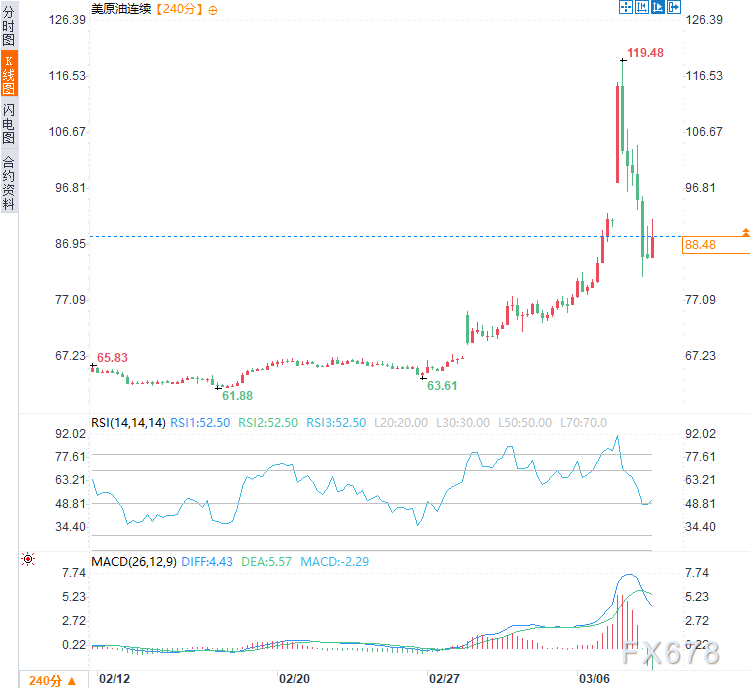
During the Asian session on Tuesday, US crude oil prices once tumbled sharply, as the G7 considered releasing oil reserves and Trump contemplated “relaxing” sanctions on Russian oil; prices once fell over 10%. However, the ongoing closure of the Strait of Hormuz continued to spark supply disruption concerns, causing oil prices to recover part of their losses. US crude is now trading near $88.60 per barrel, down about 6.5% on the day.
(U.S. Crude Oil 4-hour Chart, Source: EasyHuitong)
Energy prices fluctuating at high levels have once again boosted inflation expectations, with market concerns that sustained energy shocks will push up the CPI, making the Fed’s rate cut path more uncertain.
Rising inflation pressure has pushed up the real yield on U.S. Treasuries, providing short-term headwinds for non-yielding gold, but the safe-haven support from geopolitical uncertainty is stronger, so gold prices remain resilient overall.
The Dollar Pulls Back from March Highs, Fed Rate Cut Path Still Uncertain
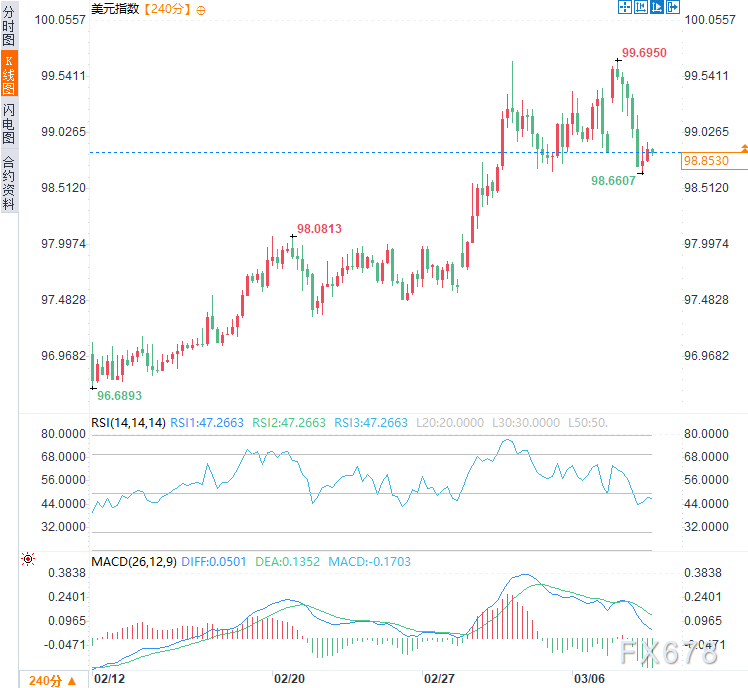
The US dollar index has pulled back from the March high (99.69) touched in the previous session, and weakened overnight, making gold more attractive to non-dollar holders. In the Asian session on Tuesday, the dollar index was narrowly fluctuating around 98.85.
However, the Fed’s “higher for longer” rate expectations still dominate, with market forecasts for the first rate cut postponed to September or even later. The rising opportunity cost puts pressure on gold, but demand for inflation hedges is starting to offset part of the negative factors. The trend of the dollar and comments from Fed officials this week may become key variables for gold prices.
(U.S. Dollar Index 4-hour Chart, Source: EasyHuitong)
The 200-Period EMA on the 4-Hour Chart Provides Support
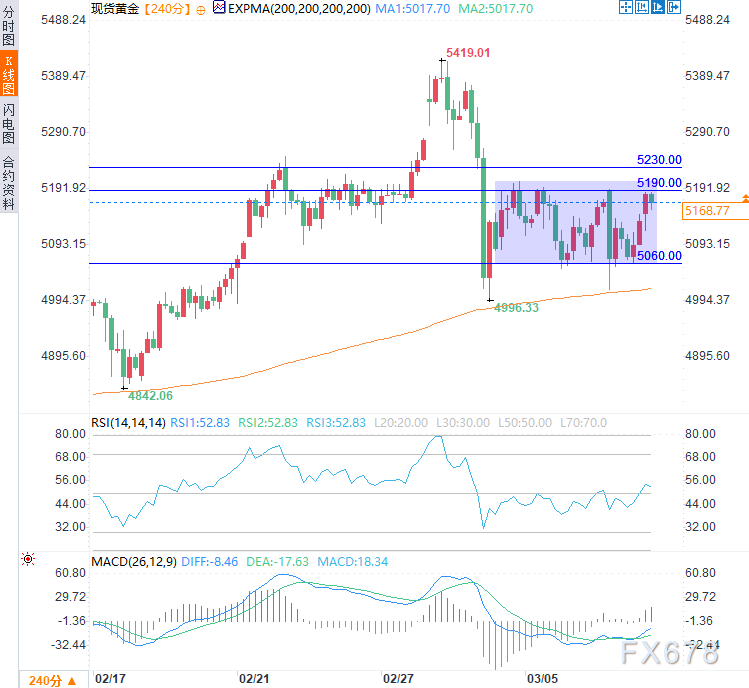
The 4-hour chart for spot gold shows that prices have been ranging in the past week, with support from the rising 200-period Exponential Moving Average (EMA, 5017.70), which converges with recent lows and becomes a key short-term support level.
The MACD lines have crossed above the signal line and positive histogram bars are expanding, indicating strengthening bullish momentum. The RSI sits above 50, reinforcing a moderately bullish tone.
On the downside, the recent low at $5,060 serves as the first support level, with the more significant defense at the dynamic support from the 200-period EMA.
On the upside, the initial resistance is at $5,190 (recent high), and after a breakout, the next level is at $5,230.
(Spot Gold 4-hour Chart, Source: EasyHuitong)
Key Focus on This Week’s CPI and PCE Data, Geopolitics Still Dominate Volatility
This week, US inflation data will become a new catalyst for gold prices: the February CPI will be released on Wednesday, and the PCE price index on Friday. If the data show persistent inflation, it will reinforce expectations for the Fed’s “higher for longer” stance, and weigh on gold; if the data show cooling, rate-cut bets will be rekindled and provide support.
At the same time, any diplomatic signals, battlefield progress, or proxy action from Washington, Tel Aviv, or Tehran could trigger sharp volatility. In the near-term, geopolitics remain the main driver of gold prices; in the medium-term, it will depend on inflation data and the Fed’s stance.
As of 13:51 (UTC+8), spot gold is trading at $5,172.19 per ounce.
Disclaimer: The content of this article solely reflects the author's opinion and does not represent the platform in any capacity. This article is not intended to serve as a reference for making investment decisions.
You may also like
US and Iran Show 'Willingness to Negotiate', Causing Global Energy Prices to Plummet
Iran's Supreme Leader has authorized the government to negotiate, while Trump has explicitly stated he "will not" resume military strikes if re-elected. The energy market is under pressure across the board: Brent crude plummeted over 6% in a single day, WTI fell below the $100 mark, and European benchmark natural gas futures at one point plunged nearly 11%. With the US election approaching, Trump faces both electoral challenges and pressure from Israel to initiate conflict. Iran has proposed a "seven-day plan" as its bottom line for reopening the Strait, with substantial underlying disagreements. Coupled with a sharp global inventory reduction of nearly 1 billion barrels, the downside for oil prices may be limited.

Apple (AAPL.US) doesn't burn money. Is the AI sell-off "safe haven" really secure?
Apple, which does not participate in the AI arms race, has become a "safe haven" amid the AI sell-off; however, with its high valuation, Apple also faces a judgment on its growth.
Apple's revenue and earnings last quarter exceeded expectations, but high memory costs, shrinking gross margin, weaker performance in China, and slowing growth in services | Earnings Report Insights
In the fourth fiscal quarter ending at the end of September, Apple's total revenue increased nearly 12% year-on-year. iPhone revenue exceeded expectations with a 17.5% increase, and Mac revenue grew nearly 24%, surpassing analysts' expectations by 11%. However, iPad and wearable device revenue both fell short of expectations. EPS rose 14% year-on-year, and the gross margin of 47.9% reached its lowest point in a year, supported by U.S. tariff exemptions. Service revenue hit a record high for a single quarter. Greater China revenue increased 21%, though it was still 6.5% below analyst expectations. For the full fiscal year, revenue set a historic record, but shareholder returns declined, with stock repurchases down nearly 5% from last year to $86.4 billion. During the earnings call, management disclosed that rising memory prices are eroding profit margins, and guidance for next quarter’s gross margin is only 45% to 46%, much lower than this quarter’s 47.9%. After-hours stock price fluctuated and turned downward, at one point dropping more than 4%.
Marvell plunges 13%, Lumentum plunges 19%! The second largest tech merger in history triggers sell-off
Marvell announced the acquisition of Lumentum for an enterprise value of $115 billion, making it the second largest deal in the technology industry’s history after the merger of SpaceX and xAI. Upon completion of the transaction, former Marvell shareholders will hold approximately 67% of the merged company, and the deal is expected to be finalized in the first half of 2028. However, as AI-related stocks are currently under pressure, the market is not optimistic about this deal. Both Lumentum and Marvell shares plummeted on Monday as investors are concerned about the limited potential for cost synergies and the uncertainty of regulatory approval.
Crypto prices
More


