
SEC’s ‘Crypto Mom’ calls for simpler disclosure rules, flags tokenization debate

US Securities and Exchange Commission (SEC) Commissioner Hester Peirce said regulators should avoid micromanaging markets and consider simplifying disclosure requirements as discussions around tokenized securities continue.
Peirce, often referred to as “Crypto Mom” for her generally supportive stance toward the digital asset industry, made the remarks Thursday during a speech to the SEC’s Investor Advisory Committee, warning that overly prescriptive rules can distort how capital flows through financial markets.
Citing Adam Smith, the 18th-century economist widely regarded as the father of modern economics, Peirce argued that regulators should exercise restraint when shaping market outcomes.
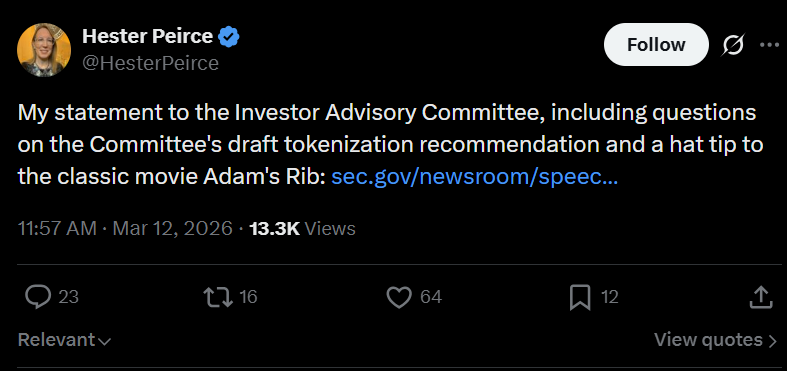 Source:
Hester Peirce
She said public companies often spend excessive time preparing mandated disclosures that may obscure rather than clarify information for investors, suggesting the SEC should consider streamlining disclosure rules.
Although the speech addressed broader regulatory issues, Peirce also pointed to the growing debate around tokenized securities and blockchain-based financial infrastructure.
She noted that SEC staff continue to work on a potential “innovation exemption” that could allow limited experimentation with tokenized securities while regulators assess how existing securities laws apply to blockchain-based markets.
Peirce also questioned whether additional disclosure and intermediary requirements would be necessary for tokenized securities, noting that blockchain systems could enable faster settlement and, in some cases, transactions without traditional intermediaries.
Related: Can US lawmakers pass crypto market structure before the midterms?
Tokenization gains traction at SEC
Tokenized securities have become an increasingly prominent topic for the SEC. Chair Paul Atkins said last year that he views tokenization as a major financial “innovation” that regulators should encourage rather than constrain.
The agency took a step in that direction in December, when it issued a no-action letter to the Depository Trust & Clearing Corporation (DTCC) allowing the market infrastructure provider to explore a blockchain-based tokenization service for securities.
The letter effectively signaled that the regulator would not recommend enforcement action if DTCC proceeded with certain tokenization-related activities, opening the door for the company to develop infrastructure to support blockchain-based settlement of traditional securities.
 Source:
Cointelegraph
The regulatory discussions around tokenization are also unfolding alongside broader policy debates in Washington over crypto market-structure legislation, which could eventually shape how digital assets are overseen in the United States.
Related: SEC chair calls for ‘coordinated oversight‘ between US regulators
Disclaimer: The content of this article solely reflects the author's opinion and does not represent the platform in any capacity. This article is not intended to serve as a reference for making investment decisions.
You may also like
The Bank of England is almost certain to raise interest rates this Thursday. How many more hikes will follow? Clear divergence between the market and economists.
The Bank of England's interest rate hike on Thursday is almost considered a certainty. However, there is a clear divergence between economists and investors regarding how many more times the Bank of England will raise rates in the future.

The AI optical interconnect sector welcomes an epic integration! A $115 billion super merger endorsed by Nvidia (NVDA.US) CEO Jensen Huang
Before finalizing this massive deal, the executives of Marvell Technology and Lumentum both received support from Nvidia CEO Jensen Huang.
Everything from Apple is getting more expensive, all because of AI
After Five Consecutive Rate Hikes, a Pause? RBA Governor Signals 'Wait and See', Aussie Dollar Drops
The Reserve Bank of Australia raised interest rates to 4.85%, reaching an 18-year high, but Chairman Bullock signaled a wait-and-see approach, causing the Australian dollar to fall. Sticky inflation and the largest drop in the real estate market in 40 years put the central bank in a difficult position.

Crypto prices
More


