
Fira launches fixed-rate DeFi lending market with $450M in deposits

Ethereum-based decentralized finance (DeFi) lending protocol Fira said on Tuesday it was launching with about $450 million in deposits, highlighting demand for fixed-rate onchain credit.
Fira said the protocol’s fixed-rate credit market allows users to lock borrowing costs and lending returns for defined periods by organizing lending around maturities rather than floating utilization-based rates, according to an announcement shared with Cointelegraph.
The fixed-rate model differs from most DeFi lending protocols, where borrowers annot lock funding costs, and lenders cannot predict returns, making long-term DeFi lending less predictable. Fira’s said its model organizes markets by maturity and determines interest rates by supply and demand mechanics, replacing utilization algorithms that fluctuate with borrowing activity.
Fira said the design is intended to create a more predictable onchain credit market by introducing yield curves and defined maturities, features that are standard in traditional fixed-income markets but rare in DeFi.
Fira is not the first DeFi lending protocol built around fixed-rate credit. Other protocols with similar structures include Notional Finance, IPOR and Term Finance.
 Fira debuts fixed-rate onchain credit market. Source: Fira
Euler-linked liquidity migrated into Fira
Fira said it debuted with $450 million in deposits, which were “reallocated” from users of the modular lending platform Euler Finance during the pre-launch phase that started on Jan. 8, Pete Siegel, chief financial officer at Fira, told Cointelegraph.
“Fira was pre-launched in January. It opened with a first market called UZR, which enabled roughly a thousand users who were already on Euler, in a product available on Euler to migrate their assets at a fixed rate.”
Siegel said the deposits were a sign of “real demand” for users seeking DeFi lending products with more predictable rates.
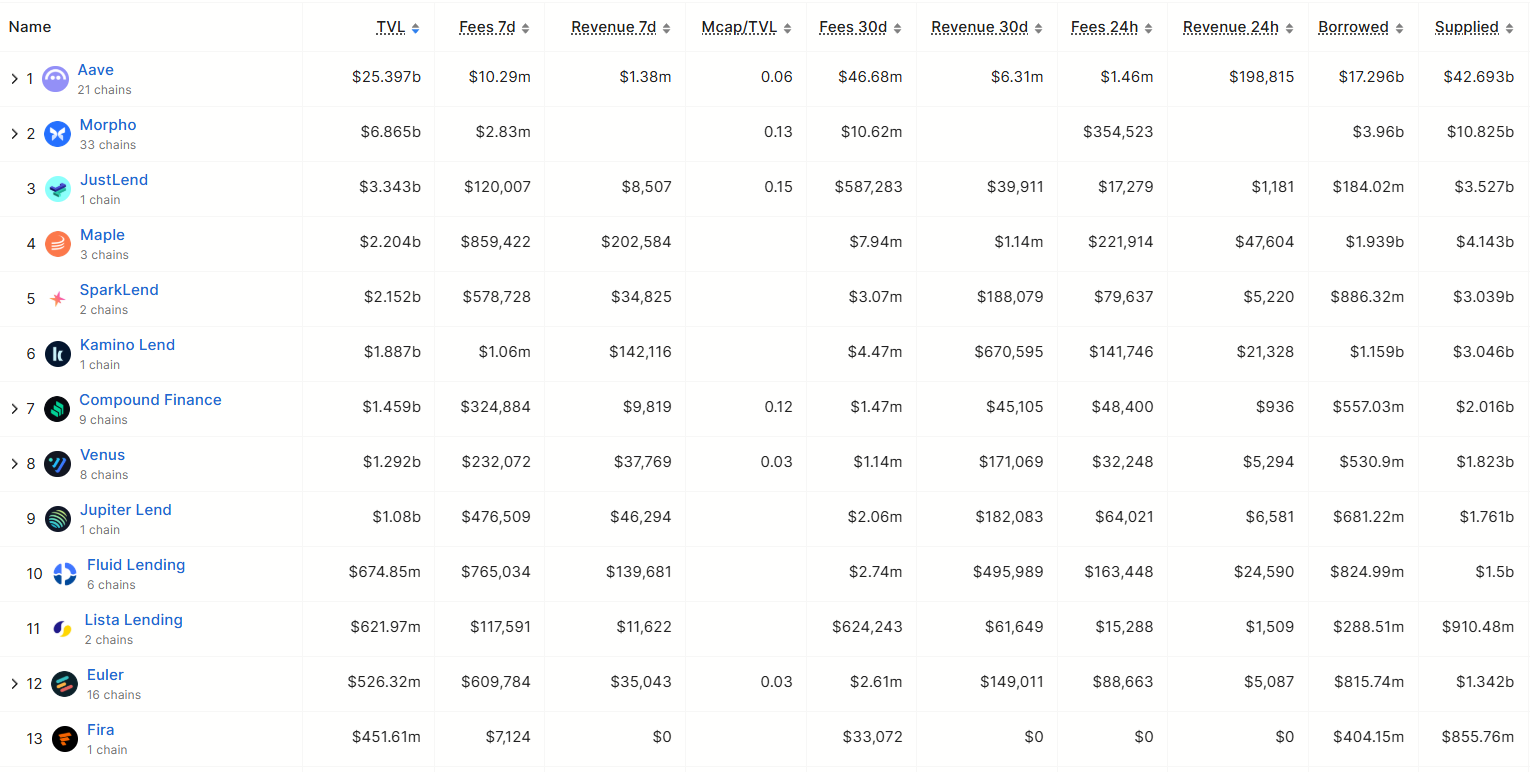 DeFi lending protocol rankings by TVL. Source: DeFiLlama
DefiLlama currently shows Fira with about $451.6 million in total value locked on Ethereum, compared with roughly $25.3 billion for Aave, the sector’s largest lending protocol.
Related: Maestro launches mining-backed Bitcoin credit market for institutions
Fira said its smart contracts have undergone six independent security audits conducted by Sherlock, Spearbit via Cantina, Hexens and yAudit between November 2025 and early 2026.
Fira’s bug bounty program through Sherlock offers up to $500,000 in rewards for users finding critical vulnerabilities in the protocol’s open-source Ethereum-based smart contracts.
Magazine: DeFi will rise again after memecoins die down: Sasha Ivanov
Disclaimer: The content of this article solely reflects the author's opinion and does not represent the platform in any capacity. This article is not intended to serve as a reference for making investment decisions.
You may also like
All Eyes on Walsh: Will the "Central Bank Super Week" See a G7 Rate Hike Wave Next Week?
Amid rising inflation, geopolitical conflicts, and oil prices surpassing $100, G7 central banks are entering a crucial rate-setting week. Driven by higher-than-expected core inflation, the Federal Reserve is expected to implement its first rate hike in three years; the Bank of Japan is likely to raise rates to 1.25%, marking a 30-year high; meanwhile, the Bank of England, the European Central Bank, and the Bank of Canada are also reinforcing their hawkish stances. Global monetary policy is undergoing a major turnaround towards collective tightening.
Uniswap processes $70.6 billion in 30-day DEX trades, outpacing rivals
Morgan Stanley’s $50.6M BTC buying shields market – But rally to $82K has THIS hurdle
Will the Fed "continue raising interest rates"? Will the "tightening cycle" of the late 1980s be repeated?
The Citi report points out that the current macro environment is highly similar to the tightening cycle of 1988-1989, when the economy remained resilient and inflation pressures gradually accumulated, followed by a slowdown in economic activity before policies shifted to easing. During that tightening cycle, the Federal Reserve raised interest rates 16 times in a row.
Crypto prices
More


