
Net Selling Pressure in US Stocks Nears COVID Crash Peak, Goldman Sachs: CTAs to Fully Shift to Buying in the Next Month

Selling pressure in the US stock market is approaching historical extremes, but conditions for a rebound are also quietly accumulating.
According to data from the Goldman Sachs prime brokerage trading desk, hedge funds have reduced global equity positions for six consecutive weeks, with net selling ranking third over the past decade—approaching the peak levels seen during the pandemic-driven crash. Meanwhile, Goldman Sachs analysts note that trend-following system investors (CTAs) have sold approximately $190 billion worth of equities in the past month and now hold around $50 billion in net short positions in global equities. However, their selling momentum is nearing exhaustion.
Goldman Sachs believes these extreme positions are creating asymmetric upside potential for the market. The bank estimates that over the coming month, CTAs will turn into net buyers regardless of market direction. In addition, pension fund end-of-quarter rebalancing is expected to provide buying support, and about $7 billion in negative Gamma exposure for option market makers will expire at the end of the month—alleviating multiple layers of technical pressure simultaneously.
Hedge Fund Selling Approaching a "Capitulation" Signal
In its weekly market data review for the week ending March 26, the Goldman Sachs prime brokerage team pointed out that the latest round of hedge fund reductions was broad-based, resulting in net selling across major regions. In Europe, macro product short exposure has risen to 11%, a ten-year high.
In the US market, the Goldman team stated in a separate report that "some signs of capitulation are starting to emerge," suggesting that pessimism among funds is nearing its limit. Measured over a rolling six-week period, US equities' net selling ranks third highest over the past decade—close to levels seen during the pandemic crash, but still lower than the peak during the 'Liberation Day' tariff shock in April 2025.
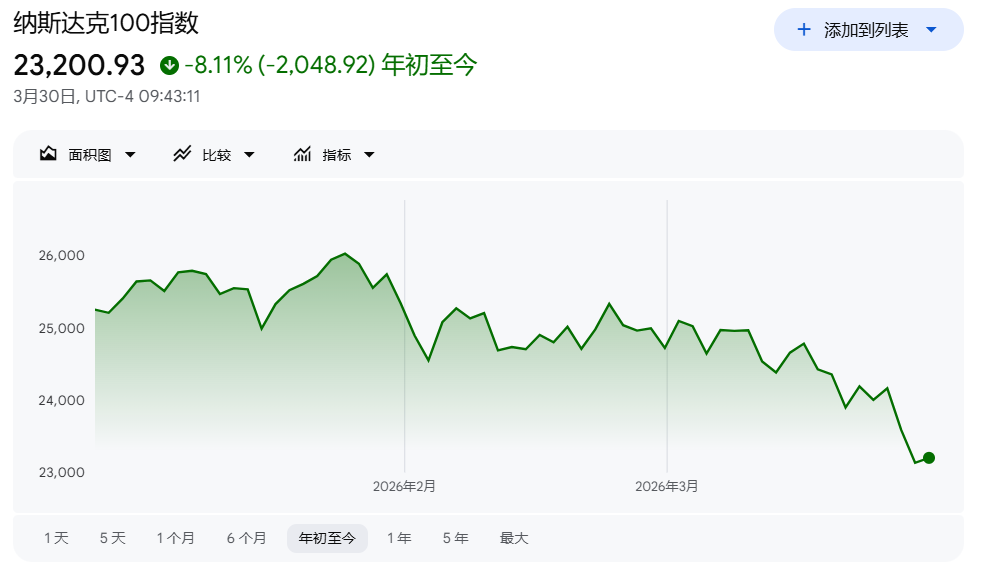
From a market performance perspective, what was once considered a moderate pullback is deepening. The Nasdaq 100 index is now down more than 10% from its peak, officially entering a technical correction zone; the S&P 500 index is also nearing this threshold. Meanwhile, the Europe Stoxx 600 index has fallen nearly 9% since March, on track for its worst single-month performance in six years.
CTA Selling Pressure Nearing Exhaustion, Upside Asymmetry Becomes Apparent
Changes in system investor positioning are another key variable in the current market. Goldman Sachs analyst Cullen Morgan notes that CTAs have sold a total of about $190 billion in the past month and now hold about $50 billion in net shorts across global equities, but their selling force is fading.
"Systematic investors are running out of ammunition," Morgan wrote. "The asymmetry points to the upside—we estimate that in any scenario, CTAs will turn buyers within the next month."
At the same time, Goldman’s models suggest that pension funds will buy equities during end-of-month and end-of-quarter rebalancing. In addition, the approximately $7 billion in negative Gamma exposure held by option market makers will expire at month’s end, automatically eliminating a persistent technical headwind. The combination of these factors sets the stage for a potential short-term technical rebound.
Geopolitics Remain the Biggest Uncertainty, Goldman Declines to Call a "Bottom"
Despite extreme technical signals, Goldman Sachs remains cautious as to whether the market has bottomed. Brian Garrett at Goldman Sachs wrote in a client report, "It feels like we are closer to the end than the beginning, but this game doesn’t have a classic 'number of rounds.'"
Garrett points out that there is currently no market participant who can provide a clear timeline for the Iran conflict, and a de-escalation will require consensus among multiple parties—a sign that is still absent.
"Though, as sell-side analysts, 'successfully calling the bottom' is pleasant—many have tried to do so—but to be honest, we’re not there yet," Garrett said.
The overall judgment from Goldman Sachs is: the unwinding of extreme positions and technical pressures provides the market with asymmetric upside potential, but a genuine trend reversal will still depend on substantive easing of geopolitical tensions.
Disclaimer: The content of this article solely reflects the author's opinion and does not represent the platform in any capacity. This article is not intended to serve as a reference for making investment decisions.
You may also like
MSTR stock falls 6.8% in 2026 despite Strategy’s $20.9B Q3 income – Why?

Bank of Japan shifts to “anti-inflation” mode! Kazuo Ueda hints at further room for rate hikes, December move under watch
The Bank of Japan kept its policy rate unchanged at 1.25% on Friday, but Governor Kazuo Ueda's remarks at the post-meeting press conference sent policy signals that are more noteworthy than the rate decision itself.

Betting Big on AI Burns Through Cash Cows—This Time, the Market No Longer "Rewards Burning Money"!
The AI spending race faces profitability scrutiny: Google’s search advertising growth rate has dropped to its lowest in five quarters, and Amazon’s single-quarter free cash flow has plunged to -$33.5 billion. Yet both companies continue with capital expenditure plans exceeding $400 billion. As their core cash-generating businesses lose momentum and debt and financing needs surge, the market is shifting from rewarding AI investment to questioning returns, forcing a re-evaluation of the valuation logic for tech giants.

Wall Street Sees AWS’s Ambition, But Can’t See the Future of Amazon’s Advertising Business
Amazon's Q3 financial report presents a mixed picture: AWS order backlog soared by 189% to $578 billion, and the CEO made the rare promise that growth will exceed 40% in 2027-2028, aiming for $1 trillion in revenue within five to ten years. However, advertising business growth plunged from 26% to 12%, and capital expenditure reached $77.3 billion, far exceeding expectations, causing the stock price to fall 7% after hours. While major Wall Street banks collectively maintain their “buy” ratings, they admit that the structural risks posed by AI agents to the advertising ecosystem remain unresolved.
Crypto prices
More


