
BitGo expands Canton Coin services with trading, onchain settlement

Digital asset infrastructure provider BitGo has expanded support for Canton Coin, adding trading and settlement services to its existing custody offering, in a move that aligns with a wider industry push to develop trading and settlement rails for tokenized financial assets.
In a Monday announcement, BitGo said it has become one of the first US-based regulated providers to offer custody, over-the-counter (OTC) trading and settlement for Canton Coin within a single platform, although similar bundled services have begun emerging across the digital asset sector.
BitGo initially began supporting the asset in October, allowing institutions to hold Canton Coin with a qualified custodian.
The latest update enables clients to trade Canton Coin electronically or via BitGo’s OTC desk, mirroring how traditional assets are executed in institutional markets. It also introduces settlement through the network’s infrastructure, allowing counterparties to complete transactions onchain.
BitGo said the expansion is part of its broader push to support tokenized finance, an area gaining traction among banks and financial institutions exploring blockchain-based settlement and asset issuance, with parallel efforts underway at firms such as Fireblocks and JPMorgan, which have also been developing tokenized settlement and payment systems.
Canton Coin has grown since late 2025, with its market capitalization reaching nearly $6 billion, according to CoinMarketCap data. The increase comes amid broader interest in tokenization and permissioned blockchain networks designed for regulated use cases.
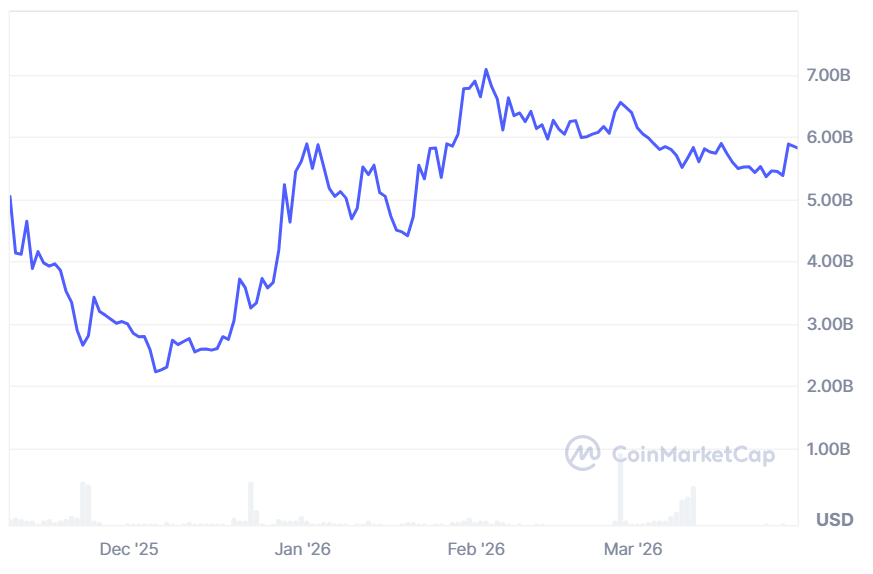 Canton Coin’s market cap has more than doubled since December. Source:
CoinMarketCap
Canton Coin is the utility token of the Canton Network, a layer-1 blockchain developed by Digital Asset. The network is designed for institutional adoption, with privacy and compliance features.
Related: Fireblocks integrates Canton Network for regulated onchain settlement
Institutional participation grows amid regulatory developments
The move comes amid growing institutional participation in the digital asset market, supported by major industry developments and a gradually evolving regulatory framework.
In a 70-page report released in December, Coinbase said institutional adoption was approaching an inflection point despite ongoing market volatility.
The crypto exchange pointed to evolving US legislation, including the GENIUS Act on stablecoins and potential progress on a broader crypto market structure bill, as factors that could accelerate institutional involvement.
 Institutional adoption mirrors broader trends in US policy developments. Source: Coinbase Institutional
A separate report published in January by Binance Research similarly found that institutional capital is playing an increasingly prominent role in digital asset markets, with activity shifting away from retail-driven trading.
Related: Crypto Biz: Stablecoin jitters meet institutional momentum
Disclaimer: The content of this article solely reflects the author's opinion and does not represent the platform in any capacity. This article is not intended to serve as a reference for making investment decisions.
You may also like

Federal Reserve Officials Turn Hawkish: Logan Expects at Least Two More Rate Hikes, Musalem Calls for Swift Action
Dallas Federal Reserve President Logan stated that the current economic outlook means the Federal Reserve will need to implement at least two more 25-basis-point rate hikes, but these can be carried out gradually to help the market adapt to rising interest rates. The St. Louis Federal Reserve President said that further tightening of monetary policy is necessary and actions should be taken as soon as possible. Early, gradual policy adjustments would cause less disruption than larger, more abrupt measures forced upon the market in the future.

U.S. tech stocks plunge, crude oil joins U.S. Treasuries as a safe haven: Brent hits six-month high, front-month premium nears decade extreme
On Friday, the Nasdaq closed down nearly 3%, and together with the S&P, both recorded their largest declines in five months. Meanwhile, crude oil rebounded over 2%, with Brent oil rising for six consecutive weeks. The near-month contract premium over longer-term contracts reached $2, approaching the highest level in at least a decade. The 10-year U.S. Treasury yield hit its lowest intraday level in more than a month.

Earnings guidance falls far short of expectations, Intel (INTC.US) plunges 29%, marking the largest single-day drop since the 1970s
Intel's stock plummeted by 29% on Friday, marking its largest single-day drop since the 1970s.
Crypto prices
More


