
Strategy's reported 617 BTC buy via STRC is still an estimate, not a confirmed same-day filing. Here's what SEC disclosures verify and how the 1.4x daily supply comparison fits.

An unconfirmed estimate circulating on April 2, 2026 suggests Michael Saylor’s Strategy purchased roughly 617 BTC in a single day through its STRC at-the-market share program, a figure that would represent approximately 1.4 times the daily supply of newly mined bitcoin BTC +0.00% . No same-day SEC filing or official Strategy dashboard update has confirmed the exact purchase.
What the 617 BTC via STRC Estimate Actually Claims
The 617 BTC figure appears to originate from a Bitcoin Magazine post on X rather than an official Strategy announcement or regulatory filing. According to that unconfirmed report, STRC Live, a third-party tracking tool, generated the estimate based on Strategy’s ongoing at-the-market offering activity.
No April 2, 2026 Form 8-K or other SEC disclosure was found to verify an exact 617 BTC purchase on that date. The number should be treated as a real-time estimate, not a confirmed transaction.
What Is Confirmed vs. What Remains an Estimate
What is confirmed: Strategy has been actively selling STRC shares and using the proceeds to acquire bitcoin, as documented in multiple SEC filings from March 2026. What is not confirmed: the specific claim that exactly 617 BTC changed hands on April 2. Investors tracking daily bitcoin ETF flow data should apply the same caution to live purchase estimates from third-party trackers.
What Strategy’s SEC Filings Confirm About STRC-Funded Bitcoin Buying
Strategy’s March 16, 2026 Form 8-K disclosed that the company sold 11,818,467 STRC shares during March 9-15, 2026, generating approximately $1.1804 billion in net proceeds. The filing explicitly stated that those proceeds funded bitcoin purchases through the ATM offering program.
During that same week, Strategy acquired 22,337 BTC for $1.57 billion, bringing total holdings to 761,068 BTC. The scale of that single-week accumulation demonstrates the STRC mechanism is already operating at significant volume, a dynamic that also shapes how traders assess which crypto assets to watch for institutional momentum.
How STRC Functions as a Bitcoin Funding Route
STRC is a preferred stock instrument that Strategy sells through at-the-market offerings. Proceeds flow directly into bitcoin purchases, creating a continuous acquisition pipeline without requiring traditional debt issuance or equity dilution of common shares.
On March 23, 2026, Strategy filed a second Form 8-K expanding the STRC ATM program. The filing authorized a new $21.0 billion STRC issuance capacity and increased authorized STRC shares from 70,435,353 to 282,556,565. Three new sales agents, Moelis, Alliance, and StoneX, were added to the program.
This expansion signals that Strategy intends to accelerate STRC-funded bitcoin accumulation well beyond the pace seen in March. The verified funding mechanism, however, does not by itself confirm any specific daily purchase figure, and the evolving U.S. regulatory landscape around crypto continues to shape how public companies disclose digital asset transactions.
Why the 1.4 Times Daily Mined Supply Comparison Matters
Following the April 2024 halving, bitcoin’s block subsidy stands at 3.125 BTC per block. With roughly 144 blocks mined per day, daily new issuance totals approximately 450 BTC.
If the 617 BTC estimate were accurate, that single-day purchase would represent about 1.37 times the entire daily mined supply, commonly rounded to 1.4x. This ratio captures attention because it suggests corporate treasury demand alone could absorb more than a full day’s new bitcoin production.
Treasury Demand vs. New Issuance as a Market Lens
When a single buyer consistently acquires more bitcoin than miners produce, it creates a structural imbalance between new supply and institutional demand. Strategy’s verified March purchases of 22,337 BTC over one week averaged roughly 3,191 BTC per day, more than seven times daily issuance, making the estimated 617 BTC figure modest by comparison.
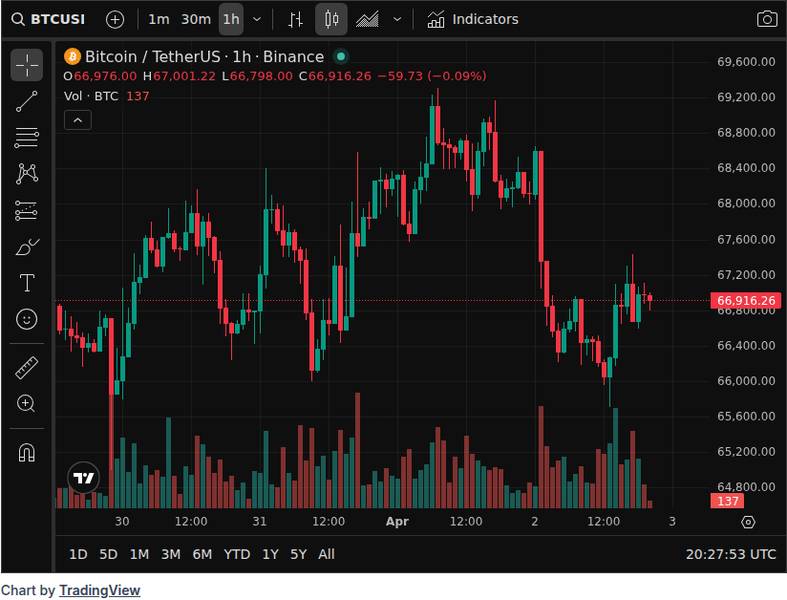
Bitcoin was trading near $66,960 on April 2, with a market cap of roughly $1.34 trillion and 24-hour trading volume around $49 billion.
 CoinGecko market snapshot used to anchor the spot-price section for bitcoin.
The key watchpoint is whether a future SEC filing or official Strategy dashboard update confirms the April 2 estimate. Until then, the 617 BTC figure remains an unverified data point from a third-party tracker, contextualized by a well-documented pattern of STRC-funded bitcoin accumulation already operating at scale.
Disclaimer: The content of this article solely reflects the author's opinion and does not represent the platform in any capacity. This article is not intended to serve as a reference for making investment decisions.
You may also like
Booking (BKNG.US) Q3 total bookings reach $54.5 billion, exceeding expectations; adjusted EPS increases by 17%. Q4 guidance turns cautious due to Middle East situation.
Booking Holdings (BKNG.US), the world's largest online travel company, released its Q3 2026 earnings after the US stock market closed on Tuesday. Total bookings, room nights, and adjusted profitability indicators all exceeded market expectations for the quarter, with adjusted earnings per share surging by 17%.
Bank of Canada Says Government Spending Has Not Fueled Inflation; Heavy Crude Oil Discount Hits Eight-Year High
Bank of Canada Governor Macklem stated that government fiscal plans have not yet significantly pushed up inflation, but there are still differences in the market regarding fiscal stimulus and interest rate hikes. Meanwhile, due to rising international shipping costs and intensified competition, the discount for Canadian heavy crude oil has widened to its highest level in eight years.
Alphabet (GOOGL.US, GOOG.US) Re-enters U.S. Municipal Bond Market, Plans to Participate in $1.5 Billion Prepaid Energy Financing Deal
Alphabet, Google’s parent company, is planning to re-enter the U.S. municipal bond market through a $1.5 billion prepaid energy financing deal.

AMD (AMD.US) Q3 Revenue Up 45% Year-on-Year, Reaches Record High; Data Center Business Revenue Nearly Doubles
Data shows that the company’s revenue in the third quarter reached $13.377 billion, a year-on-year increase of 45% and a quarter-on-quarter increase of 16%, setting a new historical high.
Crypto prices
More


