
Crypto attorney says Drift incident may qualify as 'civil negligence'

The hack of the Solana-based decentralized finance (DeFi) platform Drift Protocol could have been prevented if standard operational security procedures were followed by the Drift team, and may constitute “civil negligence,” according to attorney Ariel Givner.
“In plain terms, civil negligence means they failed their basic duty to protect the money they were managing,” Givner said in response to the post-mortem update provided by the Drift team and how it handled Wednesday’s $280 million exploit.
The Drift team failed to follow “basic” security procedures, including keeping signing keys on separate, “air-gapped” systems that are never used for developer work, and conducting due diligence on blockchain developers met through industry conferences.
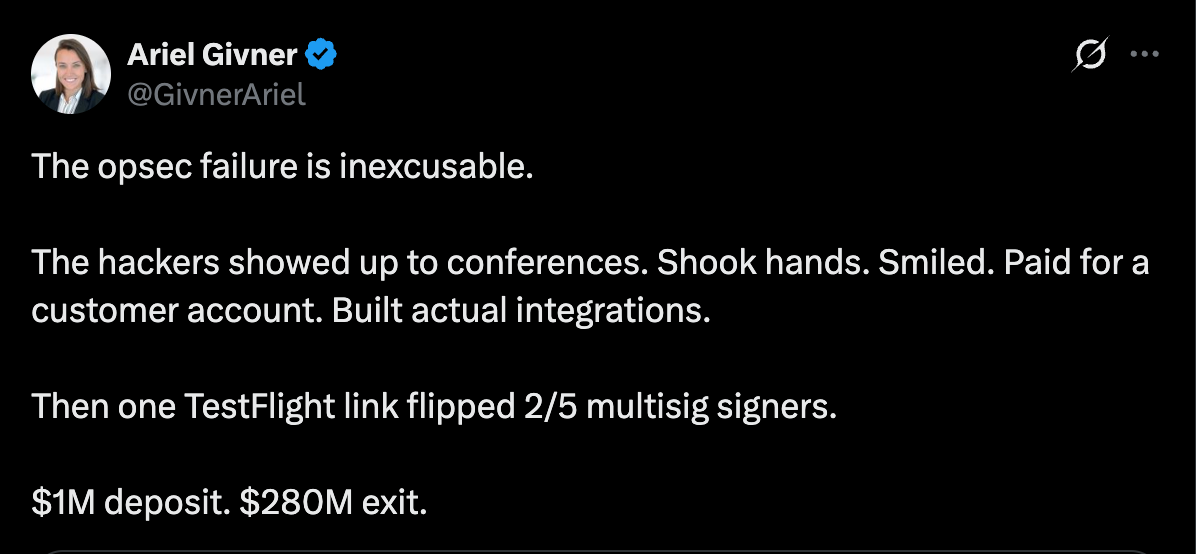 Source:
“Every serious project knows this. Drift didn’t follow it,” she said, adding, “They knew crypto is full of hackers, especially North Korean state teams.” Givner continued:
“Yet their team spent months chatting on Telegram, meeting strangers at conferences, opening sketchy code repos, and downloading fake apps on devices tied to multisignature controls.”
Advertisements for class action lawsuits against Drift Protocol are already circulating, she said. Cointelegraph reached out to the Drift Team but did not receive a response by the time of publication.
 Source:
The incident is a reminder that social engineering and project infiltration by malicious actors are major attack vectors for cryptocurrency developers that could drain user funds and permanently erode customer trust in compromised platforms.
Related: Drift explains $280M exploit as critics question Circle over USDC freeze
Drift Protocol says attack took “months” of planning
The Drift Protocol team published an update on Saturday outlining how the exploit occurred and claimed that the attackers planned the attack for six months before execution.
Threat actors first approached the Drift team at a “major” crypto industry conference in October 2025, expressing interest in protocol integrations and collaboration.
The malicious actors continued to build rapport with the Drift development team in the ensuing six months, and once enough trust was built, they began sending the Drift team malicious links and embedding malware that compromised developer machines.
These individuals, who are suspected of working for North Korea state-affiliated hackers and physically approached the Drift developers, were not North Korean nationals, according to the Drift team.
Drift said, with “medium-high confidence,” that the exploit was carried out by the same actors behind the October 2024 Radiant Capital hack.
In December 2024, Radiant Capital said the exploit was carried out through malware sent via Telegram from a North Korea-aligned hacker posing as an ex-contractor.
Magazine: Meet the hackers who can help get your crypto life savings back
Disclaimer: The content of this article solely reflects the author's opinion and does not represent the platform in any capacity. This article is not intended to serve as a reference for making investment decisions.
You may also like
Crypto Sentiment Hits Extreme Lows as Open Interest Surges: 5 Altcoins to Accumulate Before the Market Turns

Not Following Intel's Footsteps! AMD's Q3 Revenue Surges 45% Beating Expectations, Data Center Revenue Nearly Doubles, Q4 Guidance Accelerates to a New High | Earnings Report Insights
Q3 AMD revenue increased by 15.5% from the record set in Q2, with EPS up 74% year-on-year; client revenue grew 7% year-on-year, below expectations, gaming revenue exceeded expectations but dropped 40% year-on-year, and embedded revenue surpassed expectations with a 29% increase. Free cash flow fell 64% to $550 million, far below expectations, mainly due to inventory climbing nearly fourfold to $3 billion. Q4 revenue guidance midpoint is up 66% year-on-year to $17 billion, $700 million higher than analyst expectations and nearly 10% higher than Intel’s guidance for the same period. The CEO stated that with the ramp-up of the Helios system and Venice CPU, growth is expected to accelerate further in Q4. After-hours stock price once surged nearly 10%.
Booking (BKNG.US) Q3 total bookings reach $54.5 billion, exceeding expectations; adjusted EPS increases by 17%. Q4 guidance turns cautious due to Middle East situation.
Booking Holdings (BKNG.US), the world's largest online travel company, released its Q3 2026 earnings after the US stock market closed on Tuesday. Total bookings, room nights, and adjusted profitability indicators all exceeded market expectations for the quarter, with adjusted earnings per share surging by 17%.
Bank of Canada Says Government Spending Has Not Fueled Inflation; Heavy Crude Oil Discount Hits Eight-Year High
Bank of Canada Governor Macklem stated that government fiscal plans have not yet significantly pushed up inflation, but there are still differences in the market regarding fiscal stimulus and interest rate hikes. Meanwhile, due to rising international shipping costs and intensified competition, the discount for Canadian heavy crude oil has widened to its highest level in eight years.
Crypto prices
More


