
US Senate Banking panel member confirms April timeline for crypto market structure

US Senate Banking Committee member Bill Hagerty said Monday that he expects a potential path for a digital asset market structure in the coming weeks after months of delays in Congress.
Speaking at the Digital Assets and Emerging Tech Policy Summit at Vanderbilt University, he said his fellow Republican lawmakers planned to move the bill through the banking panel starting next week.
“We will be in a position, I hope, to bring all of this together very soon,” said Hagerty, referring to work on the bill in the Senate. “On the banking committee side, I think we’re very close, and my expectation is that we get it into committee in this next work period that starts on Monday of next week, so that over the next several weeks we should have this into the banking committee.”
The Tennessee senator added:
“There’re several issues still outstanding, I think none of them are insurmountable and we will get to a point I believe in April that we’ll have it out of the banking committee. There’s still a lot more work to do.”
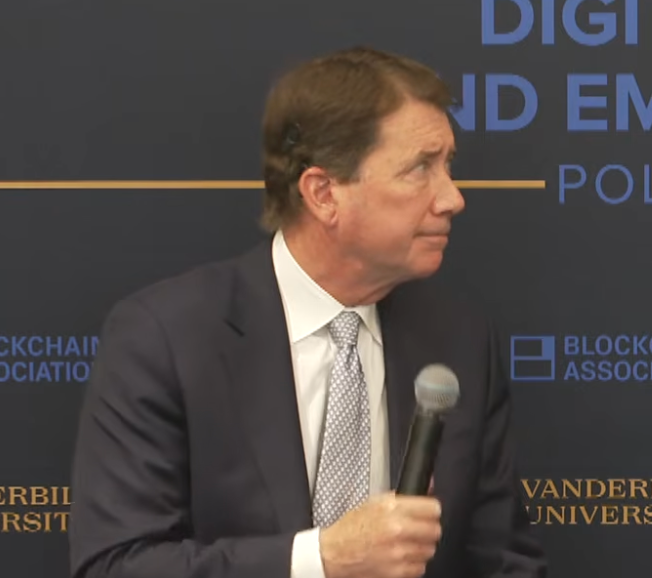 US Senator Bill Hagerty at the April 6 Digital Assets and Emerging Tech Policy Summit.
Source:
Originally titled the CLARITY Act when it passed the House of Representatives in July, the bill is considered by many lawmakers and industry leaders to be one of the most significant pieces of crypto legislation, but it has faced delays in Congress amid government shutdowns, industry pushback on stablecoin yield and ethics concerns.
It is expected to provide a comprehensive framework for cryptocurrencies in the US, including largely changing oversight of the market from the Securities and Exchange Commission (SEC) to the Commodity Futures Trading Commission (CFTC).
Because both agencies are involved, the legislation would need approval from the committee responsible for commodities — Senate Agriculture — and that for securities, the banking committee. The agriculture committee advanced its version of the crypto bill in a January markup, but concerns over tokenized equities, ethics, and stablecoin yield have delayed consideration in the banking committee, which needs to hold a markup before a potential floor vote in the Senate.
Related:
“We’re going into the midterms,” said Hagerty. “I think if we get this done in April, we can clearly get this taken care of before the midterms.”
Limited window for market structure as crypto potentially influences US elections again
Hagerty’s comments echoed those of Coinbase chief legal officer Paul Grewal, who said last week that lawmakers were “close to a deal” on stablecoin yield and other issues in the market structure bill.
According to the Coinbase-backed advocacy group Stand With Crypto, the way lawmakers vote on the legislation could impact their chances for the 2026 midterms, setting the stage for crypto interest groups to potentially influence another major US election.
The crypto-backed political action committee (PAC) Fairshake, which reported spending more than $130 million on media buys in the 2024 elections, said in January that it had a $193-million war chest ahead of the November 2026 midterms.
The group is not alone in its support for crypto on the national stage. The Fellowship PAC, which claimed to have raised “over $100 million” from undisclosed backers aligned with the crypto industry, announced the appointment of Tether executive Jesse Spiro as chair on Wednesday.
Magazine:
Disclaimer: The content of this article solely reflects the author's opinion and does not represent the platform in any capacity. This article is not intended to serve as a reference for making investment decisions.
You may also like
US Midterm Elections, How Does the Market View Today
The outcome of the US midterm elections, with the Democratic Party winning the House of Representatives, has already been priced in by the market. The real variable is the Senate—Democrats need a net gain of four seats. The most probable scenario, a "Democratic sweep," would actually be the least favorable for the stock market. Bank of America considers it a risk event that could cause a drop of over 10%. The first signal will be seen at 8:30 AM Beijing time on November 4th when the votes in Ohio are counted; votes from Texas, Michigan, Kansas, Iowa, and Nebraska will be revealed starting at 10 AM.

Crypto Sentiment Hits Extreme Lows as Open Interest Surges: 5 Altcoins to Accumulate Before the Market Turns

Not Following Intel's Footsteps! AMD's Q3 Revenue Surges 45% Beating Expectations, Data Center Revenue Nearly Doubles, Q4 Guidance Accelerates to a New High | Earnings Report Insights
Q3 AMD revenue increased by 15.5% from the record set in Q2, with EPS up 74% year-on-year; client revenue grew 7% year-on-year, below expectations, gaming revenue exceeded expectations but dropped 40% year-on-year, and embedded revenue surpassed expectations with a 29% increase. Free cash flow fell 64% to $550 million, far below expectations, mainly due to inventory climbing nearly fourfold to $3 billion. Q4 revenue guidance midpoint is up 66% year-on-year to $17 billion, $700 million higher than analyst expectations and nearly 10% higher than Intel’s guidance for the same period. The CEO stated that with the ramp-up of the Helios system and Venice CPU, growth is expected to accelerate further in Q4. After-hours stock price once surged nearly 10%.
Booking (BKNG.US) Q3 total bookings reach $54.5 billion, exceeding expectations; adjusted EPS increases by 17%. Q4 guidance turns cautious due to Middle East situation.
Booking Holdings (BKNG.US), the world's largest online travel company, released its Q3 2026 earnings after the US stock market closed on Tuesday. Total bookings, room nights, and adjusted profitability indicators all exceeded market expectations for the quarter, with adjusted earnings per share surging by 17%.
Crypto prices
More


