
Morgan Stanley: Apple quietly hoards TSMC capacity, possibly for self-developed AI server chips

According to Chasing Wind Trading Desk, Morgan Stanley released a research report on April 10, revealing Apple's massive layout in the private cloud computing (PCC) field by tracking deep anomalies in the supply chain's production capacity.
The report reveals that Apple’s strategic focus is shifting from relying on third-party cloud services to a large-scale, capital-intensive internal investment, providing a key benchmark for evaluating Apple’s subsequent cost control and profitability trajectory.
Massive Wafer Orders Expose AI Ambitions
Apple is quietly buying out TSMC's advanced packaging capacity.
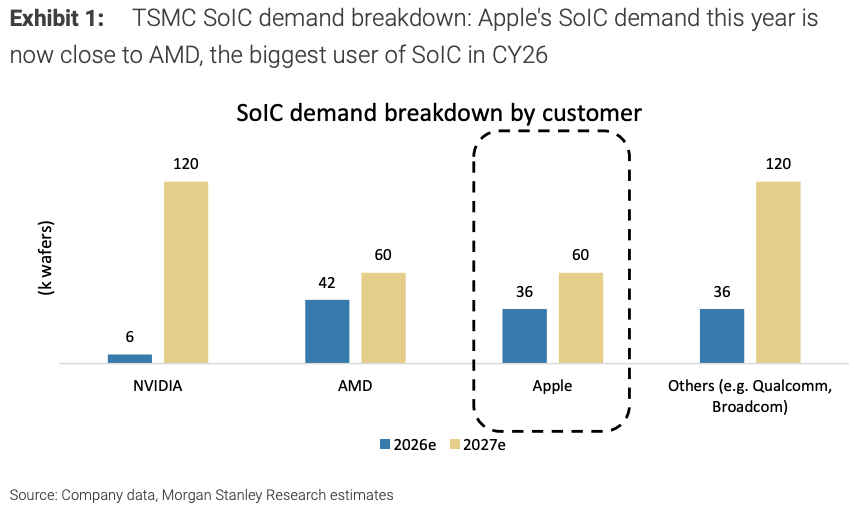
Apple's order volume for TSMC's SoIC (System-on-Integrated-Chip) is expected to reach 36,000 wafers by 2026 and soar to 60,000 wafers by 2027.
This number is highly unusual: it should be noted that the current largest SoIC customer, AMD, is forecasted to need just 42,000 wafers in 2026.
According to IDC data, high-end Mac annual shipments account for a very low proportion, meaning their actual consumption of SoIC capacity is at most no more than 1,600 wafers. Obviously, such a massive wafer order is certainly not intended for selling computers.
Targeting the “Baltra” Self-Developed Computing Power Server
Since conventional consumer-grade chips have been ruled out, where exactly is this expensive advanced production capacity going?
Morgan Stanley’s analysis points directly to Apple’s mysterious internal project—a self-developed AI server chip (internal codename "Baltra") designed specifically for private cloud computing.
“Based on the absolute scale of Apple’s orders... we believe that most of the SoIC capacity is prepared for Apple’s private cloud computing (PCC) 3nm AI ASIC (‘Baltra’).
This is set to replace the currently used M-Series Ultra processors to achieve better AI inference performance and efficiency.”
Shift in Capital Expenditure and Core Uncertainties
Such an aggressive underlying hardware bet not only corroborates past rumors of Apple’s long-term cooperation with Broadcom but also sends a clear signal to Wall Street: Apple is highly convinced of an explosive demand for Apple Intelligence inference.
Most of the AI workload will be locked onto Apple’s in-house chip servers, shifting its AI infrastructure from traditional operational expenditure (Opex) toward more sustainable capital expenditure (Capex).
However, behind this grand narrative of vertical integration, Morgan Stanley maintains a degree of cautious observation: although the strategic intent to pursue cost control is very clear, the actual performance and energy efficiency of Apple’s self-developed AI ASIC in large-scale deployment remain the biggest unknowns in this computational gamble.
Disclaimer: The content of this article solely reflects the author's opinion and does not represent the platform in any capacity. This article is not intended to serve as a reference for making investment decisions.
You may also like
CFTC gives the green light! US stock "perpetual contracts" land in the United States, Cboe and CME are anxious
CFTC approves stock perpetual contract trading, with Kalshi launching targets such as Amgen and McDonald's ahead of others; Cboe and CME file lawsuits in opposition, while Warren warns that this may cause market volatility.

High-growth narrative faces tough tests, causing Shopify (SHOP.US) shares to plunge after earnings! JPMorgan stands firm: Profit growth framework remains intact
JPMorgan reiterated its "Overweight" rating on Shopify, with a target price of $200 by December 2027.
Bubblemaps Price Prediction: BMT Price Surges 20% as Undisclosed Proxima Agreement Triggers Legal Threat
Crypto prices
More


