
All 39 US software companies wiped out!

Since 2026 until now,39 US-listed SaaS companies have all plummeted with no exception.
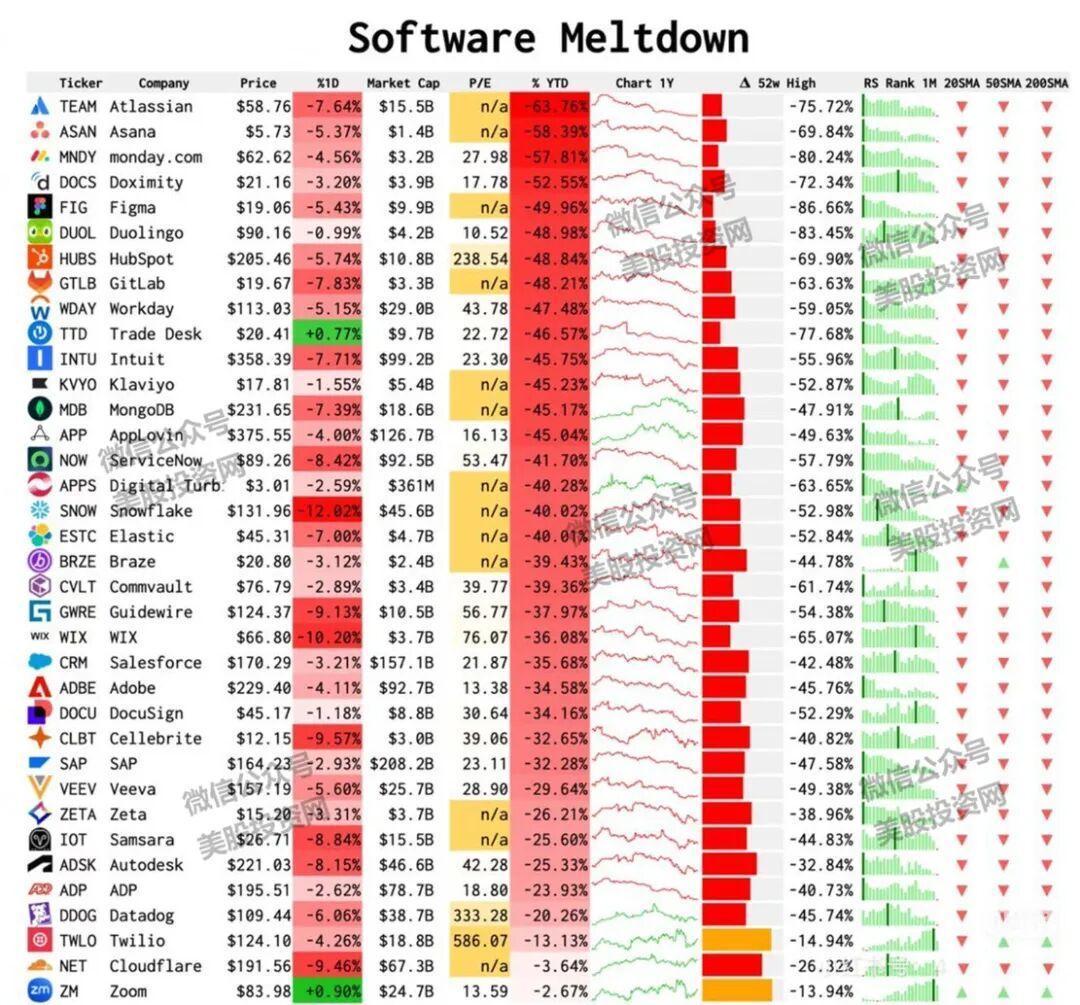
The data in this chart vividly illustrates the drastic downturn of the SaaS industry. The massive drop since the beginning of the year in project management giants like Atlassian(-63.76%), Asana (-58.39%), and Monday.com (-57.81%) is particularly striking.
The US Stock Investing Network’s point that “AI Agent is devouring traditional project management tools” does capture a very real and aggressive shift currently ongoing in the tech sector.
AI ’s Threat to Traditional SaaS Companies
The core value of traditional project management—manual tracking, status updates, and dragging Kanban cards—is exactly whatAI Agent was designed to automate.
As autonomous agents gradually gain the ability to read emails, chat logs, and code commits, and update project status and assign tasks in real time, traditional manually operated tools charging “per-seat” are facing a truly existential threat.
The market, driven by this concern, is aggressively repricing these companies: their core workflows could very soon be commoditized byAI .
A Bigger Reality: It’s Not JustAI
However, although the AI narrative is a major catalyst, to explain the sector’s “collapse” solely by this would be oversimplified. Declines of this magnitude are typically the result of a combination of several severe factors:
1) Valuations returning to reality
Many SaaS companies traded at sky-high price-to-sales (PS) ratios during the high-growth period. The current chart largely reflects the painful “mean reversion” process—the market is no longer willing to pay a premium for growth that does not lead to quick profitability.
2) Enterprise Seat Contraction (Seat Contraction)
Major enterprises are strictly auditing IT budgets:
Large-scale cleanup of software tools
Deduplication and feature consolidation
Cutting down the number of SaaS accounts
This trend had actually begun even before AImatured.
3) A Results-Oriented Market Environment
Today’s investors are very impatient with “traditionalSaaS.”
If a company cannot prove that:
It’s not just “adding a bit of AIfunctionality”
But can truly transform into anAI-first platform
without sacrificing profit margins
Then the market’s response is usually: sell first, explanations can wait.
Which ones did you buy?





Disclaimer: The content of this article solely reflects the author's opinion and does not represent the platform in any capacity. This article is not intended to serve as a reference for making investment decisions.
You may also like
When France and Germany pay for their deficits, fiscal discipline becomes the "moat" of the UK bond market; investors are positioning in advance for a rebound in gilt bonds.
Investors are betting that the new UK Chancellor, Healey, will uphold fiscal discipline and are purchasing gilts in advance. A smooth and steady budget plan is expected to turn the UK from a "risk" in the bond market into a "positive."
Anthropic's $2 Trillion IPO Faces Doubts: Risks of Mismatched Computing Commitments and Revenue
The independent institution New Constructs reported that the Anthropic IPO is absurd, with a valuation of only 150 billion. The main controversy lies in the mismatch between long-term computing power commitments and clients' short-term on-demand procurement models, coupled with macroeconomic headwinds and early investor sell-off pressure, leading to increased market volatility.

Anthropic allocates 5% of shares to set up a fund before IPO, Musk calls for direct distribution to the public
Anthropic announced the establishment of a public welfare fund, initially allocating 5% of its shares. When the company's valuation increases by 50%, another 2% will be added. The aim is to address the impact of AI on employment. Musk suggested directly distributing shares to the public.

AI Stocks Struggle to Rebound: Lacking Three Major Supports, July’s Rally Hard to Replicate
JPMorgan pointed out that due to the absence of ETF bargain-hunting funds, limited room for short covering, and the early termination of the $40 billion buyback by Samsung and SK Hynix, the rebound strength of AI stocks in October may not match that of July. The resurgence of leverage risk could intensify volatility.

Crypto prices
More


