
Crypto fund inflows hit $1.4B in second-strongest week since January

Cryptocurrency investment products logged another week of strong inflows on ceasefire optimism and a Bitcoin price breakout driving investor sentiment.
Crypto exchange-traded products (ETPs) posted $1.4 billion in inflows last week, beating the prior week’s $1.1 billion and marking the second-largest weekly inflows since January, CoinShares reported on Monday.
Following the three-week inflow streak totaling $2.7 billion, crypto ETPs now have net year-to-date inflows of around $3.8 billion, with assets under management (AUM) at $154.8 billion — the highest level since early February after dipping to as low as $128 billion in March.
The uptick in crypto funds has likely been driven by a recovery in risk appetite on US-Iran ceasefire extension talks, CoinShares head of research James Butterfill said.
The sentiment was further reinforced by Bitcoin (BTC) nearly touching $78,000 on Friday, according to CoinGecko.
Ether funds turn positive year to date
Bitcoin led last week’s ETP gains by a significant margin, with inflows totaling $1.12 billion. The gains brought year-to-date inflows to $3 billion, with AUM at $123 billion.
The majority of gains were contributed by US spot Bitcoin exchange-traded funds (ETFs), which posted $1 billion in inflows last week.
Ether (ETH) investment products also picked up with $328 million inflows in its strongest week since January, finally lifting the ETPs into green year-to-date with $197 million inflows.
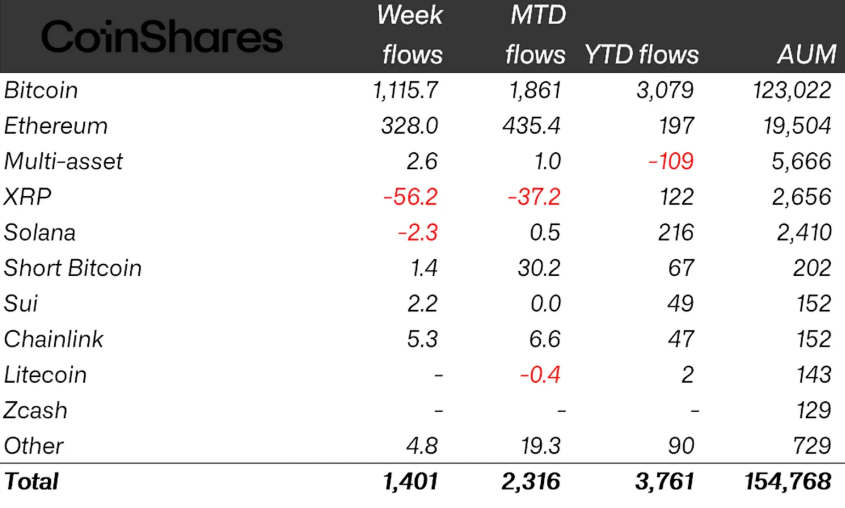 Crypto ETP flows by asset (in millions of US dollars). Source: CoinShares
Still, altcoin ETPs, including XRP (XRP) and Solana (SOL), recorded negative flows, with XRP leading the outflows at $56 million. Solana recorded minor outflows of $2.3 million.
Short-Bitcoin products saw a modest $1.4 million of inflows, suggesting residual but limited hedging demand.
Regionally, the US dominated the surge with $1.5 billion of inflows, while Germany ranked second with just $28 million of inflows. Switzerland saw the largest redemptions last week, with outflows totaling $138 million.
Addressing the implications of recent economic data, CoinShares’ Butterfill suggested that March’s Consumer Price Index (CPI) increase of 3.3% appears to have been largely looked through by markets, with core CPI at 2.6% seen as relatively contained, pointing to inflation pressures that remain more supply-driven than broad-based.
Related: Bitcoin erases weekend gains as US-Iran ceasefire faces pressure
Nomura’s Laser Digital echoed that view, telling Cointelegraph that backward-looking macro indicators currently offer only limited insight while conflicts continue to affect supply chains and spending patterns.
“Delayed indicators like CPI and PMIs mostly reflect past conditions rather than the current situation,” Laser Digital said, adding that the outlook remains “cautiously optimistic.”
 The Crypto Fear & Greed Index. Source: Alternative.me
Sentiment improvement was also reflected in the Crypto Fear & Greed Index, which moved from “extreme fear” to “fear,” with the score rising above 29 on Monday for the first time since Jan. 29.
Magazine: Bitcoin ‘on track’ for $90K, ETFs pull in nearly $1B: Hodler’s Digest, April 12 – 18
Disclaimer: The content of this article solely reflects the author's opinion and does not represent the platform in any capacity. This article is not intended to serve as a reference for making investment decisions.
You may also like

House of Doge must remove “Doge” from names by December 2026 after Dogecoin Foundation deal ends
Report: SK Hynix Plans to Launch KRW 50-60 Trillion Shareholder Returns, Setting a Historic Record
According to Seoul Economic Daily, SK Hynix plans to announce an additional shareholder return plan of 50 to 60 trillion Korean won, mainly through special dividends, when it releases its Q3 report on October 28. Including the previously completed share buybacks and cancellations, the total shareholder return for this year will reach a record 90 to 100 trillion Korean won.
The UK plans to issue more short-term bonds, which may lower gilt yields, and investors are also watching closely to see if the Autumn Budget can maintain fiscal discipline.
The UK is set to increase its use of short-term debt. This shift could lower yields on UK government bonds and alleviate the country's increasingly strained public finances. Meanwhile, the potential market reaction to the upcoming autumn budget remains a risk factor for the British bond market.
Crypto prices
More


