
Gold Trading Reminder: U.S.-Iran Talks Stalemate, Gold Prices Under Pressure Again; Will the Fed Decision Ignite a "Super Week"?

Huitong Network, April 27—— Due to the stalemate in US-Iran negotiations, oil prices surged more than 2% on Monday, inflation concerns resurfaced, expectations for Fed rate hikes this year ticked up slightly, and the US Dollar Index rose modestly, putting pressure on gold prices. While the market continues to monitor further developments in the Middle East, attention is increasingly shifting to this week’s Federal Reserve interest rate decision. In addition, the European Central Bank, Bank of England, and Bank of Japan will also announce their rate decisions this week. Furthermore, key data such as the US Q1 GDP and March PCE will be released this week.
In early Asian trading on Monday (April 27), spot gold edged lower, falling as much as 0.65% to $4,677.60/oz, due to the US-Iran negotiations reaching a stalemate, oil prices jumping more than 2% on Monday, inflation concerns mounting again, a slight rebound in Fed rate hike expectations this year, and a modest uptick in the US Dollar Index, suppressing gold prices. The market continues to track developments in the Middle East, but more attention is shifting to the upcoming Fed rate decision this week. Moreover, the ECB, BOE, and BOJ will announce interest rate decisions this week. Additionally, key US data such as Q1 GDP and March PCE will be released.
I. Talks “Spinning Their Wheels”: Endless Tug-of-War Exhausts Market Patience
The second round of US-Iran talks, which the market had high hopes for last weekend, ultimately ended as a complete “void dialogue.” Iranian Foreign Minister Aragchi hurried to Pakistan with his “three-stage proposal”, only to leave empty-handed. This proposal seemed grand: the first stage was to end the war completely and obtain security guarantees; the second stage was to focus on managing the Strait of Hormuz; the third stage would then address sensitive nuclear issues. However, Trump’s response was blunt and harsh, publicly stating on social media that there was “serious infighting and chaos” within Iran, and even said, “If they want to talk, just call!”
Trump not only applied verbal pressure, but also shattered the illusion of peace through concrete actions. He outright canceled planned visits to Islamabad by envoy Whitaker and son-in-law Kushner, claiming “travel and expenses are too high” and that the Iranian proposal was “still insufficient.” Such a capricious diplomatic posture plunged the talks into a deadlock.
The Iranian side insists they won’t participate in “imposed negotiations” until the US lifts its port blockade; the US, holding both military and economic leverage, refuses to budge. This massive trust deficit has prolonged the Strait of Hormuz blockade, keeping one-fifth of global oil shipments throttled. Goldman Sachs analysts were forced to push their estimate for normalization of Strait exports from mid-May to late June, and sharply revised their Q4 oil price targets higher. As a result, geopolitical tensions have evolved from a short-term impulse into a protracted war of attrition.
II. The Return of the Inflation Specter: When High Oil Prices Become a “Double-Edged Sword” for Gold
Normally, escalating war risks, surging oil prices, and increased demand for safe havens are all perfect ingredients for a gold rally. However, this time the script is radically different. The core problem is that persistent high oil prices are breeding a specter far more terrifying to the market than war—stubborn inflation.
With US crude peaking at $96.63/barrel early Monday, global investors’ inflation fears quickly overshadowed any safe-haven demand. This is not benign, demand-driven inflation, but malignant cost-push inflation triggered by disrupted oil supply. For gold, inflation is usually a friend, since it erodes currency purchasing power and highlights gold’s role as a store of value. But when inflation expectations overheat enough to shift central bank policy, that “friend” instantly turns into gold’s biggest enemy.
The market has started to reprice the Fed’s rate trajectory. Just last Friday, US interest rate futures still showed a nearly 40% chance of rate cuts by year-end, but by Monday, with oil prices jumping, Fed rate hike expectations for this year edged up. This dramatic reversal reflects deep-seated market fears about “stagflation.” Should the Fed maintain high rates or even resume hikes to tame oil-driven inflation, the opportunity cost of holding non-yielding gold will soar. Moreover, the new Fed Chair, Walsh, fresh off an investigation, is considered slightly dovish, but in the face of surging inflation—even he would have no choice but to adopt a tighter stance.
Meanwhile, the US-Iran stalemate has unexpectedly strengthened the dollar. In this global energy crisis, capital hasn’t flooded into gold for safety—instead, it’s returning to dollar assets. The US Dollar Index edged up early Monday, moving toward its first weekly gain in three weeks. The reason for this apparently conflicting phenomenon lies in the market’s belief in US economic resilience, and its ingrained habit of viewing the dollar as the only “safe cash” during turmoil.
For investors holding other currencies, a strong dollar means a higher cost to buy gold, directly suppressing global gold demand. Even more critical is the performance of US Treasury yields. The 10-year US Treasury yield surged this week, recording its biggest weekly gain since mid-March. Although yields dipped briefly last Friday on some hope for renewed talks, they quickly rebounded when hopes faded. As the anchor for global asset pricing, rising yields mean the allocation value of non-yielding assets like gold plummets. After all, why risk holding volatile, interest-free gold when you can earn over 4.3% on Treasuries?
Jim Barnes, strategist at Bryn Mawr Trust, aptly described current market sentiment: even an escalation of the war is unlikely to reach extremes, and the market is increasingly numb to news about Iran. This numbness doesn’t mean apathy—it means that geopolitical events have shifted from “safe-haven triggers” to a “inflation-rates driven” framework. In this framework, gold has become the sacrificial asset.
IV. Summary and Outlook: Gold Faces Short-Term Pressure, Awaiting Clarity on Rate Path
At present, gold finds itself in the most awkward stage where geopolitical dividends are being suppressed by macro monetary policy. While the prolonged US-Iran impasse is, in the long run, a test of confidence in the global monetary system and provides fundamental support for gold, in the short and medium term, inflation panic triggered by soaring oil prices and the resulting expectations for rate hikes are the Damocles’ sword hanging over gold prices.
This week’s market focus will shift quickly from the Islamabad negotiating table to the major central banks’ decision rooms. The dense sequence of meetings by the Fed, Bank of Japan, European Central Bank, and Bank of England will be key factors determining gold’s fate. If the Fed sends any hawkish signals about having to stay tight due to rising inflation, gold prices could undergo a deeper correction.
As RJO Futures strategists noted, the market is completely driven by headline news at the moment. Before the US and Iran truly sit down to sign a substantive deal, or before global central banks clearly signal a return to the rate-cut path, gold is likely to continue its “sell-the-news” choppy downtrend. Investors need to realize that in this grand drama of geopolitical rivalry and inflation, gold is no longer a simple safe haven driven only by war, but has become the most complex barometer of global stagflation risk.
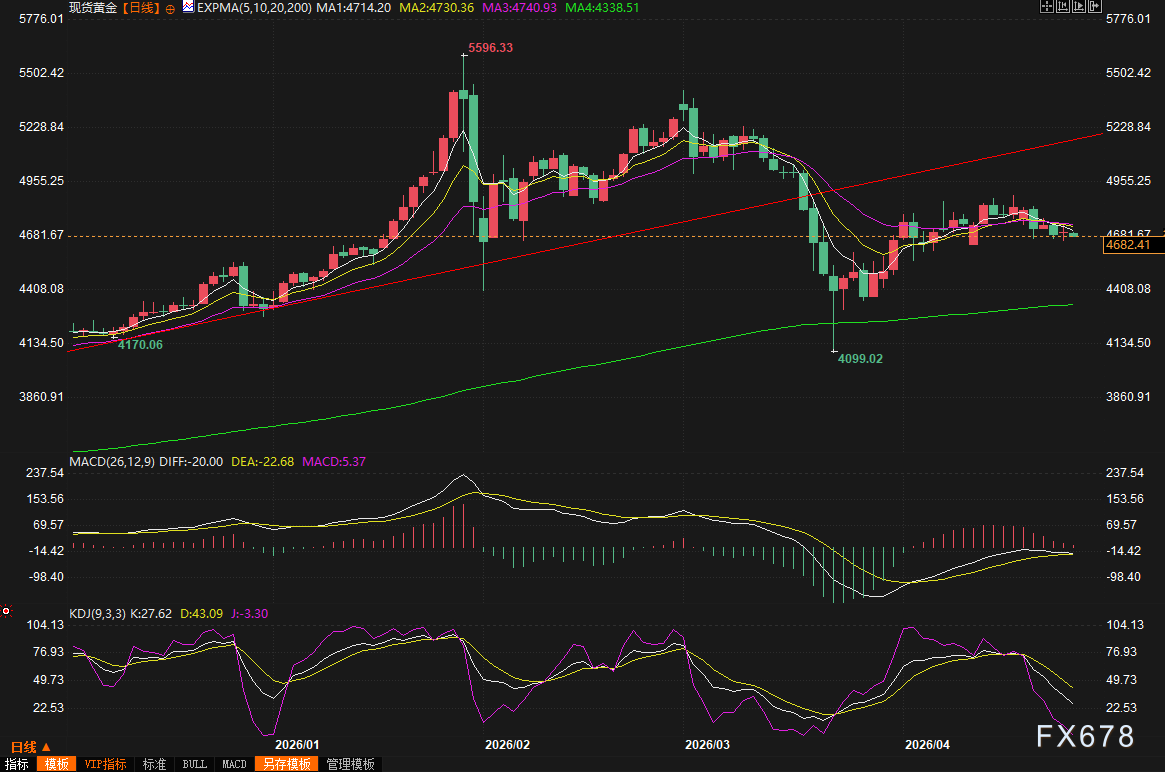
(Spot gold daily chart, source: Yihuichong)
07:25 (GMT+8), spot gold is quoted at $4,683.03/oz.
Disclaimer: The content of this article solely reflects the author's opinion and does not represent the platform in any capacity. This article is not intended to serve as a reference for making investment decisions.
You may also like
Anthropic’s performance is “good but not good enough”: under “adjusted profitability,” revenue growth sharply brakes!
Anthropic's third-quarter revenue reached $16.8 billion, an increase of nearly 50% quarter-over-quarter, and achieved "adjusted profitability"—but the market remains unconvinced. The main concern lies in monthly growth slowing sharply from 33% to single digits, leaving a gap of several billion dollars short of the year-end $100 billion target. Token prices have hit historic lows, with the disconnect between volume and price becoming increasingly prominent. Whether this "good but not good enough" performance can support a $2 trillion IPO valuation remains uncertain.
CoreWeave Drops 15%, AI Computing Power Business Faces Financing Test
CoreWeave bonds have fallen below 80% of face value, with yields surpassing 15% and a default probability exceeding 50% within five years. The company’s CEO attempted to reassure the market by citing an order backlog of over $100 billion, but analysts pointed out that orders do not equate to cash: “If borrowing costs are 9% but project returns are only 5%, the larger the scale, the greater the value destruction.” AI infrastructure-related stocks such as Oracle have also seen significant declines, with concerns spreading across the entire high-yield bond market. Musk sighed: "Oh dear!"
XRP, Chainlink and Zcash hover at key support levels as volume dries up
Berkshire increases investment by $330 million, this "APP Renovation Factory" sees its stock price soar over 40% in a single day
Berkshire Hathaway has made an additional $330 million investment in Bending Spoons, increasing its stake to 4%. This news sent Bending Spoons’ stock soaring over 41% in a single day. The transaction marks the latest major capital deployment under new CEO Greg Abel. Bending Spoons specializes in acquiring "outdated apps" and uses AI to restructure cost structures and business models to generate cash flow.
Crypto prices
More


