
Rising inflation expectations combined with Fed policy uncertainty keep gold fluctuating within a range

FX168 Finance News April 27th—— Due to escalating tensions in the Middle East and rising energy prices, market concerns over inflation have reignited. Coupled with expectations for the Federal Reserve to maintain high interest rates, the appeal of gold has diminished, causing gold prices to retreat to around $4,680 before rebounding. Although safe-haven demand still exists, the high interest rate environment has become the dominant factor, limiting gold's rebound potential.
In early Asian trading on Monday, gold prices came under pressure and fell to around $4,680 before rebounding, continuing the previous correction trend. Despite persistent tensions in the Middle East, gold did not receive significant support. Instead, macro factors dominated, leading to a price decline and highlighting that the current market pricing logic has shifted from mere risk aversion to a "rebalancing of interest rate and inflation expectations." 
On the US side, all related diplomatic visits have been suspended, while Iran has made it clear that it will not negotiate under pressure or blockade conditions, indicating that tensions are unlikely to ease in the short term. Meanwhile, Israel has intensified its military operations towards Lebanon, further escalating the regional tensions. These events have driven volatility in the energy markets, with crude oil prices maintaining high levels, reinforcing market concerns about a rebound in inflation.
In terms of logic transmission,
Meanwhile, although gold has safe-haven properties, at this stage, the market's focus on the "duration of high interest rates" is significantly greater than concern over the geopolitical risk itself. This means that even in times of tension, gold's upside potential remains limited. Investors are paying more attention to statements by Federal Reserve officials at the post-meeting press conference, especially regarding how they assess the impact of rising energy prices on the inflation path and whether this could prompt adjustments to future policy expectations.
From a market sentiment perspective, a certain degree of divergence is currently evident. On one hand, geopolitical risks provide underlying support for gold; on the other hand, upward interest rate expectations form resistance, keeping gold prices in an overall weak, oscillating pattern. Capital flows are constantly switching between these two logics, resulting in increased price volatility but no clear trend.
From a technical perspective, on the daily chart, gold prices have entered a correction phase after breaking below the short-term uptrend line, currently trading within a consolidation range. Key support lies near
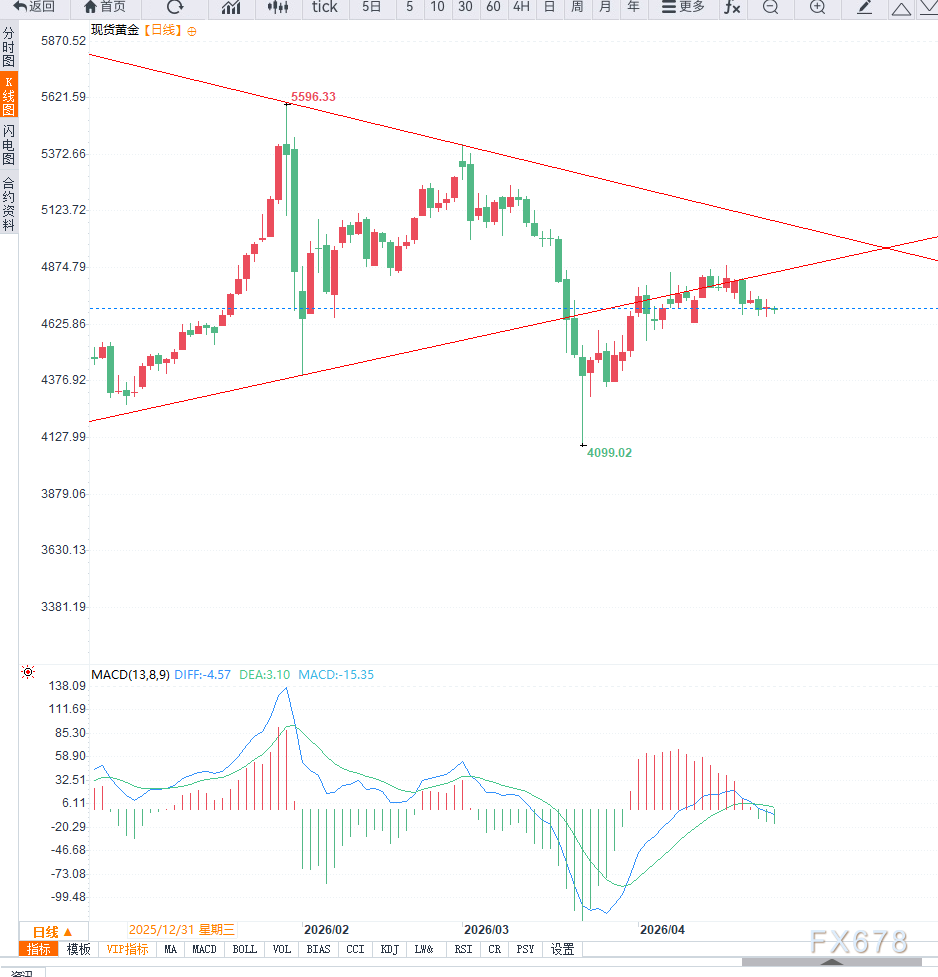
The core conflict in the current gold market lies in the tug-of-war between "safe-haven demand" and the "high interest rate environment." While tensions in the Middle East offer some support for gold, rising inflation expectations and persistently high interest rates have significantly weakened its appeal, putting overall pressure on prices. In the short term, signals from the Federal Reserve will be the main driver; if a hawkish tone is delivered, gold may weaken further. Conversely, if comments regarding inflation risks are moderate, a short-term rebound may occur. For the medium term, attention should remain on the inflation path and the timing of a possible interest rate turning point.
Disclaimer: The content of this article solely reflects the author's opinion and does not represent the platform in any capacity. This article is not intended to serve as a reference for making investment decisions.
You may also like
Anthropic’s performance is “good but not good enough”: under “adjusted profitability,” revenue growth sharply brakes!
Anthropic's third-quarter revenue reached $16.8 billion, an increase of nearly 50% quarter-over-quarter, and achieved "adjusted profitability"—but the market remains unconvinced. The main concern lies in monthly growth slowing sharply from 33% to single digits, leaving a gap of several billion dollars short of the year-end $100 billion target. Token prices have hit historic lows, with the disconnect between volume and price becoming increasingly prominent. Whether this "good but not good enough" performance can support a $2 trillion IPO valuation remains uncertain.
CoreWeave Drops 15%, AI Computing Power Business Faces Financing Test
CoreWeave bonds have fallen below 80% of face value, with yields surpassing 15% and a default probability exceeding 50% within five years. The company’s CEO attempted to reassure the market by citing an order backlog of over $100 billion, but analysts pointed out that orders do not equate to cash: “If borrowing costs are 9% but project returns are only 5%, the larger the scale, the greater the value destruction.” AI infrastructure-related stocks such as Oracle have also seen significant declines, with concerns spreading across the entire high-yield bond market. Musk sighed: "Oh dear!"
XRP, Chainlink and Zcash hover at key support levels as volume dries up
Berkshire increases investment by $330 million, this "APP Renovation Factory" sees its stock price soar over 40% in a single day
Berkshire Hathaway has made an additional $330 million investment in Bending Spoons, increasing its stake to 4%. This news sent Bending Spoons’ stock soaring over 41% in a single day. The transaction marks the latest major capital deployment under new CEO Greg Abel. Bending Spoons specializes in acquiring "outdated apps" and uses AI to restructure cost structures and business models to generate cash flow.
Crypto prices
More


