
Has the U.S. stock market short-term short covering come to an end?

Since the United States and Iran signaled readiness for negotiations, U.S. stocks rapidly recovered previous losses and set new historical highs. Whether from the numerator or denominator side, at this level there seems to be insufficient evidence to further increase positions in U.S. equities compared to pre-drop levels. We believe the main driver behind the new highs may be the large-scale short covering.
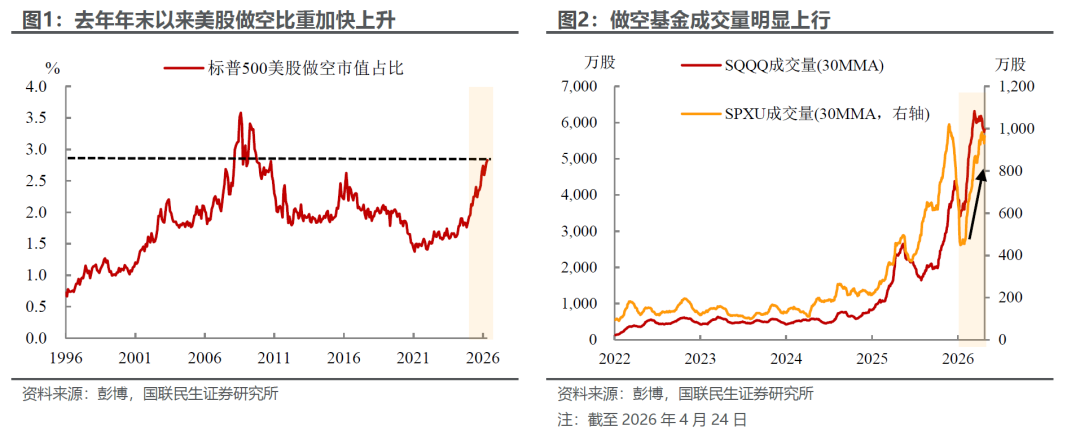
In fact, since the end of last year, as the tech sector’s previous gains accumulated excessively and expectations for rate cuts remained volatile, short sentiment towards U.S. equities continued to ferment. On top of that, persistent tension in Iran’s geopolitical situation fueled further bearish sentiment. By the end of March, the ratio of U.S. stocks sold short rose to 2.8%, second only to 2008. Meanwhile, trading volumes in short-leveraged ETFs like SQQQ and SPXU surged, reflecting skepticism about further upside potential for U.S. equities.
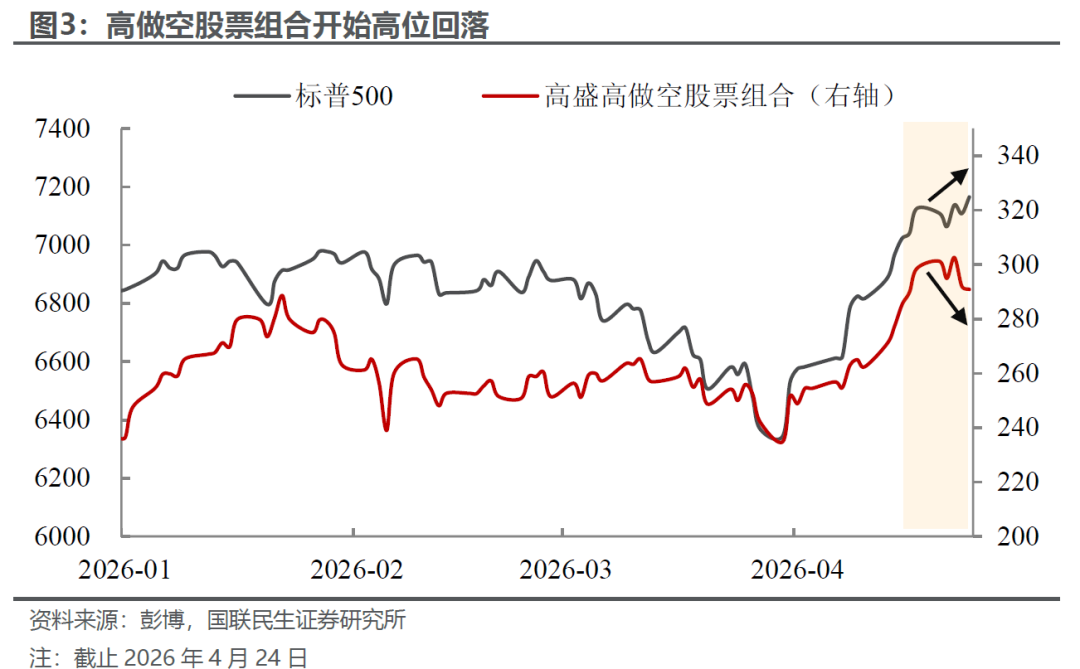
However, with the sudden easing of U.S.–Iran tensions, global risk appetite was swiftly restored. Highly-shorted stocks jumped sharply, causing funds with significant short positions to take on pressure passively and experience increasing floating losses. As a result, shorts were forced to cover massively, passively buying back positions, which in turn propelled the U.S. equity indices to accelerate upwards, creating a “short squeeze” rally.
Now, with U.S. equities at new highs, the market’s core focus has shifted: Is the technical rebound driven by short covering nearing its end? After the short squeeze subsides, what’s the outlook for medium- to long-term upside potential in U.S. stocks?
From several perspectives, we believe the passive short covering rally triggered by recent geopolitical shocks is largely ending:
First, the leading retreat of highly-shorted stocks and the weakening of short covering momentum are important signals that this round of short squeeze is coming to a close. While the S&P and Nasdaq remain strong, highly-shorted stocks have shown overall weakness or volatility in the past week. This divergence in the market shows that the passive upside momentum from short covering is cooling, and the space for purely technical recovery is likely to be constrained further.
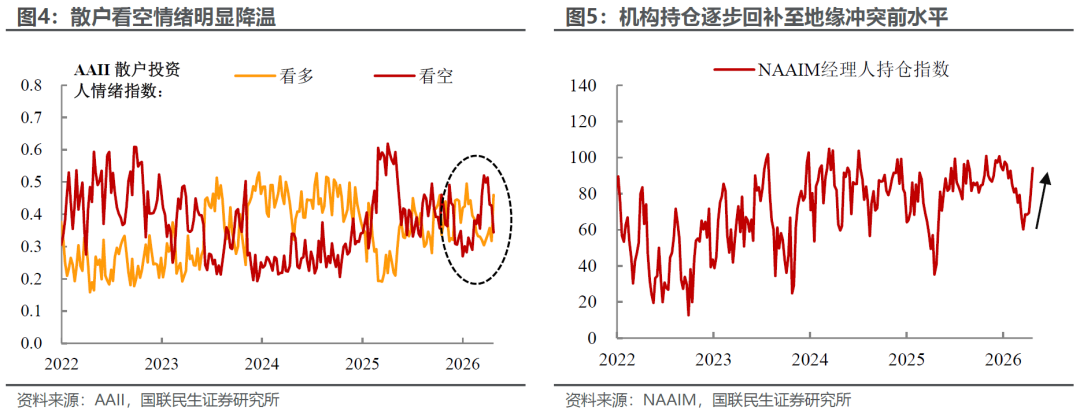
Secondly, overall market positioning and sentiment have mostly returned to normal levels before the Middle East conflict began. AAII retail bearish sentiment has fallen significantly from its late March peak and is back to its pre-conflict range. At the same time, NAAIM fund manager exposure has rapidly recovered to 94%. Market psychology has shifted from earlier panic stop-loss buying back toward a more neutral and cautious wait-and-see stance.
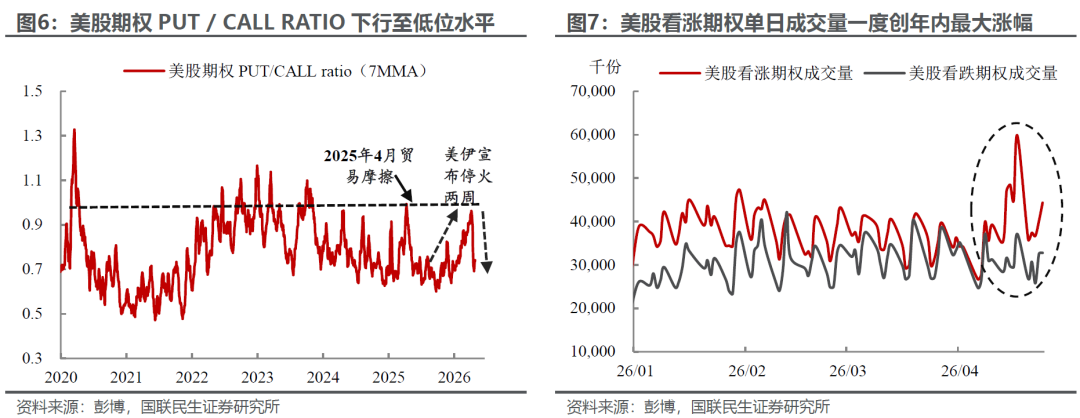
Finally, in the options market, previously, amid heightened Middle Eastern tensions and increased risk aversion, the U.S. stock Put/Call Ratio rose to multi-year highs, reflecting concentrated bearishness. But following the temporary truce between the U.S. and Iran, geopolitical risk rapidly eased, and call option volumes hit new highs for the year, causing the Put/Call Ratio to retreat quickly to multi-year lows, leaving little room for further decline.
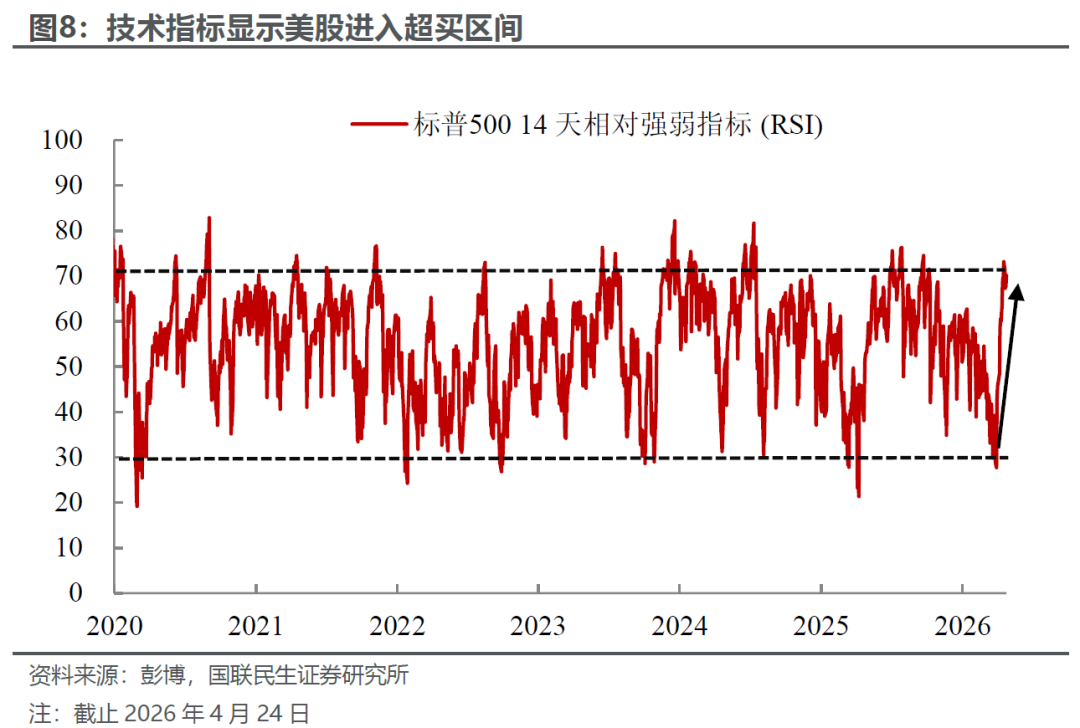
In conclusion, the supporting factors behind the short-term market rally caused by passive short covering are gradually receding. From a technical perspective, the recent rapid rise in the S&P 500’s RSI indicator has already indicated overbought conditions, and technical correction pressure is accumulating. As the benefits from short covering fade, and unless there are new catalysts such as improved earnings or policy support, the current upward trend for U.S. equities is likely nearing an end, with the market potentially transitioning into a range-bound phase and an elevated risk of minor short-term corrections.
Looking forward, can the medium-term upward trend in U.S. equities continue, and how should the market choose its next direction? The logic driving the recent U.S. stock movement has shifted from passive short covering and technical repair to two core factors: the evolution of geopolitical risks and fundamental economic factors.
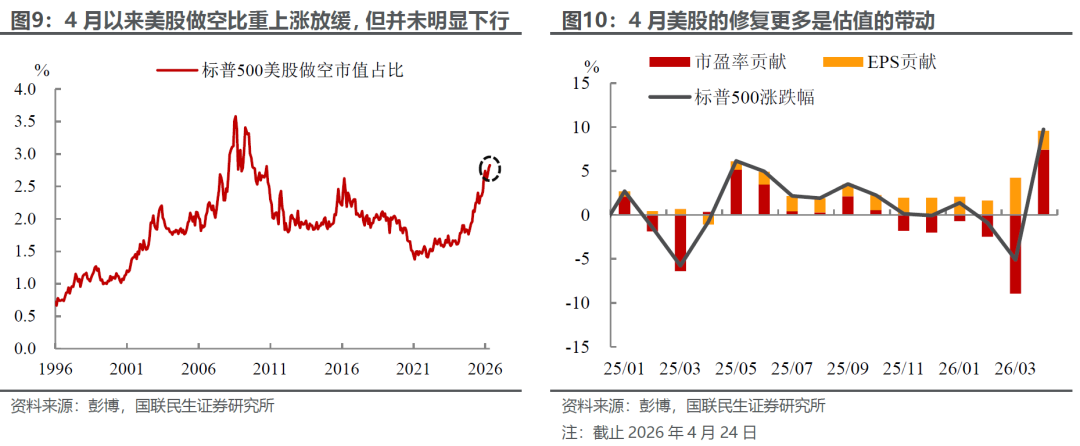
Reviewing the structure of U.S. stock shorts, long-term pessimism has not been completely cleared, and the overall mood remains cautious. Although some shorts were forced to cover since April, the proportion of short positions in the S&P 500 hasn’t shown a clear downward trend. Essentially, the short structure underwent a rotation: shorts forced to exit due to the recent geopolitical shock were replaced by new institutional shorts established due to valuation concerns and hedging needs as the index surged, bringing long/short dynamics back into balance. With valuations at relatively high levels and lacking fundamental support, the risk of a market correction is not fully priced in.
Therefore, whether U.S. equities can maintain their strong upward trend will depend heavily on the marginal changes in these two key variables going forward:
In terms of geopolitics, developments in the Middle East still remain highly uncertain, and the easing of conflict does not guarantee long-term stability. The market has already priced in optimistic expectations, weakening the risk-reward profile, and the possibility remains that capital could use new geopolitical events as an excuse to reduce high positions.
On the fundamentals side, in the short term, as long as there are no major earnings shocks for U.S. stocks, combined with a successful effort by the Fed to steer expectations for earlier rate cuts and moderate recovery in the U.S. economy, these factors would create an optimal scenario for U.S. equities. However, this also depends on the extent and persistence of oil price shocks.
Disclaimer: The content of this article solely reflects the author's opinion and does not represent the platform in any capacity. This article is not intended to serve as a reference for making investment decisions.
You may also like
US CPI Heats Up Across the Board, Triggering "Inflation Spiral" Alert; October Rate Hike Odds Once Hit 50%. "New Fed News Agency": Watch Waller's Speech This Week
After the CPI was released, the market-implied rate hike probability first rose to 50% before falling back to 40%. Wall Street generally believes that whether action will be taken in October still depends on how the Federal Reserve assesses inflation trends. "The New Fed News Agency" noted that, unlike in August when price increases were concentrated in certain items, the stronger-than-expected performance of September's core CPI was more broad-based, further reinforcing the case for a December rate hike. The speech by Waller on Friday morning Beijing time is his last public statement before the Fed's blackout period ahead of this month's meeting. Economists are warning about an "inflation spiral," with real purchasing power and midterm election pressures interweaving.
The calm period in the US stock market is over! The S&P 500 ends its record of 53 consecutive trading days without a drop of over 1%. AI stock sell-off intensifies market concerns.
The S&P 500 Index fell by 1.1%, ending a streak of 53 consecutive trading days without a drop of 1% or more. This was the longest period of calm since January 2020.
Federal Reserve Beige Book: U.S. economy expands moderately but inflationary pressures intensify; AI boosts productivity curbing some corporate hiring demand
The latest Beige Book released by the Federal Reserve on Wednesday shows that overall economic activity in the United States continues to grow, but performance varies across regions. Consumer spending remains generally weak, and there has been little change in the labor market.
Overnight US Stocks | September Inflation Remains High, Major Indexes Decline, Coreweave (CRWV.US) Drops Over 15%
At the close, the Dow Jones Industrial Average fell by 47.96 points, or 0.09%, to 51,622.14 points; the S&P 500 Index dropped by 85.95 points, or 1.10%, to 7,719.50 points; and the Nasdaq Composite Index declined by 511.51 points, or 1.88%, to 26,692.87 points.
Crypto prices
More


