
Gold Closing Review: Powell's “Final Press Conference” Looms! Gold Price Falls Below $4,700, but Analysts Raise Year-End Expectations

On Monday (April 27), during the North American trading session, spot gold (XAU/USD) prices fell. Due to a lack of progress in U.S.-Iran negotiations, market risk appetite worsened slightly, the U.S. dollar trimmed earlier losses, and gold came under pressure as a result.
At the end of the U.S. session, spot gold closed at $4681.72 per ounce, down $28.90, a decrease of 0.61%.
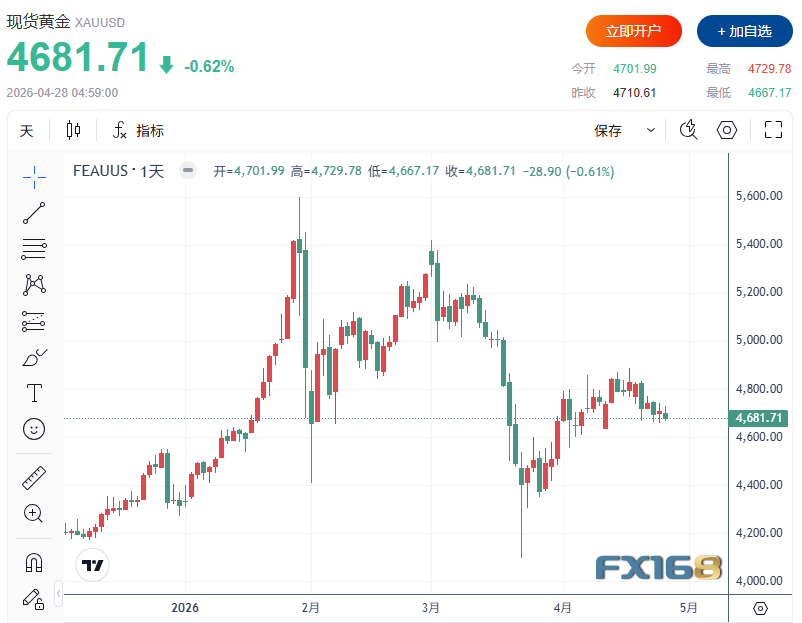
(Image source: FX168)
Federal Reserve's High Rate Expectations Outweigh Gold’s Safe Haven Appeal
Although geopolitical risks are still unfolding, gold has not received significant support. Reports indicate that Iran is prepared to reopen the Strait of Hormuz if the United States lifts the blockade on Iranian ports. In addition, according to Axios, Tehran proposed a three-stage plan aimed at ending the war, resolving the Strait of Hormuz issue, and discussing the nuclear issue.
U.S. President Trump canceled the envoy’s trip to Pakistan over the weekend, saying it would be a waste of time. He also stated that although Iran had put forward a “much better” deal, it was still not enough.
Meanwhile, expectations that interest rates will remain high for longer overshadowed gold’s appeal as an inflation hedge. The U.S. 10-year Treasury yield rose 3.5 basis points to 4.342%, putting pressure on the non-yielding gold.
According to Prime Terminal data, the swap market has priced in that the Federal Reserve will keep rates unchanged until 2026.
Market Focuses on Federal Reserve Meeting and Powell’s Last Press Conference
Traders are also turning their attention to the Federal Reserve’s monetary policy meeting. The meeting will begin on Tuesday and end on Wednesday, when the policy statement will be released and Chair Powell will hold his final press conference as head of the U.S. central bank.
Powell is expected to be asked about his future at the Federal Reserve. While his term as chair ends on May 15, his term as a member of the Fed's Board of Governors will continue until January 31, 2028.
Meanwhile, a Reuters poll shows analysts expect gold prices to rise further, citing “strong central bank demand and economic uncertainty expected to offset the risks of inflation spikes triggered by Middle East tensions and hawkish policy bets.”
The median forecast indicates that gold is expected to end 2026 at $4,916 per ounce, up from the estimate of $4,746.50 per ounce three weeks ago.
On Tuesday, the economic calendar includes the release of the four-week average for ADP employment changes, housing data, and the U.S. Conference Board’s April Consumer Confidence Index.
Technical View: If $4,650 is Lost, Gold May Fall Further
From a technical perspective, financial site FXStreet noted that gold is currently consolidating below $4,700, with key resistance at the 20-day and 100-day simple moving averages, which are above $4,729 and $4,733, respectively.
In the past three trading days, although gold briefly broke through $4,700, it has not managed to stand firm above the key resistance zone. If these resistance levels are breached, a rebound could be in sight.
Momentum indicators show that bears remain in control, and the Relative Strength Index (RSI) also reflects downside momentum. Therefore, if Middle East-related news continues to push up energy prices and support a stronger dollar, gold may face further downward pressure.
The first support below is the psychological level of $4,650, followed by $4,600. Once below $4,600, gold could further test the April 2 low of $4,554.
Conversely, if spot gold rises back above $4,700, the next target would be the area around the 20-day and 100-day moving averages. A break above the $4,729–$4,733 range would further target the psychological level of $4,750, followed by $4,800.
Disclaimer: The content of this article solely reflects the author's opinion and does not represent the platform in any capacity. This article is not intended to serve as a reference for making investment decisions.
You may also like
Federal Reserve Beige Book Warns of "Fierce" Oil Prices: Half of Districts Face Strong or Intensifying Price Pressures, Businesses Confront Price Increases and Profit Squeeze
The Beige Book shows that all 12 Federal Reserve districts reported the impact of rising oil prices. Businesses generally indicated that high diesel prices and fuel surcharges are passing additional costs down the entire supply chain. Since the previous Beige Book report just over a month ago, the U.S. economy has experienced moderate growth, with manufacturing serving as the main support. The labor market continues to see low hiring and low layoffs, and firms in nearly half the districts reported that AI investment is impacting employment.
Crypto market wipes out over $42 billion amid sticky U.S. inflation

Shiba Inu Forms First 4-Hour Death Cross Setup in October: Potential Scenarios
Crypto prices
More


