
Rising tensions between the US and Iran and persistent inflation concerns: gold stabilizes, silver surges

Fx678 News, May 12—— On Monday (May 11), spot gold prices stabilized and rebounded, and silver surged sharply, boosted by the renewed deterioration of US-Iran diplomatic deadlock and the rebound in oil prices. Spot gold traded around $4,727 to $4,730 per ounce during the session, up about 0.3%; US gold futures reported at $4,740, up 0.2%; spot silver traded around $85 per ounce, with a daily surge close to 6%.
On Monday (May 11), spot gold prices stabilized and rebounded, and silver surged sharply, boosted by the renewed deterioration of US-Iran diplomatic deadlock and the rebound in oil prices. Spot gold traded around $4,727 to $4,730 per ounce during the session, up about 0.3%; US gold futures reported at $4,740, up 0.2%; spot silver traded around $85 per ounce, with a single-day gain of nearly 6%.
US President Trump stated on Monday that he would discuss the direction of the Iran war with the national security team and warned that the ceasefire agreement was "on the verge of collapse," describing it as "weak," and called Iran's latest response "completely unacceptable" on social media. The Iranian side insisted on US compensation for war losses and stressed its sovereignty over the Strait of Hormuz. Iranian foreign ministry spokesman Baghaei said Tehran’s proposal was “generous and responsible” and accused Washington of making “unreasonable demands.”
The continued deadlock in negotiations has raised concerns about a supply disruption in the Strait of Hormuz, prompting a rebound in oil prices. Brent crude rose about 3% to around $104.32 per barrel; WTI crude was around $98.40, up about 3.2%. Both benchmarks had previously fallen about 6% last week amid expectations for a ceasefire deal.
Daniel Pavilonis, Senior Market Strategist at RJO Futures, noted: "The market is highly focused on expectations of whether the Strait of Hormuz can be reopened, and is generally digesting the backdrop of persistently rising energy prices."
The continued rise in oil prices has reinforced market expectations that "high interest rates will be maintained for a longer time," putting pressure on non-yielding gold. The market currently broadly expects the Federal Reserve to keep rates unchanged this year, but the CME FedWatch tool shows the probability of a rate hike in December has risen to about 20%. Many global brokerage firms have also reduced expectations for two rate cuts this year, with forecasts becoming more divided; some institutions believe there may be no rate cuts at all until 2026.
Market focus turns to Tuesday's release of US April CPI data: a month-on-month increase of 0.6% is expected, with the year-on-year figure rising to 3.7% (previously 3.3%); core CPI is expected to rise 0.3% month-on-month and 2.7% year-on-year.
In this regard, American gold exchange market analyst Jim Wyckoff said: "The current rise in gold prices is mainly driven by buying on dips and position allocations in anticipation of this week's inflation data."
Multiple Factors Jointly Support Precious Metals
Despite limited upside, the downside risk for gold is also restricted. Ongoing geopolitical uncertainties are supporting safe-haven demand, while central bank, retail and investment buying are providing a price floor. In addition, the market is watching Trump’s two-day visit to China this week, where he will meet with Chinese President Xi Jinping to discuss topics including Iran, Taiwan, artificial intelligence, and nuclear weapons.
Notably, Indian Prime Minister Modi called on citizens to suspend gold purchases for a year to protect foreign exchange reserves, leading to a sharp plunge in Indian jewelry stocks. India is the world’s second-largest gold consumer, so this move could place psychological pressure on market sentiment.
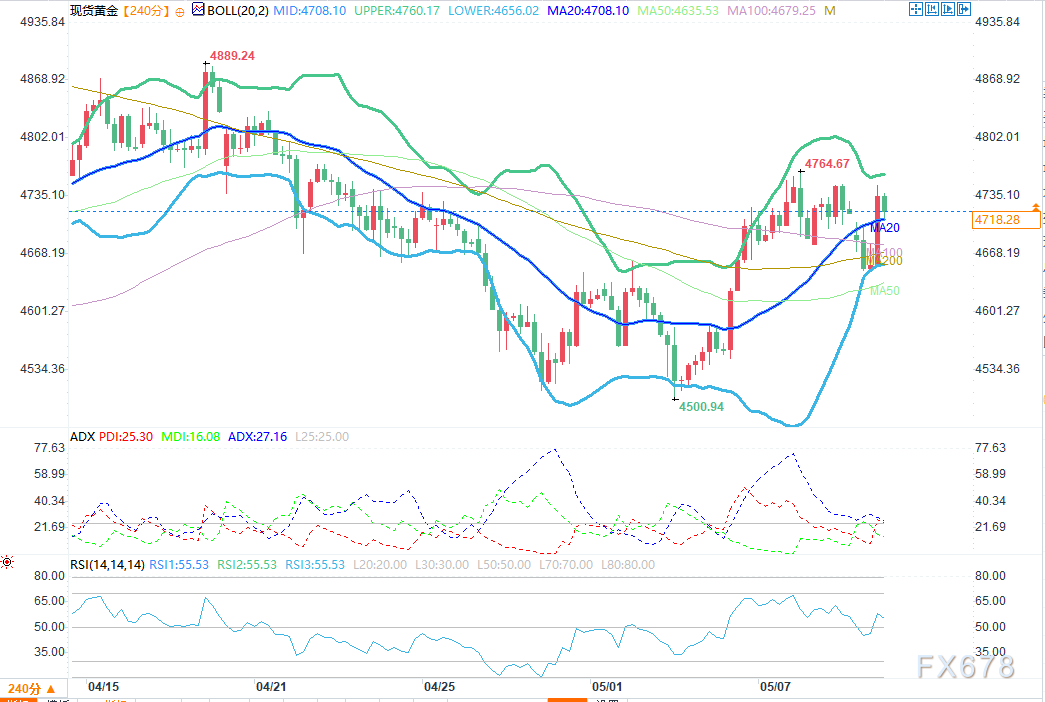
(Spot Gold 4-Hour Chart. Source: Yihuitong)
The bullish structure in the 4-hour spot gold cycle remains intact. Prices continue to operate above the middle Bollinger Band (around $4,708), and the moving average system (MA20, MA100) is also in a bullish alignment, providing support for prices.
In terms of momentum, the RSI indicator is currently around 56, in the neutral-to-strong zone, with no clear overbought signal nor indication of momentum exhaustion; the ADX indicator is around 27, confirming the presence of a trend, but the value is still near 25, indicating the trend's strength has not yet reached a "strong one-way" level and future breakout signals need to be watched.
Regarding resistance and support, the first upper target is the upper Bollinger Band (around $4,760). A breakout above could open up more upside potential; on the downside, support is first at the middle Bollinger Band at $4,708, followed by $4,664, where the lower edge of the previous consolidation platform aligns with the MA50. If this zone is breached, it would weaken the current bullish structure.
Disclaimer: The content of this article solely reflects the author's opinion and does not represent the platform in any capacity. This article is not intended to serve as a reference for making investment decisions.
You may also like
Fed Voting Member Harker: Fighting Inflation Requires Faster, More Frequent Small Rate Adjustments, Be Vigilant Against Inflation Expectations Becoming Entrenched
Cleveland Federal Reserve President Loretta Mester believes that inflation pressures have spread beyond the energy sector, with AI investments and tariffs driving up costs. To prevent high inflation from becoming entrenched in the economy, she suggests that the Federal Reserve should consider smaller, quicker, and more frequent rate adjustments, rather than waiting for inflation pressures to accumulate and then taking larger actions. She did not explicitly support an interest rate hike in October, emphasizing policy transparency: explaining the response mechanism does not equate to committing to a specific rate path.
Will the US cancel 20-year Treasury bonds? BNP Paribas: It may trigger market panic; Citibank: Positioning 20-year bonds to outperform 10-year bonds
There are market rumors that the U.S. Treasury is considering cutting back or canceling the issuance of 20-year Treasury bonds, which were reinstated in 2020. The yield on 20-year bonds has long been higher than both 10-year and 30-year bonds, resulting in a "hump" in the yield curve and higher financing costs. The market is closely watching this Friday’s routine survey questionnaire, as well as whether a clear signal will be released in the quarterly refunding statement on November 4. Citi suggests positioning in advance, but BNP Paribas warns that such a move could be interpreted as a panic signal that policy tools have been exhausted.

Bitcoin price volatility accompanies a 6% drop as sentiment turns neutral
WF stock trades at $36, up 196.78%, with daily RSI at 97.86
Crypto prices
More


